
 E-Paper



CPRI issues advisory as late blight disease threatens potato crops
The disease is favoured by cool, moist weather conditions, making the current weather scenario conducive to its spread

 Prefer HTon Google


The Central Potato Research Institute (CPRI) has issued an advisory for potato farmers across the country, warning of a high risk of late blight disease in the crop due to changes in weather conditions.
Institute director Brajesh Singh cautioned that the Indo-Blight cast (pan-India) model has predicted a likelihood of late blight disease this year, similar to last year, and timely management is essential to save the crop from disease outbreaks.
Late blight disease, a fungal infection caused by Phytophthora Infestans, is a significant threat to potato crops, causing substantial yield losses and reducing tuber quality. The disease is favoured by cool, moist weather conditions, making the current weather scenario conducive to its spread.
Singh emphasised the importance of proactive management, saying, “Late blight disease can cause substantial damage to potato crops, and timely management is crucial to prevent its spread. We urge farmers to take the necessary precautions and follow our advisory to ensure a healthy and productive crop.”
According to the CPRI advisory, farmers who have not yet sprayed fungicide on their potato crop or whose crop is not yet showing symptoms of late blight disease should immediately spray fungicide containing mancozeb chlorothalonil at the rate of 0.2 % on disease-susceptible varieties. It involves dissolving 2 kg of medicine in 1,000 litres of water per hectare.
In fields where symptoms of the disease have already appeared, farmers are advised to spray fungicides like cymoxanil + mancozeb, fermion + mancozeb, or dimethomorph + mancozeb. The recommended rate of application is 3 kg per hectare (1,000 litres of water) for cymoxanil + mancozeb and fermion mancozeb, and 1 kg with mancozeb 2 kg (total mixture 3 kg) per hectare (1,000 litres of water) for dimethomorph with mancozeb.
The advisory emphasises the importance of repeating fungicide spraying at an interval of 10 days, depending on the intensity of the disease.
However, farmers are cautioned against repeated use of the same fungicide and advised to use a sticker (0.1%) along with the fungicide to enhance its effectiveness.
Proper drainage in fields key
In addition to fungicide application, the CPRI advisory stresses the need for proper drainage in fields and preventing weed growth — which can in turn harbour the disease-causing fungus and increase the risk of infection in potato crops.
The timely management of late blight disease is critical to prevent significant yield losses and ensure a healthy potato crop. Farmers are urged to take the necessary precautions and follow the advisory to protect their crops from this devastating disease.
Himachal Pradesh, has emerged as a major hub for potato production in the country. Covering approximately 14,685 hectares, potatoes account for about 20% of the total vegetable cultivation area in the region. The state’s climatic conditions, with its cool temperate climate, high wind velocity, and moderate humidity, especially in the higher hills, provide an ideal environment for cultivating disease-free, high-quality potato seeds and table potatoes.
Himachal at high risk
The low aphid population in the state also contributes to the production of disease-resistant potatoes, making Himachal a prime location for seed potato production. The state’s potatoes are known for their high dry matter content, reaching up to 20%, which is a vital factor for producing quality chips.
The timing of potato harvest in Himachal Pradesh is also advantageous, with around 80% of the cultivated area relying on rainfed agriculture, predominantly managed by small and marginal farmers. This makes potato cultivation a lifeline for many farmers in the state.
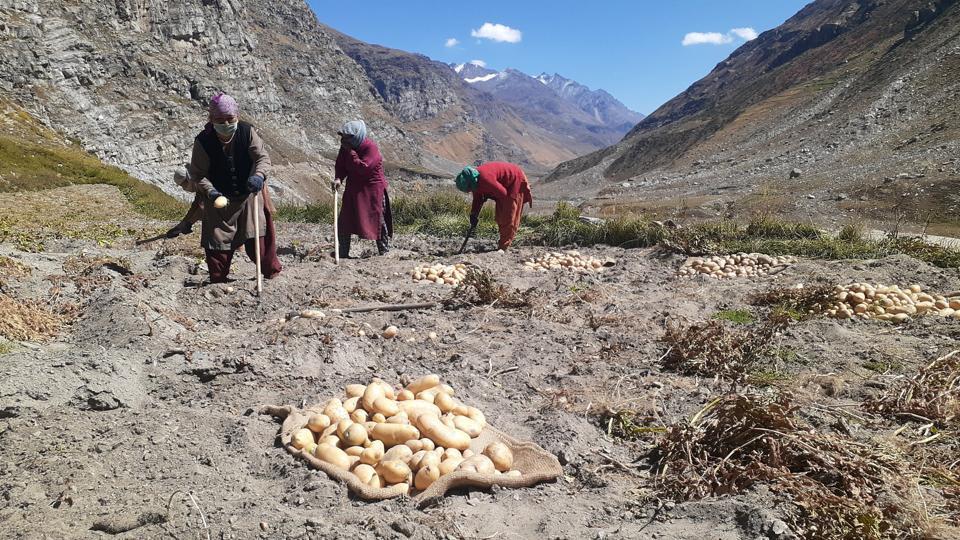
The Lahaul Valley, a cold desert in Himachal Pradesh, stands out as a significant area for potato production..The valley specialises in cultivating prized seed potato varieties like Kufri Chandramukhi, Kufri Jyoti, Table Santana, and Shafordi, favoured for chip production.
According to experts, the state’s potato production has immense growth potential and can contribute significantly to the country’s food security.


