
 E-Paper



{Finance commission meet} Punjab seeks special package, hike in states’ share in taxes
Punjab government has sought ₹132, 247 crore from the 16th finance commission to give impetus to the development of the state, increase in states’ share of the divisible pool of taxes collected by the Centre to 50% from the present 41% and changes in the criteria for horizontal devolution of funds among states.


Punjab government has sought ₹132, 247 crore from the 16th finance commission to give impetus to the development of the state, increase in states’ share of the divisible pool of taxes collected by the Centre to 50% from the present 41% and changes in the criteria for horizontal devolution of funds among states.
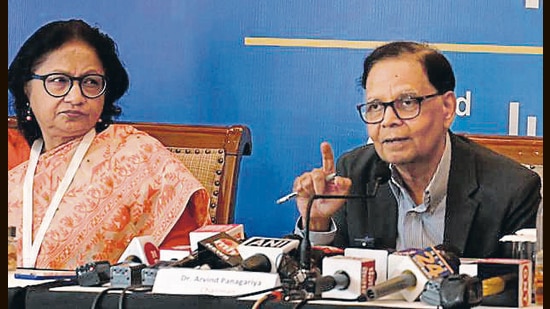
These demands were made by the state team led by chief minister Bhagwant Mann during its deliberations with the 16th finance commission headed by Dr Arvind Panagariya here on Monday. The net proceeds of taxes collected by the Centre are distributed between the Union and the states through vertical distribution on the basis of recommendations made by the Finance Commission which is constituted every five years for this purpose.
Mann, while making a strong case, asked for a special economic package for the holistic development of the state. The funds sought by the state include development funds totalling ₹75,000 crore, ₹17,950 crore for agriculture and paddy diversification, ₹5,025 crore for stubble burning, ₹8,846 crore for tackling narco-terrorism and drug abuse, besides ₹6,000 crore for industry revitalization.
“Apart from this, ₹9,426 crore should be given for urban local bodies and ₹10,000 crore for rural local bodies,” he said in a statement.
During the meeting, the CM also spoke about the rapidly depleting water table and said it is really pathetic to learn that the same high-powered motors that are used to extract oil in Dubai and other Gulf nations are being used for pumping out groundwater in the state. “The only way out to save the water of the state is to promote crop diversification,” he said. Mann also said the state’s problems are not new and have a legacy nature, and many of these problems came into existence due to ill-advised political decisions of previous governments just before the election days.
After the meeting, Panagariya told reporters that the state government sought an increase in vertical devolution in favour of the state from the current level of 41% to 50% for the division of shareable taxes equally between states and the Union. At present, the Centre’s share of the net proceeds of Union taxes (divisible pool) is 59% as per the recommendation made by the 15th finance commission in 2021. The states’ share in the divisible pool was 42% from 2015 to 2020 (the award period of the 14th finance commission), 32% from 2010 to 2015 (13th finance commission), and 30.5% from 2005 to 2010 (12th finance commission).
State seeks changes in horizontal devolution of funds
“After determining the states’ aggregate share in the divisible pool, there is horizontal division among states on the basis of factors such as area, population, forest coverage, and income distance,” Panagariya said at a press conference. He said the state is in favour of keeping the weight of population criterion at 15% as assigned by the 15th finance commission but wants allocation of a weight of 5% on the basis of the proportion of SC population and 2.5% on the basis of elderly population above 68 years. Other changes sought by the Punjab government in the horizontal devolution criteria determined by the 15th finance commission included a reduction in the weight of area and forest cover to 12.5% from 15% and 7.5% from 10% and an increase in weight of income distance to 47.5% from the present 45%.
Asked about rising subsidies and their rationalisation, the finance commission chairman said the state government did talk about subsidies and how 95% was on account of power subsidy, but the roadmap to rationalisation was not an issue of the commission at this stage.
On the state’s request for the continuation of the revenue deficit grant for the next five years, he said the commission cannot comment on the matter as it had just started its discussions with the states. “We have to go to 28 states. We have held meetings in Himachal Pradesh and Chhattisgarh. Punjab is the third state. This process may take 7-8 months. Generally, finance commissions give revenue deficit grants. How much is that, to which states, and the principles to decide the same. All these things will be decided only after the commission’s assessment of the needs of different states,” he said.
Panagariya was also asked about the Punjab government’s complaint that the Centre was withholding its funds. He said some other states were also complaining but this was the decision of the central government. “The commission gives its recommendations about devolution of funds, local body grants, disaster relief, sectoral assistance, and state-specific grants. It is the prerogative of the Centre to accept the recommendations of the commission or not,” he said.
The finance panel comprising Panagariya and members Ajay Narayan Jha, Annie George Mathew, Dr Manoj Panda and Dr Soumyakanti Ghosh will visit Amritsar for a meeting with the representatives of industry.
GFX:
State’s wishlist
₹75,000 crore
Development funds
₹17,950 crore
Agriculture and paddy diversification
₹5,025 crore
Stubble burning,
₹8,846 crore
Tackling narco-terrorism, drug abuse
₹6,000 crore
Industry revitalization
₹9,426 crore
Urban local bodies
₹10,000 crore
Rural local bodies


