The Finance Commission has recommended a grant of ₹350 crore to Punjab for crop diversification in the state with a view to reducing pollution caused by stubble burning and saving groundwater.
The grant has been recommended from the 2021-22 to 2025-26 financial year. The commission’s report was tabled in the Lok Sabha by Union finance minister Nirmala Sitharaman two weeks ago and has been accepted “in principle” by the central government.
“The Punjab government has sought support for bringing down pollution levels through a shift from paddy to other crops, especially maize. This will also help reduce the air pollution in the northern region,” the commission said while making recommendation for state-specific grant.
The spike in pollution levels in Delhi and adjoining areas in the winter months each year is blamed on fumes from the burning of paddy residue by cultivators in Punjab and Haryana. The request for central funds for crop diversification was made by a state team led by chief minister Capt Amarinder Singh during a meeting with the 15th Finance Commission team headed by former bureaucrat NK Singh in Chandigarh in January 2019.
The commission, which recommended funds for crop diversification as part of the ₹1,545 crore state-specific grants, has stressed on the need for the state to diversify from paddy and wheat into low water-intensive and high-value crops, including horticulture.
{{/usCountry}}The commission, which recommended funds for crop diversification as part of the ₹1,545 crore state-specific grants, has stressed on the need for the state to diversify from paddy and wheat into low water-intensive and high-value crops, including horticulture.
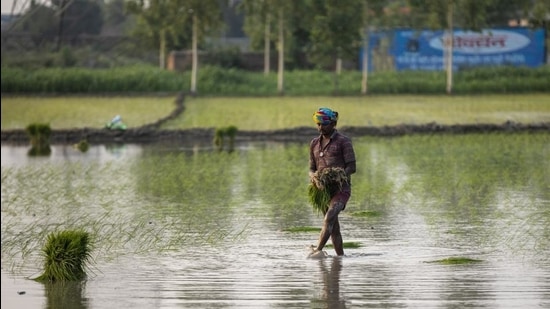
{{/usCountry}}Exploitation of the groundwater in Punjab is the highest in the country at 76% as compared to the all-India figure of 16%. “With only 1.5% of India’s geographical area, the state produced 17.4% of the country’s wheat and 11.3% of the rice in 2015-16. The state (where farmers get free power) had the second highest discharge of groundwater through irrigation (34.1 billion cubic metres) in 2017 and the estimated groundwater availability for future irrigation is negative,” the report said, pointing out the state’s declining trend in crop diversification between 1994-95 and 2014-15. The farmers’ over-dependence on water-guzzling paddy crop is seen as one of the main reasons behind the dropping water table.
The expert panel headed by former Planning Commission deputy chairman Montek Singh Ahluwalia, in an interim report titled ‘Medium and Long-Term Post-Covid Economic Strategy for Punjab’ had suggested last year to the state government to reduce the area under common paddy by about 1 million hectares (out of total 3.1 million hectares) over the next 6-7 years to reduce the use of electricity and avoid environmental damage from excess use of water.
Agriculture experts have been recommending maize – used as chicken feed – as the best bet for crop diversification for a switch from paddy given its low-water consumption, but its prices saw a sharp drop last year due to a fall in demand from poultry business during the coronavirus pandemic, leaving the farmers disappointed.
Other state-specific grants recommended