
 E-Paper



First Omicron case in Chandigarh: 135 random samples collected to detect clustering
Director, health services, says there is no hotspot or cluster in Chandigarh; infection being spread within families only

 Prefer HTon Google


After a 20-year-old man was found infected with the Omicron variant and five of his family members tested Covid-19 positive, the UT health department and municipal corporation (MC) on Tuesday collected 135 random samples from Manimajra to check if the area is a cluster of infection.
The samples will be tested using reverse transcription-polymerase chain reaction (RT-PCR) technique, reports of which will be out on Wednesday.
“As a routine precautionary measure, we collected 135 random samples from Manimajra to find the transmission rate in the area. We are expecting a low positivity rate among these samples as the Omicron-infected man and all his family members were in home quarantine for the past two weeks,” said Dr Suman Singh, director, health services (DHS), Chandigarh.
The 20-year-old had landed at Sri Guru Ram Das Ji International Airport, Amritsar, on November 22, but tested negative for Covid-19 at the time. Later, he travelled to Chandigarh to meet his relatives who stay in Manimajra.
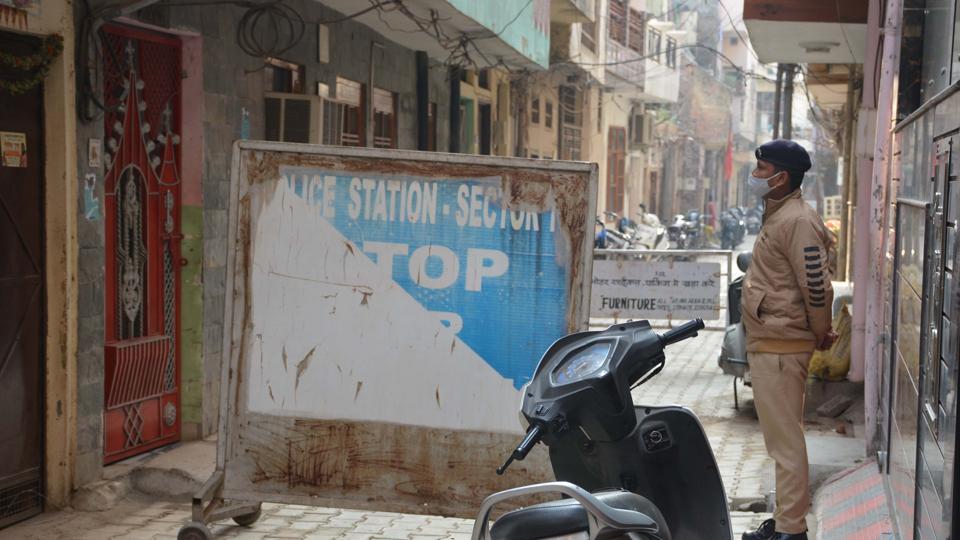
As per protocol, he was put under home quarantine and re-tested on December 1, when he completed the eight-day quarantine period. In the second test, he was found infected with the virus. Due to his travel history, his samples were sent for genome sequencing to National Centre for Disease Control (NCDC), Delhi, to check for the variant of concern. On December 12, it was confirmed he was infected with Omicron, following which the area around his residence in Manimajra was sealed.
The man and his five infected family members are still under home quarantine. The UT health department has already sent samples of his five family members for genome sequencing to NCDC.
“All family members are fully vaccinated against Covid-19, and hence they are asymptomatic and are not severely infected. The health department is monitoring their health regularly,” said Dr Singh.
The DHS added, “In UT, there is no cluster or hotspot of infection as the transmission is being restricted to only close contacts. Usually, only the family members of one infected person are coming out to be positive.”
“Currently, the new cases comprise people from all age groups and walks of life, and have been found complacent in following Covid-appropriate behaviour. This is a crucial time as an increase in cases can lead to another surge. People must not lower their guards and wear face masks, maintain social distancing and should get vaccinated at the earliest,” she said.


