E-Paper



For 2 years, Jammu and Kashmir winters without enough snowfall: Govt in assembly
For the past two consecutive years, Jammu and Kashmir, particularly the Himalayan Valley, has witnessed largely dry winters with the amount of snowfall or rain not even crossing the half-way mark of the normal, the IMD data shared by the government in J&K Assembly said.

 Prefer HTon Google


For the past two consecutive years, Jammu and Kashmir, particularly the Himalayan Valley, has witnessed largely dry winters with the amount of snowfall or rain not even crossing the half-way mark of the normal, the IMD data shared by the government in J&K Assembly said.
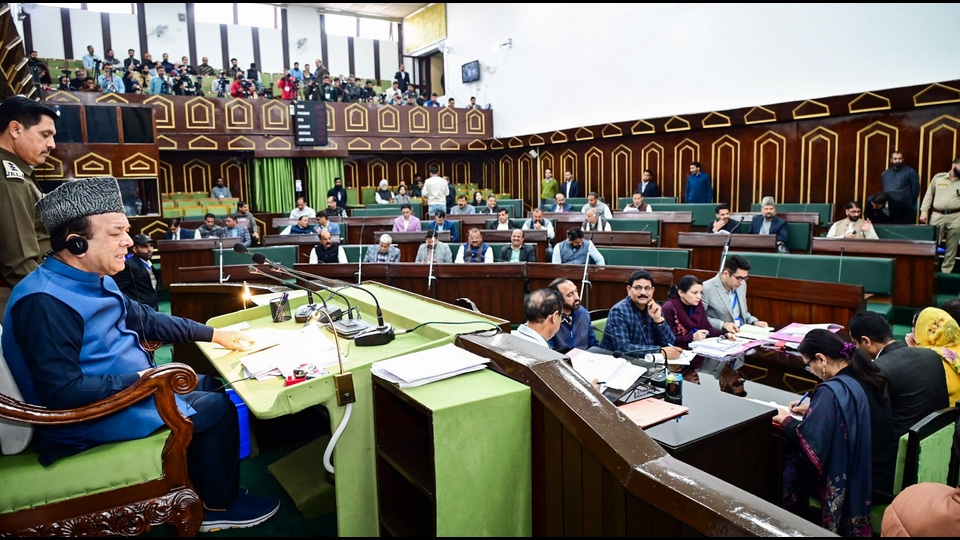
The large-scale deficit has triggered a rethink in the government to have a collaborative climate-resilient response across various departments for water conservation, crop diversification and better weather monitoring as IMD is planning to make a hyper-local forecasting system over the Himalayan states.
The data shared in the ongoing session of the assembly indicated that Jammu and Kashmir has received just 49.8% precipitation of the normal from October 2024 to February 2025 and 45.6% precipitation of the normal in the corresponding period (Oct-2025 to Feb-2026) this winter season so far.
In response to a question by legislator Sajad Shaheen, the incharge minister of disaster management and relief department expressed the government’s concern over the “adequacy” of the precipitation in J&K.
“The India meteorological department data shows that the winter precipitation regime in the last two years has remained persistently and substantially below normal in Jammu & Kashmir. A divisional break-up indicates that the deficit has been more acute in Kashmir division,” the minister said.
Sharing the statistics, the response said that the last two years have recorded very large precipitation deficits vis-a-vis the normal. “During October 2024-February 2025, Jammu and Kashmir received 50.11% less precipitation than normal. In the immediately following season October 2025- February 2026, precipitation further remained depressed reflecting an even higher deficit of 54.33%,” the response said.
The government takes continuous updates from IMD with respect to the precipitation particularly in winters for Jammu & Kashmir as a whole and separate precipitation status for Kashmir Division and Jammu Division and same is shared with all stakeholders departments.
“IMD also shares inputs for planning and policy interventions to the planning departments and agencies,” the minister said.
The response informed that the IMD is planning to make a hyper-local forecasting system over the Himalayan states with National Disaster management Authority choosing two of the seven districts from Himalayan states in Jammu and Kashmir.
“For Jammu & Kashmir, Ramban and Kishtwar districts are identified,” the government said.
The IMD is going to install four more Doppler weather radars and 34 automatic weather stations or snow gauges in J&K in addition to already existing 3 X-band radars (in Srinagar, Jammu and Banihal).
“The four new radars are likely to be installed in Doda, Rajouri, Anantnag & Baramulla for catering weather services/early warning systems,” the response said.
Moreover, additional 26 automatic weather stations and eight snow gauges are likely to be installed in far-flung areas of Kishtwar, Doda, Ramban, Rajouri, Udhampur, Kupwara, Bandipora, Baramulla & Shopian along with other hilly districts in addition to the existing network of 14 manual and 34 automatic weather observatories.
The government stated that they have contemplated sector wise plans to deal with the issue of precipitation deficit and its effects in the UT including taking the long term measures involving coordinated efforts of different departments like Forests, Ecology and Environment, Agriculture Production Department, Jal Shakti Department and Power Development Department etc.
“All the departments are working for water conservation and resilient sustainability measures,” it said.
The Agriculture Production Department is in the process of adopting long-term policy interventions and climate-resilient strategies to address recurring snow-deficit winters, with a focused emphasis on safeguarding agriculture and livelihoods.
The department of forests, ecology and environment stated that its revision of the State Action Plan on Climate Change (SAPCC) is presently at an advanced draft stage. .
J&K to remain mostly dry till Feb 24: MeT
The J&K meteorological centre in Srinagar has predicted mostly dry weather with no major weather system over Jammu and Kashmir till February 24.
“Overall, no major rain or snowfall forecast over the entire J&K till 24th February,” a MeT update said on Thursday.
The MeT said that there is a possibility of light snowfall at isolated higher reaches on Friday and on Feb 16-17.