
 E-Paper



Golden memories from Helsinki Olympics, 1952
The plane landed on a small airstrip without any damage, to be greeted by fire brigades and ambulances but no arrangements to get them off the plane except a rope ladder! The gymnasts had no problems, but the weightlifters, wrestlers and others put the rope ladder to a great test


In July 1952, the Olympics were held in Helsinki, the capital of Finland. My father, Sarjit Singh Garewal, attended this event, firstly as a special correspondent for National Sports, then as a member of the Indian Olympic Committee, and also as protégé-secretary-handy man of the late Guru Dutt (GD) Sondhi, the principal of Government College, Lahore, and founder of the Olympic movement in India, who was a senior member of the International Olympic Committee (IOC). The late Raja Bhalindra Singh of the erstwhile Patiala princely state was also attending his first meeting as a member of the IOC. Accompanying him was Randhir, his six-year-old son, who later went on to become India’s top shooter. The Finns had never seen Indians or Sikhs before and could not pronounce the word raja.
The Indian contingent boarded a chartered flight from Calcutta amid garlands and goodbyes. The plane left in the morning only to be told five hours later that it would be making an emergency landing at Ahmedabad. There was shock all around among the flyers which had chef de mission Moin-ul Haq, weightlifters, gymnasts, swimmers, and footballers. Anyway, the plane landed on a small airstrip without any damage, to be greeted by fire brigades and ambulances but no arrangements to get them off the plane except a rope ladder! The gymnasts had no problems, but the weightlifters, wrestlers and others put the rope ladder to a great test. After three hours, the flight was on its way again to land at Karachi. The plane went through repairs and took off for Basra to be told after about an hour that it was landing again. “Not in the middle of the Arabian Sea?” asked Sondhi. We were back in Karachi for more repairs. The plane left after about six hours. The contingent lunched at Basra, dined at Athens, and watched the sunrise over the Alps, and arrived at Amsterdam 48 hours after leaving Calcutta.
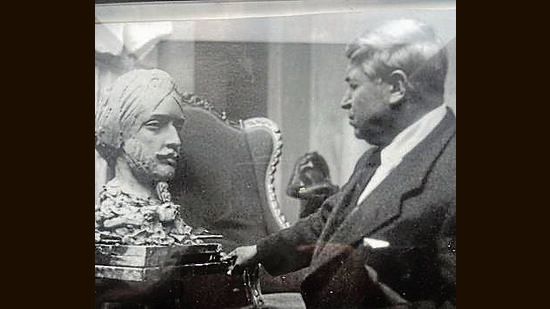
When it finally landed at Helsinki at 4pm, the Indians were received by the reception committee along with an army of photographers. The National Anthem was played, and the Indian flag went up. The Finns had never seen a turbaned and bearded Indian before. A young blonde ran out of the receiving line to greet my dad with recognition and affection, resulting in a hug and a kiss. She was an old friend from the Finnish Embassy in New Delhi. The next day, the photograph appeared on the front page of the Helsinki newspaper, headlined ‘The Indians have arrived’. On reading the news, Waino Aaltonen, Finland’s famous sculptor invited my father to his studio to model for him. His sculpture is in a famous museum in Turku, Finland.
Meals at the Olympic village were less than a dollar. With melons and grapes from France, oranges from Spain, juicy steaks, smoked salmon, good Chinese and Indian dishes and all have you, it was a treat. But the Indian camp had its own problems. The weightlifters had arrived without any gear and no funds to buy it in Helsinki. The choice was between them going gearless or not participating at all. So a hat was passed around and a sizeable collection was handed over to them. The other problem was that the wrestlers and the weightlifters, for that matter the entire contingent, began putting on weight, almost a pound a day. So somebody had to be with them to keep a check on their diet.
This was the most dangerous assignment my father ever handled throughout the tour. The result was controlled weight and bad tempers but he lost more weight than anybody else! Another problem was mild inebriation and the hordes of attractive blondes following the Indian players. Both these lapses were controlled by the great coach of Indian hockey, Harbel Singh. He promised that the day we won the gold medal in hockey, the boys would be at liberty to paint Helsinki red. And they did paint it red after the win against Holland in the final match.
The opening day was rather cloudy, and later turned rainy. The Olympic flame was lit by famous Finn runner Paavo Nurmi. With Indians, the question was who should carry the Indian flag in the march past. It was decided in favour of Balbir Singh of the hockey team because he was taller and heftier as compared to the others. Our team marched past in spite of damp turbans with drooping turrahs and received a standing ovation.
In 1952, few Europeans had heard of the partition of the Indian sub-continent. For them, it was one India and an Indian must wear a turban and sport a beard. My father ran into an old friend from Lahore; a handsome pathan, and a nawabzada, who was a member of the Pakistan delegation. It was common courtesy in a restaurant to place a small flag of your country on the table. The nawab sahib at once insisted that along with the Indian flag, the Pakistani flag should also be placed. After much discussion, the manager was summoned. He had a simple question to ask, “But sir, where is Pakistan?” After that, they never ate together.


