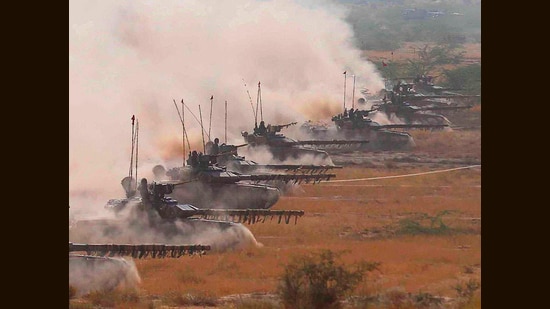
‘Operation Parakram’ was launched by the Indian military after the terrorist attack on its Parliament at New Delhi on December 13, 2001. The might of Indian military was mobilised for an impending war with Pakistan, the perpetrators of the said terrorist attack. I had assumed command of my tank regiment during august 2011 and were out in the field for routine training and field firing in the deserts of Rajasthan with skeleton equipment and crews which got supplemented with our complete wherewithal once orders were received to mobilise to our battle stations. Spirits were high, morale touching the sky and my men and tanks raring to march across the international border. Large-scale movement of troops on road and rail to get to their designated take-off zones for an offensive or defensive roles was witnessed by the world and as a young Commandant of a potent tank regiment, there seemed no doubt that the fortune of fulfilling the ultimate dream of going to battle may become a reality.
It was on the night of Lohri, January 13, 2002, when Gen Pervez Musharraf, the president of Pakistan addressed his nation , an address laced with war rhetoric of an impending conflict with India, that we were quite certain that the balloon will go up. Well, we waited for the go ahead. Extensive reconnaissance, intelligence gathering and surveillance inputs were constantly fed to the fighting units to sharpen their tactics for a wholesome victory. We were at an operational briefing at a tactical headquarters and an interesting revelation through a radio intercept shocked us no end. Thus went the conversation between a tank regimental commander with his boss at the higher headquarters, “Janaab, mere paas sirf 15 haathi (tanks) hain jo larai ke qabil hain baaki sab khalaas hain (Sir, I have only 15 tanks battle worthy out of a total of 45).” There was no surprise or shock in his response when the boss was quick to order, “Bashir, chaurahe aur museum par khare haathion ko topi pehnaao aur apni fauj mein shaamil karo.. ginti poori honi chahiye (Bashir, remove trophy tanks at the roundabouts and public places and make up the total anyways)”. Similar intercepts of inadequacy in the war fighting machinery of our adversary came to light. Corresponding morale of Pakistani troops and its will to fight became evidently clear. Sadly, the war did not see the light of the day for whatever reasons and our dreams of visiting ‘Sukkur’ , a city in the Sind province of Pakistan, on our tanks, which was one of our objectives remained unfulfilled. But , this was the closest we came to an all out war after Operation Brass tacks in 1987, when cricket diplomacy bailed Pakistan out.
Now, coming to the prevailing situation post-Pahalgam tragic episode. Both the nations are yet again on a sensitive brink. Pakistan is what it is. Rhetoric, false propaganda, denial and innocence in full demonstration. The situation of its economy, national strength and overall health has not seen an upward climb. Albeit, it has deteriorated since 2001, a good two decades and a half back when situation was precarious. It’s military capability to get into an open confrontation with the fourth largest military of the world is slender to say the least. At best , cross border firings to expand its outdated ammunition is the recourse to show an offensive spirit. On the other hand, India’s wiser strategy to stifle, suffocate and starve and keep ‘cards close to the chest’ will prove to be a force multiplier. Keeping our powder dry continues unabated, however. Like Sun Tzu, the famous Chinese general , philosopher and strategist righty remarked, “The supreme art of war is to subdue the enemy without fighting.”
{{/usCountry}}Now, coming to the prevailing situation post-Pahalgam tragic episode. Both the nations are yet again on a sensitive brink. Pakistan is what it is. Rhetoric, false propaganda, denial and innocence in full demonstration. The situation of its economy, national strength and overall health has not seen an upward climb. Albeit, it has deteriorated since 2001, a good two decades and a half back when situation was precarious. It’s military capability to get into an open confrontation with the fourth largest military of the world is slender to say the least. At best , cross border firings to expand its outdated ammunition is the recourse to show an offensive spirit. On the other hand, India’s wiser strategy to stifle, suffocate and starve and keep ‘cards close to the chest’ will prove to be a force multiplier. Keeping our powder dry continues unabated, however. Like Sun Tzu, the famous Chinese general , philosopher and strategist righty remarked, “The supreme art of war is to subdue the enemy without fighting.”
{{/usCountry}}avnishrms59@gmail.com
(The writer is a Chandigarh-based freelance contributor, views expressed are personal)