There is an animated discussion on elections among a group of people at Dr Rajeev Sharma’s clinic in Nagrota in Himachal politically most significant district of Kangra. Discussion hovers around what the ruling Bharatiya Janata Party (BJP) has done in the past five years, the lack of leadership in the both Congress and BJP and the double engine growth. Amid this, a frail-looking eighty-year-old man blurts out, “Congress will sweep the district.” Dr Sharma is quick to identify him as a Congress sympathiser and claim that there is a “palpable anger” against the ruling BJP government. He is not sure whether it would translate into votes for Congress.
Such discussions are not unusual in the district, which is said to be the road to the Himachal assembly in Shimla. In 2017, the BJP won 11 of the 15 assembly seats, the highest for any district in the state, Jairam Thakur became chief minister. In 2012, the Congress won 10 seats, and Virbhadra returned as CM for the sixth time. Election data shows that since 1993, Kangra has voted the party to power; alternatively, for Congress or the BJP, the two main political parties in Himachal’s bipolar contests.
The district is said to have swing voters that decide the fate of the party to rule Himachal. “In the last 30 years, Kangra has given a clear verdict to a political party. The party which secured Kangra has won at least nine seats and hardly ever Congress and BJP got seven seats each. Data shows both Congress and BJP get a minimum of 40% votes, and the remaining 3-5% are swing votes. That is the reason why Kangra will decide the verdict again,” said Harish Thakur, professor of political science at Himachal Pradesh University in Shimla.
In Kangra, the Rajputs, like the rest of the state, dominate, while other backward classes (OBC), locally called Chaudhary, are also politically significant. Locals say Rajput constitute about 34% of the district population, OBCs about 32% and 20% are Brahmins. The remaining 14% are mostly the shepherd community, called Gaddi, and scheduled caste. “Both parties have given a significant share of tickets to Rajput and Gaddi leaders. BJP has not given even a single ticket to Brahmin in Kangra, whereas the Congress has given one ticket,” Thakur said.
{{/usCountry}}In Kangra, the Rajputs, like the rest of the state, dominate, while other backward classes (OBC), locally called Chaudhary, are also politically significant. Locals say Rajput constitute about 34% of the district population, OBCs about 32% and 20% are Brahmins. The remaining 14% are mostly the shepherd community, called Gaddi, and scheduled caste. “Both parties have given a significant share of tickets to Rajput and Gaddi leaders. BJP has not given even a single ticket to Brahmin in Kangra, whereas the Congress has given one ticket,” Thakur said.
{{/usCountry}}In the battleground Kangra, Dr Sharma said caste plays an important role for voters to decide their preferences and overall state issues swing the voters. Kartar Singh, 53, of village Jingsu in Nagrota assembly, who identified himself as a fan of Prime Minister Narendra Modi, said he would be voting for Congress this time because the state BJP government was “inefficient.” In Baldar village, Captain Roshan Lal, who retired from the Indian Army in 1995, said people vote for the party that works for people. “People here are highly literate and aware. If the party has worked and delivered, we vote for it, or else we change,” the 83-year, wearing his Army cap and dotting a handlebar moustache, said.
Agnipath, a key issue here
For Singh, the switch from BJP to Congress was only for the 2022 assembly polls and the primary reason for his anger was area BJP MLA Arun Kumar, who had defeated senior Congress leader, G S Bali, in 2017. This time, Congress has given the ticket to Bali’s son, Raghbir Singh, who is pitted against Kumar. In addition to local anti-incumbency, Roshal Lal identified falling sale price of agriculture crops as another major concern for locals and Lacha Devi of Umti village in neighbouring Shahpur assembly constituency said food inflation was making it difficult for her to run her kitchen. “No vegetable or dal is less than ₹100. The price of a litre of edible oil is still above ₹200. Government has done nothing to reduce prices,” she said.
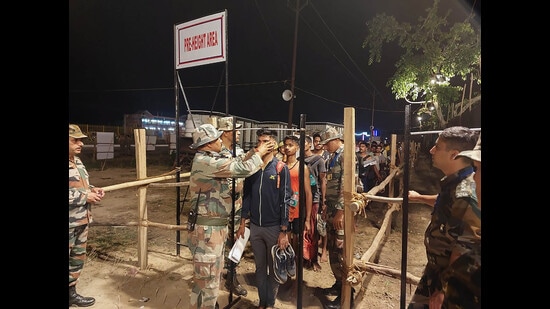
Unlike most other districts of Himachal, the introduction of the Agnipath scheme in the country from June 2022 appears to be an election issue in Kangra and neighbouring districts of Hamirpur, Una and Mandi, which sends 35 of 68 law-makers to the state legislative assembly. Agnipath provides for a four-year tour of duty job for youth between 17.5 to 21 years with a provision of one-fourth of the recruits, to be called Agniveers, retained in the armed forces. Before Agnipath, all recruitments got short-term permanent commissions with pension benefits. There are around 1.30 lakh ex-servicemen and about 40,000 serving personnel from these four districts in the armed forces, according to estimates by Himachal ex-servicemen association, claiming that every third family in the Kangra district has either a serving or retired member from the armed forces.
“Army has traditionally been the biggest job provider in the lower parts of Himachal. Every year up to 4,000 youth from Kangra, Hamirpur, Una and Mandi districts got jobs in the Indian Army. With recruitment under Agnipath scheme going all India in place of regiment-wise, the hiring from Himachal will go down by one-third. Of them, also one-fourth will be retained. It would be a major blow to young job-seekers here,” said Major General (retired) DVS Rana, who lives in a village near Palampur.
Agreeing with him, Colonel (retired) KKS Dadwal, president of Dharmsala State War Memorial, described the introduction of Agnipath scheme as “beyond logic” and claimed that the government does not want people to join Army. “Saving revenue has become more important than saving the country when both China and Pakistan are constantly targeting our border areas. Agnipath will have electoral implications,” he said.
At Chhabuta village in Hamirpur district, a young Army aspirant, Sombir Rana, 20, said his dream of serving in the Indian army for life got shattered with the introduction of the scheme. “There was no Army recruitment since 2019 (due to Covid-19) and we were eagerly waiting for hiring to re-start this year. The government introduced Agnipath which provides a contract only for four years. What will I do after four years? I will have to hunt for another job. And, there is no surety of getting another job,” he said.
A job in the armed forces is linked with societal and economic respectability in the region, where many have sacrificed their lives for the nation. “We have the highest number of martyrs in the country. A job in Army not only brings respect in the society but also enhances match-making. In Agnipath, the boy will be without a job when he reached marriage age,” Roshan Lal said. To be sure, union home minister, Amit Shah, in June assured that Agniveers will get preference in Central Armed Paramilitary Forces and Assam Rifles recruitment. “Es bar goli hum ballot se nikalaga (This time, we will fire a bullet through the ballot),” Rana said.
Suresh Diwan, an electronic shop owner in Nagrota town, admitted to “some anger” among ex-servicemen in rural areas and claimed that it will not have much electoral impact. “They (ex-servicemen) also understand that Agnipath will transform the Indian Army and would provide the military with more funds to get modern weapons. A large number of youth from villages participated in Agnipath recruitment rallies in Mandi and Kangra. This shows that youth is not angry over the scheme,” he said.
Locals say that Agnipath has added to “distress” among youth over not getting government jobs, the biggest employment avenue in the state. In Bhalet village of Kangra’s Sulah assembly constituency, Ravindra Sharma, 63, said his son was not able to get a job in Himachal Police despite being on the merit list because of the paper leak scam. “For five years, my son is trying for a job in Army or Himachal government. We were confident that he will get a job in the police but the exam got cancelled after paper leak allegations. But, the time next exam comes, he will not be eligible to appear,” Sharma said. More than 120 km away, Satpal Agnihotri, frying samosas at his tea stall outside Una bus station, rued that his son also did not get a government job even after trying for three years. “Only those who are close to politicians get a job. Poor people like us have to work from 4 am till midnight every day,” he said.
In Himachal, Kangra has the highest number of residents as a percentage of the population in government jobs. This is because while four of the 12 districts have cash-rich apple crop and a tourism industry, which has reduced economic hardship, most of the lower Himachal districts have no cash-rich crops and a booming tourism industry. “A government job in lower Himachal provides economic stability unlike hill districts where tourism and apples have brought financial prosperity,” said Pradeep Thakur, who is from Mandi and heads the organization fighting for the restoration of old pension scheme (OPS) that provides for monthly pension equivalent to 50% of the basic. That’s why, he said, restoration of the old pension issue is finding huge traction in lower Himachal districts.
In absence of an upbeat campaign, Congress is heavily banking on “resentment” against the government to clinch Kangra. Sudhir Sharma, a Congress candidate from Dharamshala assembly segment, said Agnipath and the old pension scheme (OPS) were two major issues in the Kangra district and would become a reason for the defeat of BJP. “I can see anger among people on a range of issues. But, these two are very dominant as they affect the future of large parts of the population,” he said.
Sanjay Sharma, a Kangra-based BJP spokesperson, said the flaring up of the OPS issue has polarized the voters as people know that giving OPS will cripple the state economy. “We have been able to convince people that OPS was not given because of Virbhadra Singh-led Congress government and not BJP,” he said. On the Agnipath scheme, he said, Congress was trying to make it an election issue. “To me, it is an issue at all. A large number of youth from Kangra participated in recruitment rallies which shows that they have accepted the scheme wholeheartedly,” he said.
At Dr Sharma’s clinic, there is a discussion that prime minister Narendra Modi’s image can cast its shadow over these issues. “The real campaign will start when a large number of Central BJP leaders will come. We will have to wait and see what impact it will have on voters,” Dr Sharma said.