
 E-Paper



Himachal sees 79% rainfall deficit in January so far
All the state districts experienced a rainfall deficit in January with lower parts of the state being the worst affected with Bilaspur, Hamirpur, Kangra, Solan and Una districts recording more than 90% of the deficit


Himachal Pradesh has recorded 79% less rainfall in January so far with only 14.7 mm actual precipitation recorded against a normal of 70.8 mm.
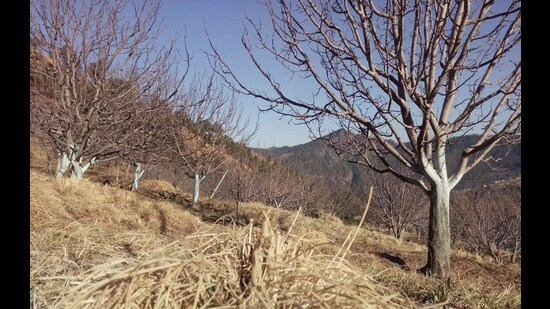
All the state districts experienced a rainfall deficit in January with lower parts of the state being the worst affected with Bilaspur, Hamirpur, Kangra, Solan and Una districts recording more than 90% of the deficit. While Kinnaur district has also witnessed 91% less rainfall, Chamba recorded an 82% rainfall deficit, Mandi 81%, Shimla 77% and Sirmaur 76%.
IMD officials attribute this to a few western disturbances in January with lesser moisture influx. However, more showers are expected in the coming days.
Winter precipitation is crucial for maintaining soil moisture, which is essential for healthy crop growth. Farmers and horticulturists are increasingly concerned about the impact of inadequate rainfall. At present, farmers are particularly worried about the rabi crops and are eagerly awaiting more rain across the state.
Wheat, chickpeas and lentils are the major crops grown in the rabi cycle. Dhyan Chand, a farmer of Nandpur village in Kangra district, said the farmlands in the area rely entirely on rainwater for irrigation so if sufficient rainfall does not occur it impacts the crops. “First due to the dry spell in October and November, the sowing of wheat got delayed and now again less rains are worrisome for us because the crop needs more moisture otherwise it will impact the harvest,” he said.
Meanwhile, Kangra deputy director of horticulture Dr Kamal Sheel Negi said while the current lower precipitation levels may not immediately impact the next season’s crops, the absence of adequate moisture will be crucial during the flowering period, which begins in February for some crops, can have adverse impact on the crop. “Moisture is essential during flowering and fruit setting periods. If sufficient rainfall does not occur in February, it could adversely affect the next season’s crop,” he said.
The India Meteorological Department’s (IMD), Shimla office, has predicted light precipitation at isolated places on January 29 and 30 and again on February 2. While light to moderate precipitation is likely on January 31 and February 1 at a few places. On January 29 and 30, light rain or snowfall is likely in parts of Chamba, Kangra, Kinnaur, Kullu, Lahaul-Spiti and Mandi districts. However, light rainfall is expected in other parts as well on January 31.


