
 E-Paper



Himachal stays saffron as BJP scores hat-trick
Anurag Thakur wins for the fifth time, Kangana edges Vikramaditya in battle of Lok Sabha poll debutants


The Bharatiya Janata Party (BJP) completed a hat-trick in the state’s four Lok Sabha seats — Kangra, Shimla, Mandi and Hamirpur — albeit with reduced margins.
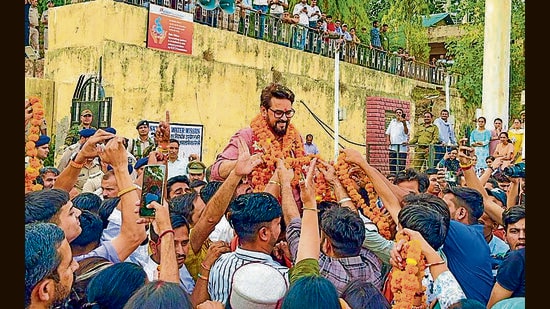
Union information and broadcasting minister Anurag Thakur posted a fifth win from Hamirpur securing 6,07,068 votes. He defeated his Congress rival, Satpal Raizada, with a margin of 1,82,357.
The seat has remained a BJP stronghold, owing to former chief minister Prem Kumar Dhumal’s clout. Thakur also made inroads into chief minister (CM) Sukhvinder Singh Sukhu’s home turf of Nadaun. Notably, the Congress had ran a high-decibel campaign in Hamirpur — which was the epicentre of the rebellion that pushed the Sukhu-led government to the brink after six party rebels and three independents voted for the BJP candidate Harsh Mahajan in the February Rajya Sabha elections to catch the government unawares.
Later, the six were disqualified from the assembly for defying the whip which necessitated the assembly by-polls.
Anurag back with reduced mandate
Both Sukhu and deputy chief minister Mukesh Agnihotri hailed from the lower belt and their active involvement in the campaign helped Congress improve its vote percentage, but it wasn’t enough to unseat Anurag. The leader, in fact, secured leads in all the 17 assembly segments falling under the seat.
Thakur had centred his campaign around the development work carried out in Hamirpur during his term. BJP national president Jagat Parkash Nadda, who hails from Bilaspur, also actively participated in the campaign, helping his party secure the lead in the district’s four assembly segments – Bilaspur (Sadar), Ghumarwein, Naina Devijee and Jhan Dutta.
Bhardwaj gets the biggest margin
Rajeev Bhardwaj, BJP’s Kangra candidate, won with the highest margin in the state, securing 6,32,793 votes 2,51,895 more than Congress vanguard leader and former Union minister Anand Sharma.
Sharma made his electoral debut in 1982 when he unsuccessfully contested the assembly elections from Himachal against BJP’s Daulat Ram Chauhan from Shimla. He was elected to the Rajya Sabha in 1984 at age 31, after which he served four terms in the Upper House.
A prominent member of the G -23 group, the group of leaders who wrote a dissenting letter to the party leadership, a ticket to Sharma from Kangra surprised not only the leaders of the party but also the party cadre.
Though Sharma campaigned hectically, raking up national issues like the Agniveer scheme and battle to save the Constitution. His pitch, however, failed to match the well-oiled machinery of the saffron party.
Bhardwaj, meanwhile, was also able to cut through the dominant Rajputs, Gaddi, and other backward classes vote bank given his longstanding association with Kangra and Chamba districts.
Kangana fails to win over tribals
Mandi Lok Sabha seat, a significant battleground witnessed a fierce contest between actor-turned-politician and BJP candidate Kangana Ranaut and Congress’ Vikramaditya Singh.
Ranaut secured 5,37,022 votes to defeat Vikramaditya by a margin of 74,755.
While Vikramaditya performed well in the tribal belts across Kinnaur, Lahaul-Spiti, Rampur Bushahr and Anni, Ranaut secured a major chunk of 40,863 votes from former chief minister Jai Ram Thakur’s Seraj segment.
Thakur had led the charge for the BJP in Mandi, while Vikramaditya banked on his father Virbhadra Singh’s legacy. Both Virbhadra and his wife, Congress’ state unit chief Pratibha Singh have represented Mandi on multiple occasions.
In Mandi, both parties ran a high-decibel campaign, with the candidates wasting no opportunity to pin the other down. Vikramaditya also raked up local issues, but Ranaut relies more on Prime Minister Narendra Modi’s appeal and BJP’s achievements at the Centre.
‘Absentee’ Kashyap ekes out win in Shimla
Congress had tasked the sitting MLA from Kasauli, Vinod Sultanpuri, to upset BJP’s sitting MP Suresh Kashyap.
Kashyap, a low-profile leader who crisscrossed the constituency over the course of the campaign, raked up national issues to compensate for his prolonged absence from the constituency.
Congress hit out at the leader for his apparent abandoning of his constituents, but came up short in the result. Sultanpuri gave a spirited fight, but Kashyap secured a win with a decent margin of 90,548 votes.
Kashyap, who was instrumental in getting a tribal tag for the dominant Hatti community inhabiting the Trans Giri region in Sirmaur, received overwhelming support in his home district of Sirmaur. Interestingly, he was not able to gain much in his home constituency of Pachhad.
Barring Rohru and Jubbal, Kotkhai Kasypa secured leads in all the 15 other assembly segments comprising the Shimla parliamentary seat. Sultanpuri, who somewhat relied on his father’s legacy to establish an initial connection, was able to make an impression in the apple-growing regions to a certain extent.
Fruit growers in the region were upset with the reduced duty on foreign apples and the rising cost of production.
The election was also a litmus test for the Sukhu government’s popularity, given that Congress boasts of MLAs in 13 of 17 assembly segments falling under the Shimla Lok Sabha seat. Shimla’s parliamentary representation also extends prominently into the Sukhu cabinet, with key ministers and officials hailing from the region.
At least five cabinet ministers — industry minister Harshwardhan Chauhan, health minister Dhani Ram Shandil, education minister Rohit Thakur , public works minister Vikramaditya Singh and rural development minister Anirudh Singh, deputy speaker Vinay Kumar, chief parliamentary secretaries Sanjay Awasthi, Homan Lal Brakta and Ram Kumar — hailed from the region.


