
 E-Paper



HP governor skips address, objects to remarks on 16th Finance Commission
Move triggers fresh standoff with Congress govt; CM Sukhu rejects Centre’s comparison with 17 other states, citing Himachal’s unique hill-state constraints.

 Prefer HTon Google


Himachal Pradesh governor Shiv Pratap Shukla on Monday skipped reading the customary governor’s address at the start of the budget session of the assembly.
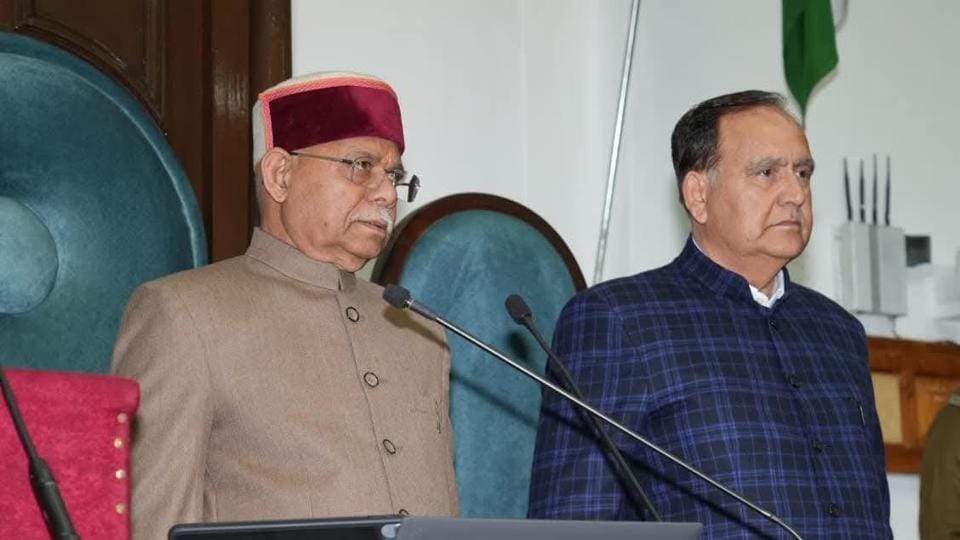
“I don’t think I should read it,” Shukla remarked, specifically pointing out that the prepared text contained “comments on a constitutional institution”. While he addressed the House for barely a few minutes, he noted that the remainder of the speech detailed the Sukhvinder Singh Sukhu-led Congress government’s past and future achievements, which he felt the House should deliberate upon independently.
The flashpoint appears to be the government’s criticism of the 16th Finance Commission. The skipped portion of the address reportedly contained disparaging remarks regarding the commission’s recommendation to discontinue the Revenue Deficit Grant (RDG) to Himachal Pradesh.
Reacting to the standoff, chief minister Sukhu downplayed the governor’s move, stating it was “not an exception” and that governors have skipped addresses in the past. However, he remained firm on the state’s financial grievance. “This is not about the government; RDG is our right. Do not harm the rights of the state,” Sukhu said.
The CM further challenged the Centre’s comparison of Himachal with 17 other states that also face grant adjustments. “Himachal cannot be compared to those 17 states. They have big projects and different economies. Himachal is a hill state where revenue generation is inherently limited due to natural resources and geographical constraints,” he added.
The state government has now called for a three-day session under Rule 102 specifically to deliberate on the RDG crisis. Sukhu expressed hope that the opposition BJP would “rise above party lines” and join the state government in approaching the Centre to restore Himachal’s financial rights.
The RDG previously constituted 12.7% of the state’s budget, the second-highest dependency in the country. With the grant’s discontinuation, the state faces an annual loss of ₹10,000 crore, a blow that has crippled its ability to bridge the gap between resources and spending. The state’s internal resources stand at about ₹18,000 crore, while committed expenditures, including salaries, pensions, and debt servicing, totalling to ₹48,000 crore. Even after accounting for ₹13,950 crore in central tax devolution and ₹10,000 crore in borrowings, the total pool of ₹42,000 crore falls significantly short of the state’s obligations.
What RDG withdrawal means
*The Revenue Deficit Grant (RDG) is a constitutional lifeline under Article 275(1), designed to bridge the gap between a state’s own revenue and its essential spending. For Himachal Pradesh, its discontinuation by the 16th Finance Commission from the 2026-27 fiscal year creates a fiscal crisis.
*The state is already struggling to pay ₹8,500 crore in revised salary arrears and ₹5,000 crore in Dearness Allowance (DA). Without the RDG, these payments face an indefinite freeze.
*To save funds, the government may be forced to scrap subsidies on electricity, water, and food, which currently cost the exchequer over ₹1,200 crore annually.
*There is pressure to abandon the Old Pension Scheme (OPS), a key poll guarantee of the Sukhu-led Congress government, and revert to the Unified Pension Scheme (UPS) or NPS to unlock ₹1,800 crore in additional borrowing capacity restricted by the Centre.
*The finance department has suggested abolishing all government posts vacant for over two years and potentially closing or downsizing 30% of state institutions to maintain liquidity.


