E-Paper



J&K to take stock of its critically endangered Hangul population
The four-day counting exercise will start on April 3 and will around 220 wildlife experts, field staff, academics and scholars

 Prefer HTon Google


Wildlife authorities will carry out a population census of the unique Kashmiri royal stag, vernacularly known as the Hangul, which once ruled the Valley but has become a critically endangered species with sightings mostly reported in Srinagar’s Dachigam National Park.
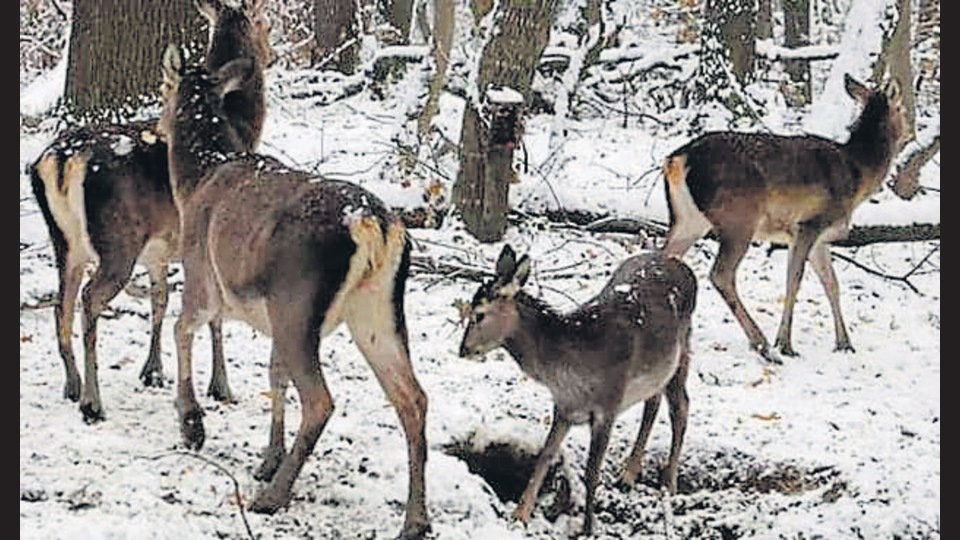
The four-day counting exercise will start on April 3 and will around 220 wildlife experts, field staff, academics and scholars, some of them from the higher educational institutes of Kashmir. A population census is conducted every two years.
“The census was scheduled to start from March 23 but has been postponed to April 3. It will be a four-day activity that will be held on alternate days,” said wildlife warden, Central Kashmir, Altaf Hussain.
The last viable population of Hangul (Cervus hanglu hanglu) in the Indian sub-continent exists only in the protected Dachigam National Park, a vast mountainous 141 sq km sanctuary on the outskirts of Srinagar, where Hangul grazed in hordes before the start of militancy in 1989. Lately, there have been a few sightings in connected areas outside the park in south Kashmir but their number is believed to be negligible.
The specie has been placed in ‘critically endangered’ category by International Union for Conservation of Nature (IUCN) and is the only survivor of the red deer group in the Indian sub-continent. In 2019, the population of the animal had slightly improved to 237 from 214 in 2017.
“There will be an orientation programme for experts and scholars before starting the census. Later, three field counts will be held on alternate days,” said Hussain, adding that the teams will disperse around 40-45 identified tracks of the Hangul.
“Each track will be assigned to one group of four to five people with equipment such as GPS, binoculars, range finder and date sheets. They will be recording every physical sighting, sighting of pelt or other impressions on the basis of which we will be able to assess the number,” Hussain said.
Population dropped to 200 from 3-5K during insurgency
Poached for its meat, antlers and skin, the deer’s population dropped below 200 in the early 1990s from 800-900 in 1988 after insurgency paralysed the state administration. It had a thriving population of 3,000-5,000 in the 1900s.
However, the number of Hangul stabilised after poachers were forced out when militancy reached its peak in mid-1990s and militants and the army battled each other deep in the forests, the natural abode of the shy animal.
“Around three-four decades ago, Hangul thrived on a massive landscape from Bandipora (north) to Tulail Shopian (south) through Dachigam (centre),” Hussain said.
The deer’s population has stabilised owing to conservation efforts of the wildlife department to protect the park and minimise disturbances. “Its population is not declining at an alarming rate anymore. We have been able to stabilise the numbers of the animal,” he said.
However, wildlife experts are concerned as to why their numbers are not increasing despite three decades of conservation efforts.
In 2016, a report compiled by a team of environmentalists and wildlife experts, named armed conflict, large-scale interferences to its habitats in the form of excessive grazing by livestock of nomads in the Hangul’s erstwhile summer habitats, grass cutting, fuel and firewood collection, human trampling owing to vehicles of hundreds of paramilitary forces camped inside the park and employees of more than seven government departments, as some of the reasons.
“We have been able to control some of the factors to a large extent, though there is pressure in upper Dachigam,” Hussain said.