
 E-Paper



Kashmiri artist takes to canvas to portray deeply sensitive themes
In the politically-charged landscape of Kashmir, an artist has taken to canvas to portray some deeply sensitive themes and is carving out a space for himself; Kunwar Aamir Hameed Wani’s pursuit to become an artist, however, has not been an easy one


In the politically-charged landscape of the Valley, an artist has taken to canvas to portray some deeply sensitive themes and is carving out a space for himself.
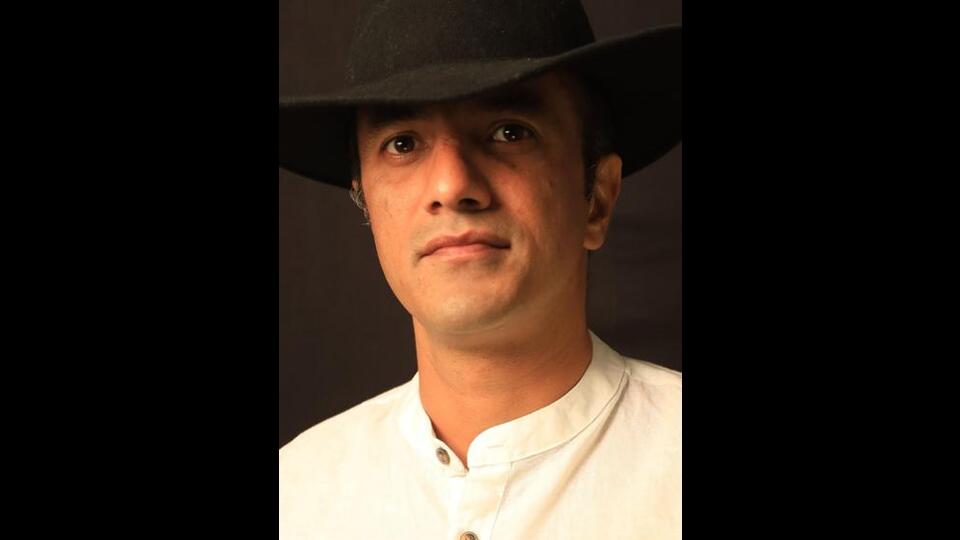
Kunwar Aamir Hameed Wani’s pursuit to become an artist, however, has not been an easy one. From rigid parents who wanted him to do MBBS or engineering to sceptical relatives and friends who never supported his choices, he had to fight from the very beginning.
His oil and acrylic artworks on canvas and paper are mostly focused on contemporary and abstract forms. His main works centre around the pain of migration of Kashmiri Pandits and how it left a devastating effect on the society in J&K. He has also given a life to the Russian Revolution and has worked on a collection on Jerusalem, a city which has been important to Jews, Christian and Muslims throughout history.
“I have been painting the life and exodus of Hindus from Kashmir, which left a devastating effect on both Hindus and Muslims here,” he says.
“The attempt is to show how the exodus of Kashmiri Hindus overnight caused a huge cultural void in the history of the Valley. There may have been some elements that fanned that fire, but it is also a fact that no ordinary Kashmiri Muslim was in favour of this,” he added.
“There was no wholesale hatred as a recent film would want us to believe. There are more examples and stories of love and brotherhood between the two communities. Even now, many Kashmiri Muslims go to Jammu with walnuts and lotus roots for their Pandit neighbours and friends,” he says.
Wani, 39, started his art journey at a very early age. Born in the northern town of Pattan in 1984, his family migrated to Srinagar, the capital of the picturesque Himalayan valley, as his school in his Goshbug village in Pattan closed owing to the violence which engulfed the valley from early 1990s and triggered the migration of Kashmir’s minority Pandit community.
His collection on Pandits includes ‘The migration’, ‘For my burnt house I shed a million tears and sob’, ‘colorblind ghetto’ and ‘Wandhama massacre’, illustrating the foreboding life of migrants in camps in Jammu and the ruin of their homes in the Valley.
“The Wandhama massacre depicts a faceless child oozing blood from his mouth, a picture of which I saw in a newspaper cutting. I painted to emphasise that a child can’t be killed in the name of any ideology or religion,” he says.
He was affected by the plight of Pandits early in his life when his kindergarten teacher left his village in early 1990s and when his father took him to Jammu in his teenage years in 2000 to meet her, the visit was life changing.
“We both cried. They were living in Baribrahmana in two rooms in abject conditions in contrast to the palatial house and vast land they had here,” he says. “After that I visited the camps and accommodations in Jammu multiple times,” he says.
Wani has also painted about the life of ordinary Kashmiri Muslims and the trauma they faced in the strife torn valley. Some of these works were done after pellets were used against young people in Kashmir, many of whom lost their eye sight due to the use of the pump action guns by security forces against protesters. However, he was been wary of sharing those works and removed them from his social media accounts in early 2021 after J&K police detained a graffiti artist in Srinagar for painting a mural in solidarity with Palestinian people.
After his Class 12, Wani’s father, a fruit grower, wanted him to do MBBS or engineering and he was forced to join an agricultural engineering course in Maharashtra from where he migrated to Punjab. However, he left the course in third year and came back home in 2008.
“My father told me everyday that I was wasting my time and give me examples of doctors, engineers and professors in our extended family,” he says.
And that is when he decided to sell his bike and leave the Valley for work. “I didn’t look back and decided to do what my heart says. Initially I worked at a BPO in Pune and later shifted to Delhi in 2014 to work in American Express, where I gathered some savings and bought some painting material,” he says.
He started with watercolor and crayons and then progressed to oil and acrylic and Japanese ink. In Delhi, he made his first professional paintings. He started working on the Russian Socialistic Revolution and his first professional art works were portraits of Karl Marx and Karl Liebknecht, following which he decided to paint on Jerusalem.
“I read about Jewish and Palestinian art history and the architecture there and also about the eras of Muslims, Christians and Jews’ triumph which prompted me to paint abstract art about the place showing triumphs of all the three communities,” he says.
However, when he tried to get published in local newspapers in Kashmir, he was given a cold shoulder. “The editors thought these were contentious themes,” he says.
However, he received his share of success when the works were published in architecture and cultural magazines based in Israel in 2018-19. Since then, he has participated in an online international art exhibition organized in 2020.
Earlier this month, he participated in his first physical exhibition in Kolkata organised by Birla Academy of Art and Culture from April 7-10. “My first two portraits of Karl Marx and Karl Liebknecht were displayed there and I got an award for both of them,” he says.
And he earned the trust of his parents when he commissioned his first commercial piece – a 3 by 4 ft portrait - in Kashmir in 2020 for ₹40,000.


