The municipal corporation’s internal survey has identified 26 “critical” wards in Ludhiana for priority sewerage intervention, but the proposed works have come under scrutiny amid questions over tender terms, with rate contracts extending to two years despite tenders being issued for one year.
Officials said the local bodies department had floated tenders for desilting as well as repair and maintenance of sewerage lines for a one-year period, aimed at addressing frequent complaints of sewer blockages, overflow and damaged pipelines across several parts of the city, particularly in densely populated and low-lying areas. However, the rate contracts finalised under the same process have been fixed for two years, prompting concerns among activists and experts, who have questioned the rationale behind extending the contract duration beyond the original tender terms.
The 26 identified wards are among the worst affected areas and have been prioritised for immediate intervention as part of the planned works.
The financial details of the contracts have also drawn attention. For desilting of sewerage lines, the rate has been fixed at ₹295 per kilometre, while for larger pipelines of 42 inches, it stands at ₹12,546 per kilometre.
For combined works involving repair, desilting and maintenance, the rates are significantly higher. For an 8-inch sewer line, the rate has been fixed at ₹1,53,185 per kilometre per year, while for 42-inch pipelines, it goes up to ₹1.92 crore per kilometre per year.
{{/usCountry}}For combined works involving repair, desilting and maintenance, the rates are significantly higher. For an 8-inch sewer line, the rate has been fixed at ₹1,53,185 per kilometre per year, while for 42-inch pipelines, it goes up to ₹1.92 crore per kilometre per year.
{{/usCountry}}Activists have termed the variation in rates as substantial and have sought clarity on how these figures were arrived at.
Despite the concerns, civic body officials maintained that the focus remains on addressing long-pending sewerage issues in the identified wards. MC commissioner Neeru Katyal said the civic body is preparing to roll out works in these priority areas. “We are chalking out a plan for 26 wards in Ludhiana and our priority is to clean the sewerage lines which are critical. The rate contract has been finalised for two years by headquarters as tenders have been floated across the state,” she said.
Officials argued that fixing rate contracts for a longer duration ensures continuity of work and avoids delays caused by repeated tendering. T
hey added that the move would help the civic body respond more effectively to sewer-related complaints, especially during the monsoon season when the problem tends to worsen.
However, activist Kuldeep Khaira questioned the inconsistency, asking why the tender specified a one-year period if the intention was to award contracts for two years. He demanded that all tender documents and approvals be placed in the public domain to ensure transparency.
Residents in affected areas have welcomed the decision to prioritise 26 wards but remain sceptical about its execution, pointing out that previous desilting drives failed to deliver lasting results, with blockages recurring within months.
Urban experts said that while prioritising critical wards is a step in the right direction, the success of the initiative will depend on strict monitoring, quality of work and accountability of contractors.
MC joint commissioner conducts inspection of sewer desilting works
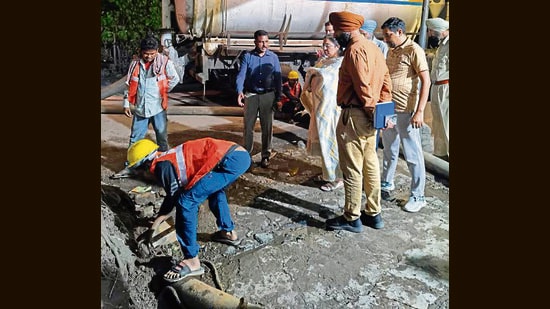
Civic body joint commissioner Vineet Kumar conducted a midnight inspection of ongoing sewer desilting works in the city, officials said on Sunday.
The inspection was carried out during the intervening night of Saturday and Sunday at Daba Road, Hargobind Marg and the Sundar Nagar area, where cleaning of major sewer lines was underway using super suction machines.
Officials said the main sewer lines are being cleaned with advanced machinery to ensure efficiency. In areas with heavy traffic, the machines are deployed during night hours to avoid congestion and ensure smooth execution of work.
During the inspection, Kumar directed officials to expedite the desilting process and maintain efficiency.