In a major setback to around 68,000 allottees of the Chandigarh Housing Board (CHB), the Ministry of Home Affairs (MHA) has refused to allow need-based changes in dwelling units on the pattern of Delhi.
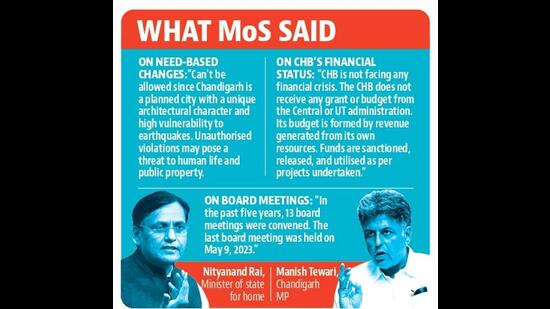
Chandigarh Member of Parliament (MP) Manish Tewari had raised the question in the Parliament and asked why CHB isnt allowing need-based changes on Delhi pattern of 1999, despite repeated representations made by residents over the past 25 years. He also questioned why CHB is hesitant to implement a one-time amnesty scheme to regularise all need-based changes in CHB dwelling units, given that 68,000 residential units are affected.
In his reply, Minister of state for home Nityanand Rai said that certain need-based changes were allowed by the CHB in relaxation of the Chandigarh Building Rules, 2017. “The Chandigarh administration considered the requests in 2022 and decided that the said requests on the Delhi pattern cannot be allowed since Chandigarh is a planned city with a unique architectural character and has high vulnerability to earthquakes as it falls in Seismic Zone-IV. Unauthorised violations may pose a threat to human life and public property,” he stated.
Tewari also raised other questions about whether CHB is facing financial crises, details of the budget estimates, revised budget, and actuals for CHB during the last five years, details of funds sanctioned, released, and utilised by the CHB during the said period, the minutes of the CHB board meetings, and the inventory, projects under construction, and projects sanctioned during the said period.
{{/usCountry}}Tewari also raised other questions about whether CHB is facing financial crises, details of the budget estimates, revised budget, and actuals for CHB during the last five years, details of funds sanctioned, released, and utilised by the CHB during the said period, the minutes of the CHB board meetings, and the inventory, projects under construction, and projects sanctioned during the said period.
{{/usCountry}}In December 2023, former UT administrator Banwarilal Purohit had said the authorities were reconsidering need-based changes in about 68,000 CHB flats and would frame a policy accordingly, but nothing was done. Over 55,000 exhibit one form of violation or another, including additional rooms and toilets, conversion of balconies into rooms, covering of courtyards, and even construction of stairs on government land.
CHB residents’ federation president Nirmal Dutt said, “The home minister’s refusal to allow need-based changes on Delhi pattern is shocking and disappointing. This solution, already adopted by six other states, is the only one fit to solve the problems of CHB residents, 95% of whom are violators in the Board’s records,” he said.
To another question, the Minister replied that in the last five years, out of the four projects sanctioned, one project was completed and three projects were kept on hold due to administrative reasons.
In August last year, former UT administrator Purohit had put CHB’s ambitious Sector-53 General Housing Scheme on hold, terming it unnecessary. The administrator also told CHB not to pursue another housing scheme at IT Park that has been caught in environmental clearance tangles for its proximity Sukhna Wildlife Sanctuary.
In May this year, the Punjab and Haryana high court directed UT to allot land to UT employees who had applied for the 2008 Self-Financing Employee Housing Scheme at the same rate as 2008. The administration is set to move to the top court against the decision, stating that they will suffer a financial loss of nearly ₹2000 crore.