
 E-Paper



Over 3k moved to safer places in Punjab as Pong, Bhakra open floodgates
Situation grim in Hoshiarpur and Gurdaspur districts with the Army, NDRF teams being pressed into service for relief and rescue operations

 Prefer HTon Google


More than 3,000 people have been rescued or moved to safer places in Punjab as many areas were inundated following the release of excess water from Bhakra and Pong Dams on Wednesday.
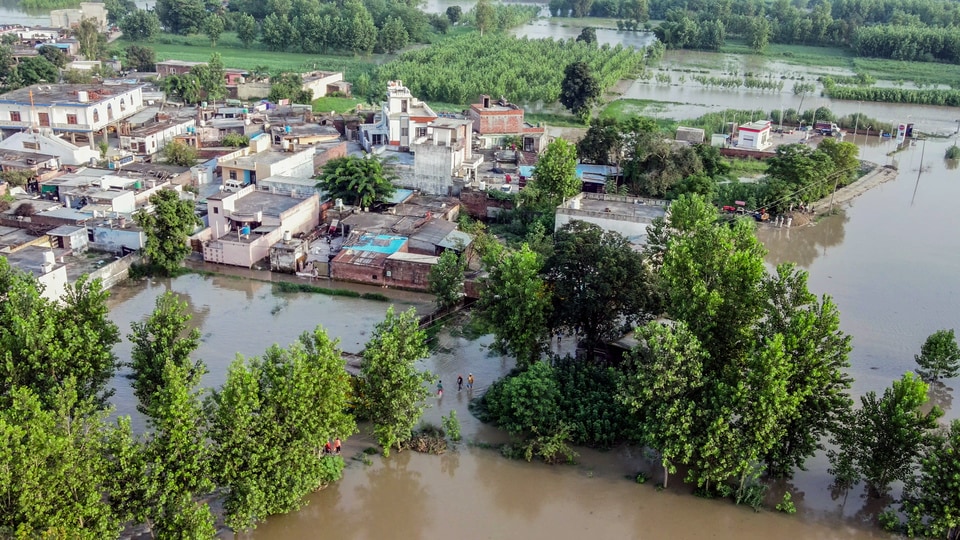
A maximum of 2,500 people were evacuated from 25 Bet area villages in Mukerian and Dasuya subdivisions were inundated after excess water was released from the Pong Dam. Residents of Mehtabpur village, which is worst hit by floods, said their houses were under 4 feet of water.
The Bhakra Dam on the Sutlej and the Pong Dam on the Beas —both in Himachal Pradesh —are brimming after heavy rains in their respective catchment areas. Both dams are managed by the Bhakra Beas Management Board (BBMB). BBMB secretary Satish Singla said water levels in Bhakra and Pong dams stand at 1,677 feet and 1,398 feet, respectively on Wednesday.
The BBMP secretary added that Bhakra Dam received an inflow of 1.93 lakh cusecs while the Pong Dam received over seven lakh cusecs because of rains in its catchment areas in the past few days.
Floodgates at both dams were opened two days ago, with 1.43 lakh cusecs of water flowing from Pong Dam and about 80,000 cusecs from Bhakra Dam.
25 villages submerged in Hoshiarpur
Excess water released from the Pong dam wreaked havoc in several villages in Mukerian and Dasuya sub-divisions. Around 25 villages situated in the Bet area have been affected by floodwater. The district administration has deployed national and state disaster management teams to rescue people.
The situation is no better in other villages situated along the Beas. Rescue operation is on in Haler Janardhan, Kolian, Motla, Chakwal, Dhanoa, Bela Sariana, Passi Bet and adjoining villages. Due to a breach in the dhussi bandh, water entered Jagatpur, Daduwal, Purana Shala and other villages. Rara, Fatta Kulla and Miani villages near Tanda are also submerged. Boats have been pressed into service to rescue trapped villagers.
Deputy commissioner Komal Mittal claimed that over 2,500 people had been rescued so far and shifted to relief camps.
Mittal said the evacuation work in about 15 villages is still underway and around 1,000 people have been sent to relief camps. The relief camps have been set up in
Bhangala, Atalgarh, Sariana, Gera, Motka, Mehtabpur and Harse Mansar villages. The Mukerian-Gurdaspur road was closed for traffic as it was submerged in flood water.
200 moved to safer locations in Rupnagar
The floodwater entered many villages in Rupnagar district, forcing the district administration and NDRF to evacuate nearly 200 persons from villages.
The most affected villages are Shahpur Bela, Harsabella, Bhalan, Plasi, Sesowal, Passiwal and dozens of other Mandiklan villages.
DC Preeti Yadav said a total of 18 villages are flooded. “Four NDRF companies have been deployed in flood-affected villages of Rupnagar,” she said.
“It has been almost 10 days since there was no rain in Punjab, and BBMB should have used this time for the controlled release of water. However, the opening of floodgates has affected us. We have lost all our belongings”, said Jatinder Singh, a flood-affected person in Nangal.
Army, NDRF pressed into action in Kapurthala
Amid rising water levels in Beas, as many as 250 people stranded in the Mand area, situated adjacent to dhussi bandh in Kapurthala’s Bholath sub-division, were evacuated on Wednesday.
Deputy commissioner Capt Karnail Singh said at least 450 people were stuck at their homes surrounded by river water in the mand area at Talwandi Kuka, of which over 250 had been brought to safety by the teams of the army, Punjab police and locals. The evacuees have been shifted to relief camps set up at the village Gurdwara Sahib and a school.
The DC added that the district administration has also urged the NDRF to deploy their team at Talwandi Kuka village, while “Another rescue team of two MEC of the Indian Army and 21 Jat Regiment will be reaching by evening from Ferozepur to start rescue work at Kapurthala and Sultanpur Lodhi sub-division areas.
High alert in Jalandhar
Jalandhar has been again put on high alert amid the release of water from Bhakra Dam. Taking stock of the situation, the district administration has sounded high alert in the villages situated in the periphery of the dhussi bundh of Sutlej in Phillaur, Nakodar and Shahkot sub-division. Deputy commissioner Vishesh Sarangal said the situation is under control but the people living in the villages near dhussi bundh have been directed to remain vigilant.
Situation grim in Majha
Several villages situated near Beas in Gurdaspur, Amritsar and Tarn Taran districts in the Majha region have submerged after water was released into the river from the Pong dam. In Amritsar district, 26 people and 30 cattle heads have been rescued, as per the district administration.
Around 15 to 20 villages near Beas in Sri Hargobindpur sub-division of the Gurdaspur district have been hit hard. Fields have submerged and road connectivity has been disrupted. Around 4 feet of water has accumulated in houses in Purana Shala village.
Teams of the district administration along with locals are evacuating people and taking them to safer places. People are seen moving to safer places along with their cattle in tractor-trailers.
In Amritsar, over 30 villages have been inundated due to Beas.
Cracks have been spotted at some places in dhusi bandh. Also, people can be seen working tirelessly to plug minor breaches in the bandh in Sri Hargobindpur.
At the Harike headworks, the confluence of Sutlej and Beas rivers, the water level rose rapidly overnight. Till Wednesday morning, the headworks received 1 lakh cusecs of water from upstream leading to a flood-like situation in lower areas.
As per information assessed from the office of headworks, till 4 pm, the headworks received 1.32 lakh cusecs of water from upstream, of which 1.16 lakh cusecs of water was released. As per officials, 2 lakh cusecs more is expected to be received by the headworks.


