
 E-Paper



Panchkula: Vertical growth on fragile foundation
ISSUES THAT MATTER: Structural damage, crumbling infrastructure, and a looming high court verdict turn controversial housing policy into silent frontrunner for May 10 civic elections


The construction of stilt-plus-four (S+4) residential buildings has emerged as the most polarising issue in the run-up to the Panchkula Municipal Corporation elections on May 10. While political parties have largely sidestepped the topic in their manifestos, for the residents of Panchkula’s planned sectors, the policy is a primary grievance.
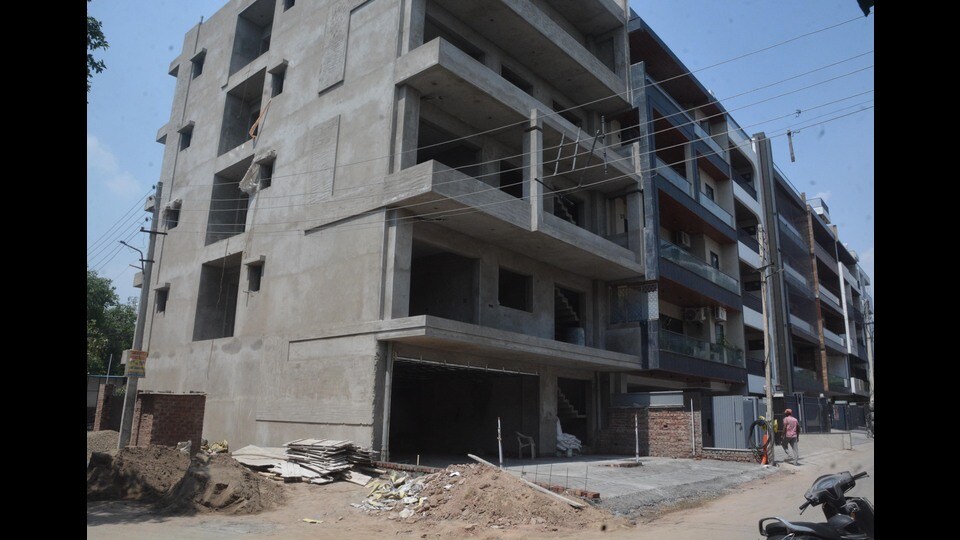
At the heart of the debate is a clash between urban density and the preservation of the city’s original character, a battle that is now playing out both on the streets and in the courtroom. The S+4 policy has followed an erratic trajectory, initially notified in 2019 and later suspended in February 2023 following widespread protests. Reinstated in July 2024 with revised conditions, it remains embroiled in controversy. The Punjab and Haryana high court is currently hearing a bunch of petitions challenging the notification, with a critical hearing scheduled for May 4—just six days before Panchkula goes to the polls.
City under strain
While an interim stay issued on April 2 currently applies exclusively to Gurugram following a spot inspection there, Panchkula residents are actively mobilising to secure a similar extension. Sources indicate that local resident welfare associations (RWAs) are compiling photographic evidence of congestion and structural risks to argue that Panchkula’s infrastructure is under the same unbearable strain cited by the court in the Gurugram case.
Across the city, the sentiment is that Panchkula’s vintage design—engineered for single-unit housing—is buckling under vertical expansion. SK Nayar, the president of the Citizens’ Welfare Association, points out that the existing backbone of the city is nearing a breaking point. Underground water pipelines, sewerage systems, and internal roads were never intended for the four-fold increase in occupancy that S+4 buildings bring.
This density has led to the chronic overloading of local transformers, resulting in frequent power fluctuations and overheating. Drainage systems are increasingly choked, and internal roads have become nearly impassable due to heavy roadside parking in areas where a single plot now houses four independent families. The opposition is particularly fierce in the older sectors 2, 4, 6, and 10 through 18, where residents argue that capacity norms are being recklessly exceeded.
Beyond the infrastructure, the environmental toll is visible in the heaps of construction and demolition waste lining the streets, obstructing commuters and fuelling dust pollution.
Personal cost, institutional response
For many, the policy has a human cost that transcends urban planning statistics.
For instance, Pramod Hans, a resident of Sector 11, alleges that his house suffered severe damage—including tilting walls and structural cracks—due to an S+4 project next door. Despite an inspection by a Punjab Engineering College (PEC) team confirming the damage was linked to the construction, Hans has yet to receive his estimated ₹35 lakh in compensation and has been forced to seek relief in court.
“With 11 family members living under this roof, our safety is at risk every day,” he says.
A Haryana Shehri Vikas Pradhikaran (HSVP) official, speaking on condition of anonymity, maintains that the department is managing the transition, noting that fewer than five new applications are now received monthly. The official claims that 95% of neighbour-related complaints are resolved amicably, often through compensation, and that empanelled structural engineers now oversee new builds.
However, for those living in the shadow of these structures, the definition of amicable remains a point of debate as the city moves toward a landmark election.
What the leaders say
Shyam Lal Bansal, BJP: Acknowledges that rising prices drive floor-wise ownership, but insists neighbours’ interests must be legally safeguarded.
Sudha Bhardwaj, Congress: Criticises the policy for ruining the city’s aesthetics, leading to parking woes and congestion in residential zones.
Manoj Aggarwal, INLD: Argues the policy has stripped the city of its character; suggests restricting such builds only to newly developing sectors.
Rajesh Kumar, AAP: Supports the residents’ opposition, stating that existing infrastructure is buckling under the pressure of increased density.


