
 E-Paper



PAU kisan mela: Climate resilient crop varieties to be in focus
Among wheat varieties, new recommendations comprising PBW Zinc 2, PBW RS 1 and PBW 826 will be the major highlight


Ludhiana: In a bid to promote climate resilient varieties and resource conservation technologies, various departments of Punjab Agricultural University (PAU) will put up stalls and hold field demonstrations during the kisan mela on September 14 and 15 to upgrade the knowledge and skills of farmers and enable them to reap substantial agri-economic rewards.
Among wheat varieties, new recommendations comprising PBW Zinc 2, PBW RS 1 and PBW 826 will be the major highlight. Besides, PBG 10 of chickpea, IPFD 12-2 of field pea and Ajmer Fennel 2 of fennel are some of the other new varieties which will be the area of focus, according to a press release issued on Wednesday.
Live demonstrations will be given on varieties of vegetable crops, techniques of nursery raising, resource conservation technologies, nutrition garden model, and integrated pest management in different crops.
In addition, exhibitions will be put up on in-situ rice straw management, mushroom cultivation, low tunnel and net-house technologies for vegetables, PAU fruit fly trap and termite trap, leaf colour chart, irrigation and drip irrigation techniques in orchards, establishment of disease free citrus nursery, system of layout of orchards, herbal gulal from petals of different flowers, and gladiolus varieties, cut foliage, dry and fresh flowers. Farmers will also be provided marketing tips for poplar and eucalyptus wood.
In agricultural engineering and processing, farmers will be apprised of PAU smart seeder, surface seeder, spraying system with unmanned aerial vehicle/drone, improved grain storage methods, mini rice mill, maize dryer, turmeric processing, agro-processing complex, honey processing and related equipment, onion storage structure and jaggery processing.
Apart from this, experts will explain vodka production from Kufri Pukhraj, red wine production from grapes, value addition of millets, value addition of button mushroom via paste preparation, low alcoholic carbonated beverages, and healthy and value added products.
Field demonstrations on surface seeding-cum-mulching, a low-cost and easy technique for paddy residue management, as well as dragon fruit cultivation (recommended varieties are Red Dragon 1 and White Dragon 1) will also be given. Thrust will also be laid on demonstrating biogas generation from paddy straw (dry fermentation), paddy straw bale geyser for heating water and large scale fixed dome type biogas plants for dairy farmers.
For the farm women, the College of Community Science will lay emphasis on balanced diet for family, right selection of foods for diabetics, use of millets in daily diet, checking adulteration in food products, standardisation marks for wise buying, drudgery reducing tools and judicious use of natural resources.
The mela will also witness competitions in crop produce, crocheting, preparation of decorative articles, preparation of nutritious products using millets and pulses, and drawing competition on “What is happiness for you?” for 8 to 12 years old children.
Rain disrupts preparations
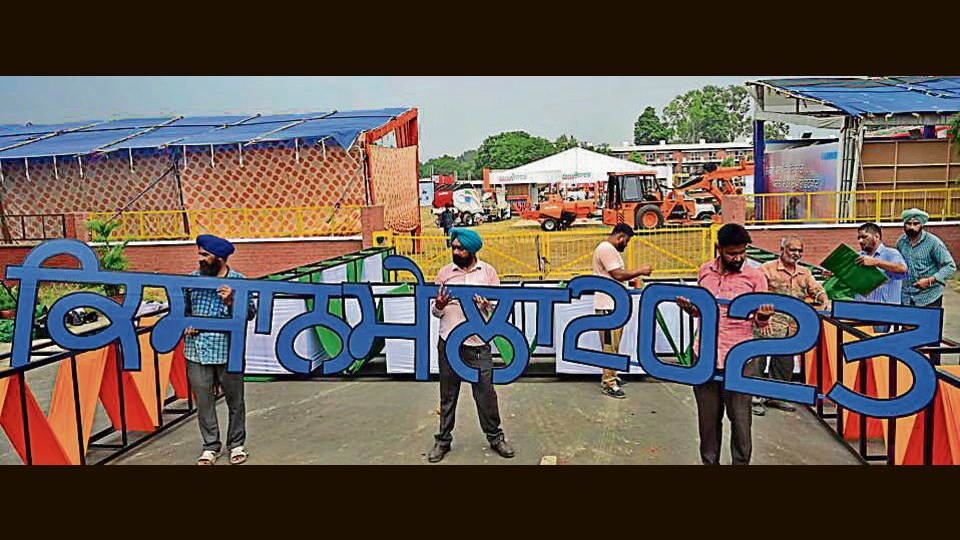
The preparations for the kisan mela were on Wednesday disrupted due to an unexpected downpour of 29 mm. This marks the third consecutive year that inclement weather threatens to mar the festivities of the event.
The untimely rain left stall owners grappling with last-minute challenges as they struggled to set up their booths. Adding to the woes, the kisan mela ground has been transformed into a muddy quagmire, making navigation within the venue a challenge. The sudden spell of rain has also caused a drop in temperature, with the maximum temperature plummeting to 34 degrees and the minimum to 23 degrees in the region.
In March, the bi-annual farm fair experienced incessant rainfall, resulting in low visitor turnout and financial losses for agricultural and veterinary entrepreneurs.
The Indian Meteorological Department’s Chandigarh observatory has issued a warning that the district is likely to experience more rain over the next two days.
“Cloud cover with the possibility of light to moderate rainfall is expected on Thursday and Friday. While chances of precipitation are at 60-80% on Thursday and they are expected to rise by Friday, making way for more rain on the second day of the mela,” warned IMD Chandigarh director Manmohan Singh.
Satbir Singh Gosal, PAU vice-chancellor, encouraged the farming community to participate enthusiastically in the mela. He highlighted the university’s crucial role in improving the socio-economic conditions of farmers through cost-effective technologies, support for agro-based industries, and generating employment opportunities for youth.


