The rural and suburban areas of Ludhiana, including Mullanpur and Dakha village, have been grappling with frequent and prolonged power cuts, adding to residents’ woes amid scorching heat.
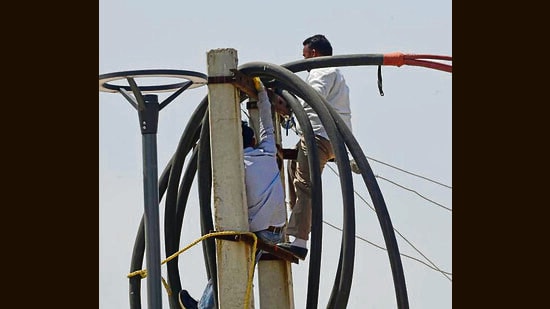
Residents said they have been facing power cuts for the past few days. One of the residents from Dakha village said people got a message from the Punjab State Power Corporation Limited (PSPCL) at 8.52 pm on Saturday night, informing them about a power cut till 11 pm. The same night, supply was again disrupted between 1.20 am and 3.30 am, he said. “Such a scenario has been a common sight,” he said.
In Mullanpur, residents said that electricity cuts affect water supply as well. A Dakha resident said, “Children and elderly are the worst affected.”
Power officials have said that rural and suburban areas are witnessing frequent outages due to load management issues and the ongoing maintenance work on feeders catering to high-demand zones. Compared to urban areas, which have relatively stronger infrastructure, village feeders are more prone to breakdowns and require shutdowns for repair and upgrades, particularly during peak demand.
A group of villagers said that the maintenance work should have been carried out in winter. “Why did they wait for summer? They should have planned it earlier,” they said.
The situation was further aggravated recently by a communication lapse from the power utility’s Patiala head office, highlighting how even minor errors can have a widespread impact. A power official, wishing not to be named, said an ambiguous message regarding “category-1” feeders (instead of specifying Ludhiana-1, Ludhiana-2, etc) led to confusion at multiple grid stations, resulting in outages being imposed across a wider area than intended. The shutdown was originally meant for select village feeders, but due to a lack of clarity, supply was disrupted in several parts of Ludhiana, he said, adding that the matter is being reviewed to avoid similar lapses in the future.
PSPCL chief engineer (central zone) Jagdev Singh Hans said efforts were underway to streamline the supply and reduce disruptions. “We are closely monitoring the situation and taking necessary steps to manage load effectively. Our teams are working to ensure better coordination and minimise inconvenience to consumers,” he said.
{{/usCountry}}PSPCL chief engineer (central zone) Jagdev Singh Hans said efforts were underway to streamline the supply and reduce disruptions. “We are closely monitoring the situation and taking necessary steps to manage load effectively. Our teams are working to ensure better coordination and minimise inconvenience to consumers,” he said.
{{/usCountry}}Four-hour outage in Noorwala, Tibba
Thousands of residents in Noorwala Road and Tibba areas faced a nearly four-hour power outage on Sunday. The supply remained disrupted from around 10 am to 2 pm.
Officials said the disruption was caused by a technical fault in the line connecting the 220 kV Jamalpur grid to the 66 kV Noorwala sub-station, leading to tripping of the Noorwala grid. As a result, seven feeders of the Tibba grid and 54 feeders of the Noorwala sub-station were shut, affecting a large area.
While the fault at the Jamalpur grid was rectified within about 20 minutes, restoration of supply was delayed due to limited staff availability, officials said.
Residents expressed anger over the prolonged outage, stating that the delay worsened the situation during peak heat and disrupted water supply and essential services.
PSPCL’s senior sub-station engineer YPS Bhullar said the fault was rectified and the electricity supply has been normalised in the affected areas.
It’s failure of management, says federation
The PSEB Employees Federation (AITUC) blamed the ongoing power cuts in the state on the “inefficiency” of the management, saying poor planning, not maintenance, is behind the crisis.
State secretary Gurpreet Singh Mehdoonda said prolonged outages have left people distressed, while anger is being unfairly directed at field staff. He further alleged that grid failures, staff shortages, and the ongoing work-to-rule have worsened the situation, with employees forced to work up to 12–16 hours daily without overtime. In several cases, feeders remain shut for hours due to a lack of staff at the grids.
The federation demanded immediate recruitment and regularisation of contractual staff besides acceding to other demands of the federation.