
 E-Paper



Punjab budget 2026-27: FM bets on women, growth with ₹2.6L cr outlay
Harpal Cheema presents ‘guarantee-fulfilling’ budget; women to get up to ₹1,500 monthly; education gets ₹19,279 cr; socio-economic survey on drugs from April.

 Prefer HTon Google


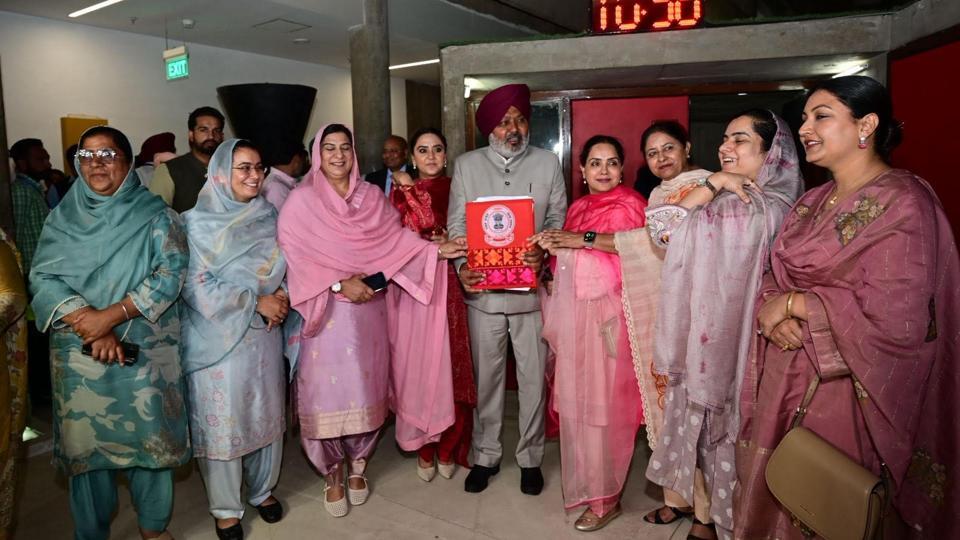
Punjab finance minister Harpal Singh Cheema on Sunday proposed a total budget expenditure of ₹2,60,437 crore for the 2026-27 fiscal, framing the proposals as a tribute to the “mothers and daughters” of the state. Coinciding with International Women’s Day, the budget—titled Saar Guarantuyan Puri Karan Wala Budget—aims to balance aggressive welfare spending with fiscal discipline in the run-up to the 2027 assembly elections.
Universal cash transfer for women
The centrepiece of the budget is the ₹9,300-crore Mukh Mantri Mawan Dhian Satikar Yojna, a direct benefit transfer scheme.
Under this initiative, the Bhagwant Mann-led Aam Aadmi Party government will transfer ₹1,000 per month to all adult women. For women belonging to the Scheduled Caste community, the monthly payout is set at ₹1,500.
The scheme is designed to be nearly universal, covering approximately 97% of all adult women in Punjab, the highest such coverage in India. The only exclusions are government employees, income tax payees, and current or former MPs/MLAs.
Women already receiving social security pensions (old-age, widow, or disability) will remain eligible for this additional benefit. “This will be the world’s first universal cash transfer scheme of this scale for women,” Cheema said.

Social welfare and power subsidy
The FM proposed ₹18,304 crore for the social welfare and justice , the highest-ever allocation for the department. This includes ₹360 crore for the Ashirwad Scheme and ₹261 crore for post-matric scholarships.
Notably, the proposed power subsidy has been scaled down to ₹15,550 crore, compared to ₹20,500 crore in the 2025-26 budget estimates, following a recent Punjab State Electricity Regulatory Commission order.
Infrastructure and rural development
To spruce up local infrastructure, the allocation for the Rangla Punjab Vikas Scheme has been doubled to ₹1,170 crore, providing ₹10 crore per assembly constituency across all 117 seats. In the rural sector, having upgraded 40,103 km of village roads, the government aims to complete the remaining 19,876 km at an estimated cost of ₹7,606 crore. ₹800 crore has been earmarked to cover one lakh houses under PMAY (Gramin), while ₹1,500 crore is allocated for the rural guarantee scheme.

Agriculture, health and education
Cheema announced ₹15,377 crore for agriculture and allied sectors, including ₹40 crore to promote direct seeded rice (DSR) to conserve groundwater.
In a major healthcare push, the FM allocated ₹2,000 crore for the Mukh Mantri Sehat Yojna, providing ₹10 lakh annual health cover per family. Another ₹1,220 crore has been earmarked specifically for the medical education and research sector.
To mark the 350th martyrdom anniversary of Guru Tegh Bahadur, the government announced a world-class university at Sri Anandpur Sahib, alongside a modern trauma centre and a dedicated Mother and Child Care Hospital in the holy city.
Additionally, 100 more Aam Aadmi Clinics are set to be established.
The education sector received a significant boost with an outlay of ₹19,279 crore, a 7% increase over the previous year.
Debt burden and growth
While the government eyes ambitious growth, the fiscal deficit is estimated at 4.08% of the GSDP, with the effective revenue deficit pegged at 2.06%.
Punjab’s outstanding debt is projected to hit ₹4,47,754.78 crore by March 31, 2027, up from ₹4,07,784.14 crore in the 2025-26 revised estimates.
The GSDP is projected to reach ₹9,80,635 crore in FY 2026-27, marking a 10% growth rate. The FM attributed this momentum to improved agricultural productivity and a resurgent services sector.
“These estimates reaffirm our resolve to combine responsible fiscal management with sustained support for economic growth,” Cheema noted, citing icons like cricketer Harmanpreet Kaur as symbols of the “strength and aspirations” the budget seeks to honour.
Addressing the state’s narcotics challenge, the budget also proposed a comprehensive Drug and Socio-Economic Survey to commence in April 2026.


