The Bhagwant Mann-led Aam Aadmi Party (AAP) government on Friday moved a resolution in the Punjab Vidhan Sabha condemning the BJP-led Union government for its “lack of response” and “failure” to sanction a ₹20,000-crore special financial package for the flood-ravaged state.
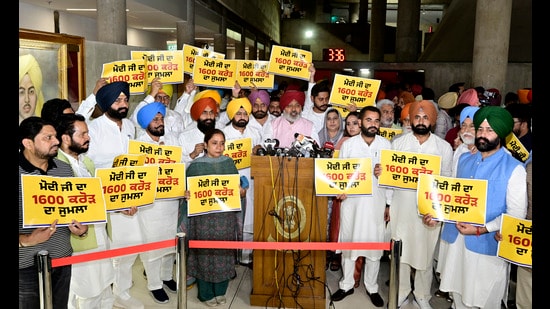
The resolution also condemned the Prime Minister’s Office (PMO) for “not responding to chief minister Mann’s repeated requests for a meeting” with Prime Minister Narendra Modi. The PMO’s lack of response had prevented the state from making a proper and comprehensive representation of the full scale of the disaster, it added.
The strongly worded official resolution on the “Insufficient, Belated and Undisbursed Relief Package from the Union Government” was moved by water resources minister Barinder Kumar Goyal on the opening day of the two-day special session convened by the state government to discuss flood relief and rehabilitation.
Immediate release of ₹1,600 crore sought
Describing the recent floods as the worst faced by Punjab, Goyal demanded a package of ₹20,000 crore from the Centre for relief and rehabilitation measures in the state. He expressed “profound dismay” at the announcement of a token relief package of ₹1,600 crore, calling it a cruel mockery of the state’s genuine demand of over ₹20,000 crore for a full recovery. “This financial assistance was a routine release and not an extraordinary grant. Punjab has not received anything from this amount so far,” he said, demanding immediate and full transfer.
The relief package was announced by PM Modi on September 9 after he conducted an aerial survey of affected areas and held meetings with political functionaries, top officials, and flood victims of the state. Ahead of Modi’s visit to Punjab on September 9, the ruling AAP and the opposition parties had raised expectations by pressing for a ₹20,000 crore relief package for the state, citing the enormity of the losses. They all had wasted no time in expressing disappointment with the PM’s announcement, terming it a “drop in the ocean.”
{{/usCountry}}The relief package was announced by PM Modi on September 9 after he conducted an aerial survey of affected areas and held meetings with political functionaries, top officials, and flood victims of the state. Ahead of Modi’s visit to Punjab on September 9, the ruling AAP and the opposition parties had raised expectations by pressing for a ₹20,000 crore relief package for the state, citing the enormity of the losses. They all had wasted no time in expressing disappointment with the PM’s announcement, terming it a “drop in the ocean.”
{{/usCountry}}The AAP government, in its resolution tabled in the state assembly, called upon the Union government to acknowledge the gravity of this disaster, revisit the assessed damages, and sanction a comprehensive and substantially enhanced special financial package of not less than ₹20,000 crore to support the farmers, rebuild the ruined infrastructure, and restore the livelihoods of the people of the state. Punjab faced its worst floods in decades, triggered by the swollen Sutlej, Beas, and Ravi rivers and heavy rainfall that has affected 2,300 villages. The death toll stood at 59, while crops on nearly five lakh acres were damaged.
Goyal said the natural disaster, regarded as the worst and most destructive deluge since the 1988 floods, which historically impacted over 34 lakh people, surpassed previous major flood events, including those in 1955 and 1978.
Goyal blames BBMB, IMD for floods
The water resources minister stated that the India Meteorological Department’s forecasts were way off the mark as the actual rainfall far exceeded predictions. “Such gross inaccuracies exposed negligence,” he alleged. He also blamed the Bhakra Beas Management Board (BBMB), which manages the dams, for the floods in Punjab and demanded that the management of dams should be transferred to the state government. “During such emergency situations, whenever we make requests to the chairman of BBMB, he calls meetings of all the states, including Punjab, Haryana, Rajasthan, and Delhi. Not all states attend, and important decisions get delayed,” he said.
Goyal added that all the members present in the House were aware of how the BBMB had treated Punjab. “When the Bhakra water level was at 1,660 feet, we requested them to start releasing water, but they said that it would be released once the level reached 1,665 feet. At times, immediate decisions have to be taken in critical situations,” he said, citing an example. He said that there were also questions raised about desilting not being carried out in the Beas River, but it was beyond the state’s jurisdiction. He claimed that the Beas River area was declared a Ramsar site in 2017 without consulting the water resources department, preventing even basic desilting or mining activity without central approval.
On the state government’s efforts, he claimed that river embankments were strengthened well in advance, breaches plugged in time, and flood protection works executed on a war footing. “Dhussi bandhs and embankments on Ravi, Beas, and Sutlej stood firm, while extensive channelisation on Ghaggar river prevented breaches for the first time in five decades, saved ₹400 crore in potential damages from Ghaggar alone. “At Khanauri, water remained at 750.7 feet for nine consecutive days, yet no breach occurred,” he added. He also expressed gratitude to all who stood by Punjab in the crisis, including leaders of different political parties, AAP national convener Arvind Kejriwal, ministers, MLAs, NGOs, and social organisations who reached out to affected people.