The humid season is when garden birds engage intensely with nesting and rearing young ones. The bulbuls, doves, tailor birds were tending to their little ones in our Chandigarh garden when all of a sudden some froze while others took to wing in intense flutters.
A caravan of mongooses appeared, a mother and two pups, and they scampered across the lawn and into the hedges where nests were cached in the lush foliage of monsoons. We marvelled at the “cuteness” of the frisky, perfectly obedient pups. The birds had other thoughts bedeviling their minds. There were now two more utterly ruthless, ugly monsters for bird parents to contend with. Birds and eggs are a favoured food of the mongoose, apart from serpents with whom the mongoose is so famously pitted against as an ace slayer.
While the Indian grey mongoose, also the state animal of Chandigarh, is commonly perceived as a creature belching perpetually on a bellyful of cobras, the mongoose is actually a generalist omnivore. Like the white-throated kingfisher, which can dwell and breed in the middle of cities without any fish in sight by feeding on rodents, lizards, insects and small birds, the mongoose adapts to human-altered landscapes and gobbles just about anything. Scorpions, grasshoppers, hens in the coop, carrion, roots, vegetation, berries, all service the mongoose’s palate. Mongooses can be found rummaging dustbins. On occasion, it drinks the blood of slaughtered prey.
A mongoose prefers taking on a cobra frontally. A hard, unwavering bite on the back of the hooded neck does the trick. A cunning predator, the mongoose knows that the frontal approach will not work with birds, which can fly and alight on the nearest tree to mock the salivating mongoose below. The mongoose stalks the bird on ground till it can lunge and grab. Mongooses follow burrowing prey and dig out the quarry with the long claws of the forefeet.
{{/usCountry}}A mongoose prefers taking on a cobra frontally. A hard, unwavering bite on the back of the hooded neck does the trick. A cunning predator, the mongoose knows that the frontal approach will not work with birds, which can fly and alight on the nearest tree to mock the salivating mongoose below. The mongoose stalks the bird on ground till it can lunge and grab. Mongooses follow burrowing prey and dig out the quarry with the long claws of the forefeet.
{{/usCountry}}A startling photographic record of mongoose hunts comes our way from unusual quarters. Avinash Sant, a Mumbai offset printer by profession and wildlife photographer by passion, took to wilderness voyages only after he turned 45. He joined the renowned NGO, the BNHS, and bought himself a camera and professional lens. His passion for wildlife is purely non-commercial and budded from a middle-aged awakening to know the names of the colourful avians that had for long frequented the peepul near his residence in Vile Parle, Mumbai.
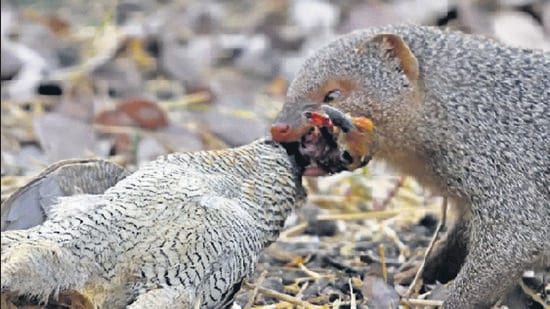
Sant’s tryst with the mongoose came while visiting Vadodara, Gujarat. A particularly adept mongoose had downed not one but two adult grey partridges / francolins (’teetar’). The teetar, like the mongoose, is restless and quick in the bush. Upon discerning danger, the teetar takes to wing with alacrity or scrambles with great speed to melt into bushes. But the mongoose had proved quicker and wilier. Sant aimed his lens at the smug mongoose dragging away the teetars.
The ‘blood is my passion’ shikari gave the camera a chilling look with its beady, piercing eyes and menacingly flashed its dreaded Dracula dentition.
vjswild1@gmail.com