
 E-Paper



Chandigarh sees 35% increase in dog bite cases in five years
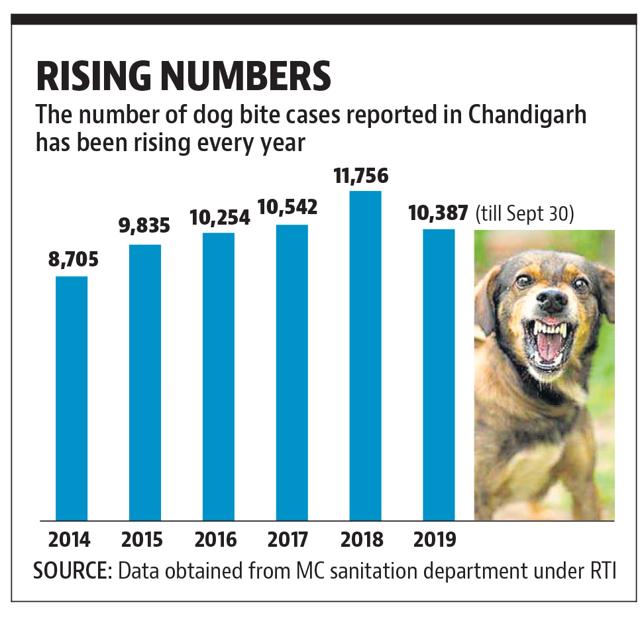
The MC’s sanitation department recorded 8,705 dog bite cases in 2014, which increased to 11,746 in 2018


The number of dog bite cases in Chandigarh has gone up by 35% in five years amid the municipal corporation failing to find a solution to the rising stray dog population.
The MC’s sanitation department recorded 8,705 dog bite cases in 2014, which increased to 11,746 in 2018 (see box). The figure has already touched 10,387 till September 30 this year and is likely to cross the last year’s figure.
Even as the civic body held a national conference on dog menace a month ago, it has not yet adopted any of the recommendations suggested by experts in its animal birth control programme meant to check stray dog population and bite cases.
The increase in dog bite cases has also coincided with the increase in stray dog population. It has gone up by 65% in seven years in Chandigarh, as highlighted by HT last month. According to the latest animal census conducted by the UT animal husbandry and fisheries department, the number of stray dogs has reached 12,900 in 2019, up from 7,847 in the last census conducted in 2012.
The MC’s dog sterilisation programme, too, lacks continuity and aggressiveness.
It is suspended since June this year due to the civic body’s inability to hire a new agency after the contract with the previous firm was scrapped due to operational hazards.
UT adviser Manoj Parida on Wednesday laid the foundation stone of a new dog sterilisation centre in Raipur Kalan.
Planned to be much bigger than the current facility in Sector 38, it will take at least a year to become operational.
In the national conference on September 28, the MC was asked to follow the sterilisation drive aggressively. Experts such as Dr Charan Kamal Singh of Guru Angad Dev Veterinary and Animal Sciences University, Ludhiana, and Major General RM Kharb (retd), former chairman of the Animal Welfare Board of India, told the civic body to focus only on sterilising female dogs and change its dog catching techniques.
They also stressed on the need for skilled dog catchers, paramedical staff and veterinary doctors for proper sterilisation. There were suggestions to limit the availability of food in neighbourhoods, which is vital to control dog population. Waste management was also said to be a key to controlling canine population as scattered garbage is natural food for dogs.
Even UT administrator VP Singh Badnore asked the MC to incentivise citizens to adopt stray dogs. However, the MC has failed to adopt any of these suggestions.
MC commissioner KK Yadav said: “We have noted all the suggestions and are in the process of implementing them.”
Baljinder Singh Bittu, president, Federation of Sector Welfare Associations of Chandigarh, said: “The MC spent more than ₹12 lakh on this conference. It will turn out to be a sheer wastage of public money if the civic body fails to adopt the suggestions of experts to reduce canine population and dog bite cases.”


