Uttarakhand chief minister Pushkar Singh Dhami on Tuesday expressed concern over the rising incidents of human-wildlife conflict in the state, and directed officials to immediately complete hotspot mapping of sensitive districts, blocks and villages and take more effective steps to reduce such conflicts.
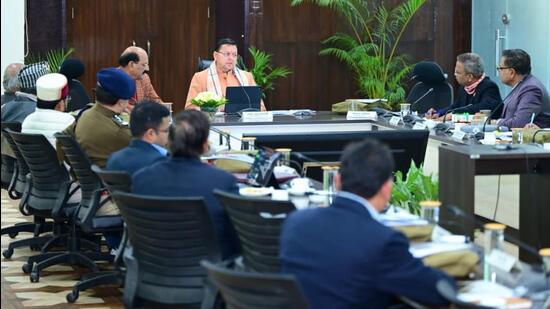
Chairing the 22nd meeting of the Uttarakhand State Wildlife Board at the secretariat, the chief minister said protecting human life and property, along with wildlife conservation, remains the government’s top priority. He instructed the forest department and district administration to ensure a joint and coordinated monitoring mechanism in areas prone to conflict involving bears, leopards, tigers and elephants.
Dhami directed that regular patrolling, digital surveillance and early warning systems must remain fully operational in vulnerable areas. He also instructed officials to mandatorily install solar fencing, bio-fencing, honey bee fencing, watchtowers and other protective measures in affected villages. Awareness camps should be organised to sensitise residents about safety and vigilance, while rapid response teams must remain on constant alert, he said.
Stressing the importance of wildlife corridors, the chief minister said conservation of all corridors, including elephant and tiger corridors, should be accorded top priority. He directed officials to strengthen the system for constructing animal passes, underpasses and overpasses along wildlife movement routes. Dhami also asked departments to review existing wildlife conservation rules and provisions and submit proposals for amendments, if required, at the earliest.
{{/usCountry}}Stressing the importance of wildlife corridors, the chief minister said conservation of all corridors, including elephant and tiger corridors, should be accorded top priority. He directed officials to strengthen the system for constructing animal passes, underpasses and overpasses along wildlife movement routes. Dhami also asked departments to review existing wildlife conservation rules and provisions and submit proposals for amendments, if required, at the earliest.
{{/usCountry}}The CM further directed that district-level Wildlife Coordination Committees, chaired by district magistrates, should be kept active. He instructed officials to strengthen safety arrangements around schools, Anganwadis, water sources and pedestrian routes. Emphasising solid waste management, Dhami said strict implementation in rural areas is essential to prevent bears and other wild animals from being attracted to human settlements.
To strengthen eco-tourism and reduce pressure on wildlife habitats, the chief minister said development work should be undertaken not only in reserve forests but also in wildlife sanctuaries and conservation reserves. He also directed that veterinarians be deployed in territorial forest divisions to respond promptly to wildlife emergencies and conflict situations.
During the meeting, the state wildlife board approved nine proposals related to forest land transfer. These included four diverse drinking water schemes and two drinking water projects in the Kedarnath Wildlife Sanctuary in Rudraprayag district, two motor road projects linked to the Rajaji National Park area, and one optical fibre project related to the Ramnagar forest division. Additionally, 22 proposals related to minor mineral extraction within a 10-km radius of protected areas were decided to be referred to the National Wildlife Board for consideration.
Forest minister Subodh Uniyal said the decisions taken in the meeting represent a comprehensive and forward-looking approach towards balancing wildlife conservation with human safety and will further strengthen Uttarakhand’s wildlife management system.
Giving details of action taken on decisions of the 21st meeting, principal chief conservator of forests Ranjan Kumar Mishra said the Standing Committee of the National Wildlife Board has approved several major projects, including redevelopment of Chaurasi Kutia, the first phase of reconstruction works for damage caused by the disaster at Mansa Devi Temple and its access road, the Rishikesh-Neelkanth Mahadev ropeway project, and special renovation of the Laldhang–Chillerkhal forest motor road.
Mishra said wildlife management plans for 56 forest land transfer proposals were approved for the period from July to December 2025, while no-objection certificates were issued for 29 proposals. He added that the ex-gratia compensation for human deaths caused by wildlife attacks has been increased from ₹6 lakh to ₹10 lakh. As many as 93 quick response teams have been constituted across 32 forest divisions for prompt action on human-wildlife conflict, and approval has been granted to send a proposal to the Central Zoo Authority for setting up wildlife rescue centres in Pithoragarh, Champawat and Rudraprayag.