E-Paper



In a first, Uttarakhand forest dept conducts seed ball broadcasting using a drone
The broadcast seeding method involves scattering seeds by hand or mechanically, over a relatively large area

 Prefer HTon Google


The forest department‘s research wing of Uttarakhand successfully conducted seed ball broadcasting, a first of its kind in the country, on Monday using a drone in the landslide-affected areas, in Manora Range of Nainital Forest Division.
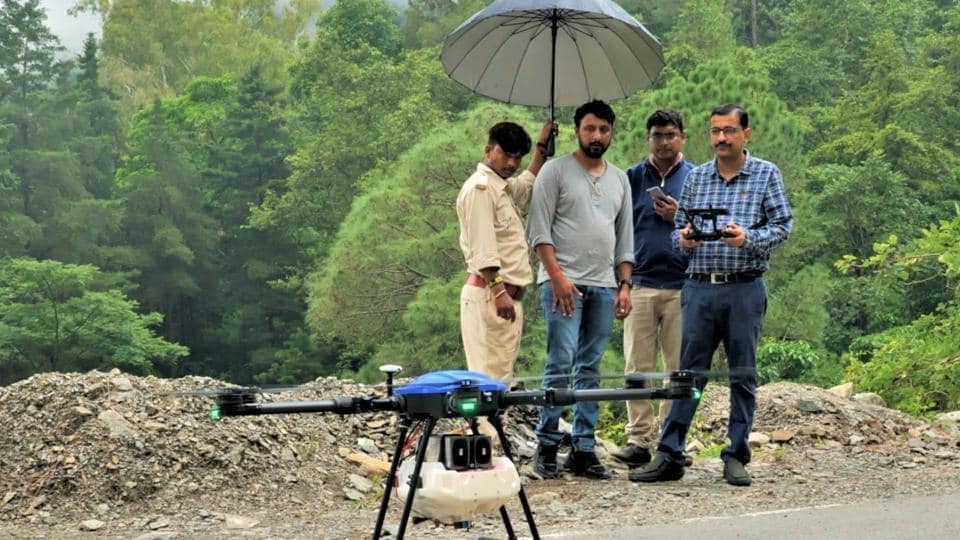
The broadcast seeding method involves scattering seeds by hand or mechanically, over a relatively large area. When such seeds germinate and grow, their roots hold onto soil, checking soil erosion and this increases the slope stability of a landslide-prone hillside.
Also Read: Landslide mitigation experts conduct inspection of cracks in Nainital
Kundan Kumar, deputy conservator of forests (research wing) said for the first time in the state, around 500 seed balls of five different native species including Bauhinia retusa (Kaunal), Coraria nepalensis (Makol), Debregeasia longifolia (Tusyari) and Bamboo have been broadcasted in the heavily landslide affected area in Manora Range of Nainital Forest Division.
“This innovative initiative aims to restore and revitalise the vegetation in the affected region, which has been impacted by landslides. By employing drone technology to distribute seed balls, the Research Wing of Uttarakhand Forest Department is taking a proactive step towards ecological restoration and conservation efforts. Regular monitoring will also be carried out to assess the germination and survivability of these species”, he said.
“The soil erosion and unstable terrain hinder successful seed germination and plant growth. Seed ball broadcasting offers a unique advantage in such environments, as it allows seeds to be dispersed more effectively across large areas, even on inaccessible or unstable terrain”, he said
Kumar said the project was approved by the forest department’s Research Advisory Committee (RAC) in 2021 with two primary objectives.
“First to reforest vast stretches of inaccessible and denuded hill slopes especially southern aspects using drones and second to find the most suitable species and method for reforestation for inaccessible sites by making comparison with traditional methods”.
“This progressive approach not only accelerates the natural regeneration process but also aids in preventing soil erosion and maintaining the ecological balance of the region. Additionally, it serves as a model for sustainable conservation practices that can be applied in other inaccessible areas, promoting biodiversity and the overall health of the forest ecosystem”, he added.