
 E-Paper



Uttarakhand cabinet approves tabling of Uniform Civil Code Bill in Assembly
The Dehradun district administration has imposed Section 144 CrPc within a radius of 300 metres of the Uttarakhand assembly building during the four-day House session beginning on February 5

 Prefer HTon Google


The Uttarakhand cabinet on Sunday gave its approval to table the Uniform Civil Code (UCC) Bill in the state assembly during the four-day House session beginning on February 5, officials aware of the matter said.
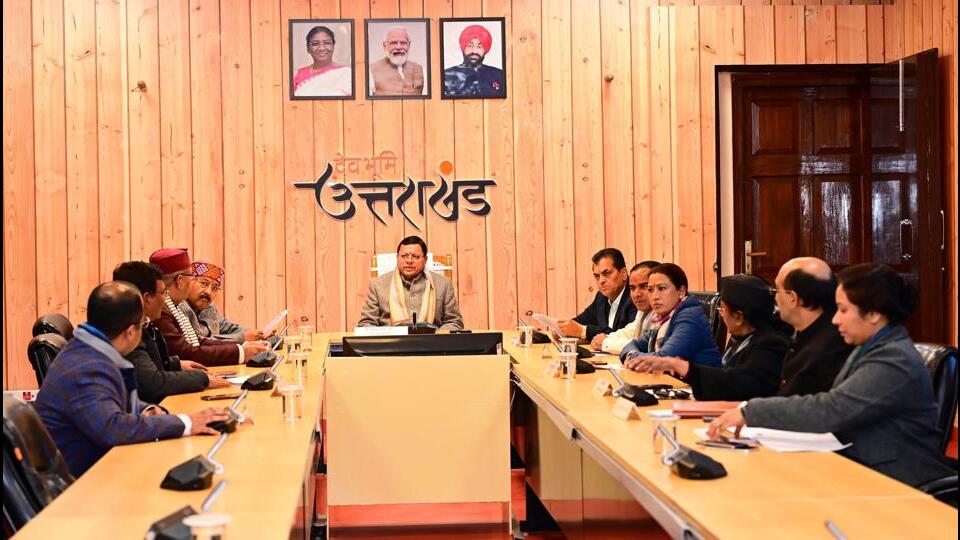
The meeting, which started around 6.30pm, went on for nearly an hour, during which the UCC draft was discussed, and it was decided that the bill will be tabled in the forthcoming assembly session, said officials.
Earlier in the day, an all-party meeting was called by Vidhan Sabha Speaker Ritu Khanduri Bhushan for the smooth conduct of the session.
Meanwhile, the Dehradun district administration has imposed Section 144 CrPc within a radius of 300 metres of the Uttarakhand assembly building during the House session. “Violation of the order will be punishable under Section 188 of Indian Penal Code (Disobedience to order duly promulgated by public servant),” Dehradun district magistrate Sonika said. On Friday, additional director general of police (law and order) AP Anshuman had directed the district police in charges (SSPs and SPs) to be on alert in view of the possibility of protests and demonstrations by some organisations against the introduction of UCC in the state assembly .
Yashpal Arya, senior Congress leader and leader of Opposition (LoP) in the Uttarakhand assembly, said, “The committee constituted by the state government on UCC has submitted its draft to the chief minister. Neither the draft report has been made public nor has the chief minister given any official statement. It will be too early to comment on UCC and comprehend the government’s intention without examining the report.”
“The committee wasn’t formed on the orders of the Vidhan Sabha. Therefore, the government should have made the UCC draft report public to allow the people of the state to study the committee’s report and provide their feedback on it. We can only react on the issue if the state government tables the bill on UCC during the upcoming session,” he said.
The draft Uniform Civil Code for Uttarakhand could not be taken up for discussion at the state cabinet meeting chaired by chief minister Pushkar Singh Dhami on Saturday. Giving reasons for the same, Dhami told reporters, “Many important issues were discussed in the cabinet meeting today. We will bring UCC in the upcoming assembly session (Feb 5-8). Right now, UCC report is being examined and required formalities are being completed with regard to it. After that, we will have another cabinet meeting and then the draft will be tabled in the assembly.”
On Friday, a five-member committee formed for UCC submitted its draft report to Dhami at his residence. The report was handed over to CM by Ranjana Desai, a retired judge of the Supreme Court and chairperson of the Committee. Other members of the committee who were present included Pramod Kohli, retired judge, Manu Gaur, social activist, Shatrughan Singh, retired IAS officer and Surekha Dangwal, vice-chancellor of Doon University. The committee submitted its report after studying relevant laws regulating personal civil matters of residents of Uttarakhand and suggested changes in existing laws on the subject that include marriage, divorce, property rights, succession/inheritance, adoption, maintenance, custody and guardianship.
UCC refers to a common set of laws that will subsume customary laws across faiths and tribes and govern issues such as marriage, divorce, inheritance and maintenance. In the Constitution, it is a part of the non-justiciable directive principles of state policy. In the run-up to the state assembly elections in February 2022, chief minister Dhami had announced that implementation of UCC would be the first decision of the Bharatiya Janata Party (BJP)-led government if voted to power.
The decades-old demand for UCC is tied to India’s complex system of personal laws that are often tied to community-based rules and customs, especially for religious minorities. A UCC, in theory, will implement homogenous rules for marriage, divorce, inheritance, financial compensation and adoption, among others, for all communities but many activists and experts fear that this may obliterate the customs and traditions of particular communities, such as tribals, and become a proxy to target their faiths.
In the Constitution, UCC is a part of the non-justiciable directive principles of state policy. In a 2018 consultation paper, the law commission said UCC was “neither necessary nor desirable at this stage”. Last year, the Law Commission again sought views and suggestions on UCC from the public and recognised religious organisations.
In June last year, Prime Minister Narendra Modi while speaking to BJP booth workers made a strong case for UCC. But almost immediately, several tribal communities in both central India and the Northeast started protesting. Uttarakhand’s law is also expected to be the blueprint for other states such as Gujarat and Assam that have promised to implement UCC.
Uttarakhand has 13.9 % Muslim population, according to 2011 census, mostly in the Terai area.


