
 E-Paper



A contrasting tale of Delhi’s two postal relics: Gol Dak Khana, Civil Lines
Gol Dak Khana’s Lutyens-era grandeur returns under INTACH’s care, but the Civil Lines post office, built in the 1850s, is left to crumble.

 Prefer HTon Google


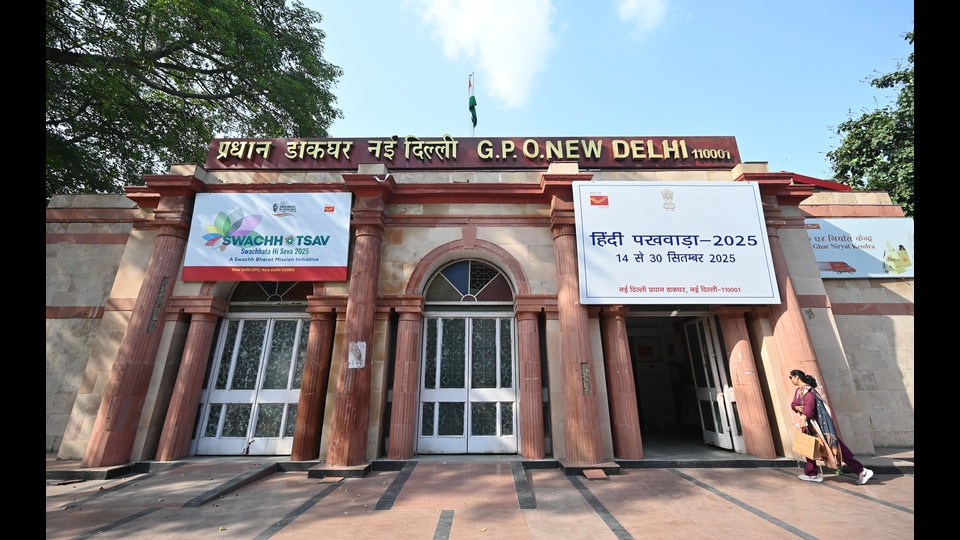
Delhi’s postal heritage tells two starkly different tales. At Gol Dak Khana, artisans breathe new life into the colonial-era landmark, restoring its grandeur brick by brick. But in Civil Lines, another historic post office lies in decay — crumbling, forgotten, and left at the mercy of time.
-------
Gol Dak Khana: The rebirth of a landmark
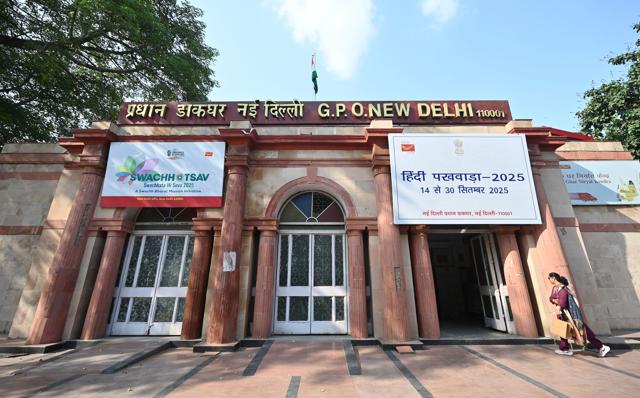
At rotary number 50, where five arterial roads of central Delhi intersect, stands Gol Dak Khana, a circular landmark that has long anchored the city’s postal memory. Even today, as honking cars swirl around the iconic structure, the colonial-era New Delhi General Post Office (GPO) continues to function – its staff sorting parcels and letters while navigating a mesh of scaffolding pillars holding the roof of the building.
But, for the first time in decades, Gol Dak Khana is undergoing a full-scale restoration. The Indian National Trust for Art and Cultural Heritage (INTACH), entrusted with the project, is reviving the building brick by brick, arch by arch, carefully stripping away decades of what experts have said have been “careless repairs”.
Alexandra Place
Built in 1934 as Alexandra Place, the complex once housed the Viceroy Camp Post Office, the nerve centre of colonial communication. Designed by Robert Tor Russell – the famed architect behind Delhi’s iconic structures such as Connaught Place and Teen Murti Bhavan – it was part of Edwin Lutyens’ grand plan for New Delhi. Over time, however, Russell’s original architectural finesse was buried under decades of haphazardly executed repairs – cement plastering, patchwork roofing, and makeshift additions to the historic structure.
Spread across 9,000 square metres, Gol Dak Khana is not just a single building (as it appears to drivers from the outside) but 12 interconnected blocks, including a central hall, staff quarters, and the Director’s Bungalow. The complex became synonymous with PIN code 110001, which originated here and remains a critical anchor for ministries and offices in central Delhi.
On a recent visit by HT, the Director’s Bungalow – a Lutyens-style structure located within the complex – had recently been given new lime plaster, restored terrazzo floors, and waterproofed tiled roofs. Chimneys and fireplaces, once neglected, now stand renewed. The garden adjacent to the bungalow, once residence to colonial officers and later postal directors, will be landscaped and replanted as a final touch.
“Earlier agencies used cement, bitumen, and waterproofing sheets that trapped moisture and worsened decay,” said an official. “We’ve removed all of that and gone back to traditional materials -- lime mortar, terracotta tiles, and breathable surfaces -- to restore the structure the way it was originally meant.”
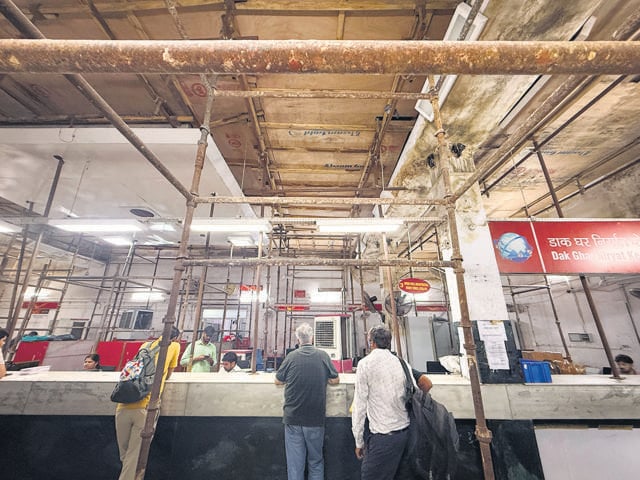
The main circular block, meanwhile, is still a work in progress. A dozen craftsmen strip away layers of cement to reveal Russell’s original form. Inside, relics from postal history – cast-iron letter boxes from princely states, pressing machines, filing cabinets – await their place in a refurbished museum. “We have a large collection of postal artefacts, and the idea is to showcase them here,” said a senior officer at the GPO.
A living post office
Unlike many heritage sites, Gol Dak Khana is no relic. It remains a bustling post office handling savings accounts, postal insurance, thousands of parcels, and millions of letters daily. Restoration is being carried out block by block to avoid disrupting busy operations.
The vision is not limited to fixing roofs and walls. INTACH plans to restore the library, revive the clubhouse, landscape gardens, and add guest facilities. A heritage-sensitive roofing system – layered with brick tiles, waterproofing, and concrete – is being laid to ensure long-term stability.
The project is also about civic memory. For decades, Gol Dak Khana was a social hub – where people came not only to mail letters but also to meet, fix appointments, and use the limited telephones available.
“This is not just about saving a building,” an INTACH official stressed. “It’s about preserving Delhi’s story. Gol Dak Khana was at the heart of the city’s communication. Its restoration gives it a future while honouring its past.”
Today, as artisans apply lime punning on domed ceilings and workers landscape colonial gardens, Gol Dak Khana is poised for a second life -- a rare instance of conservation where heritage is being treated not as a relic, but as a functional and living part of the city’s life.
---------------------------------------------------
Civil Lines Post Office: A story of decline
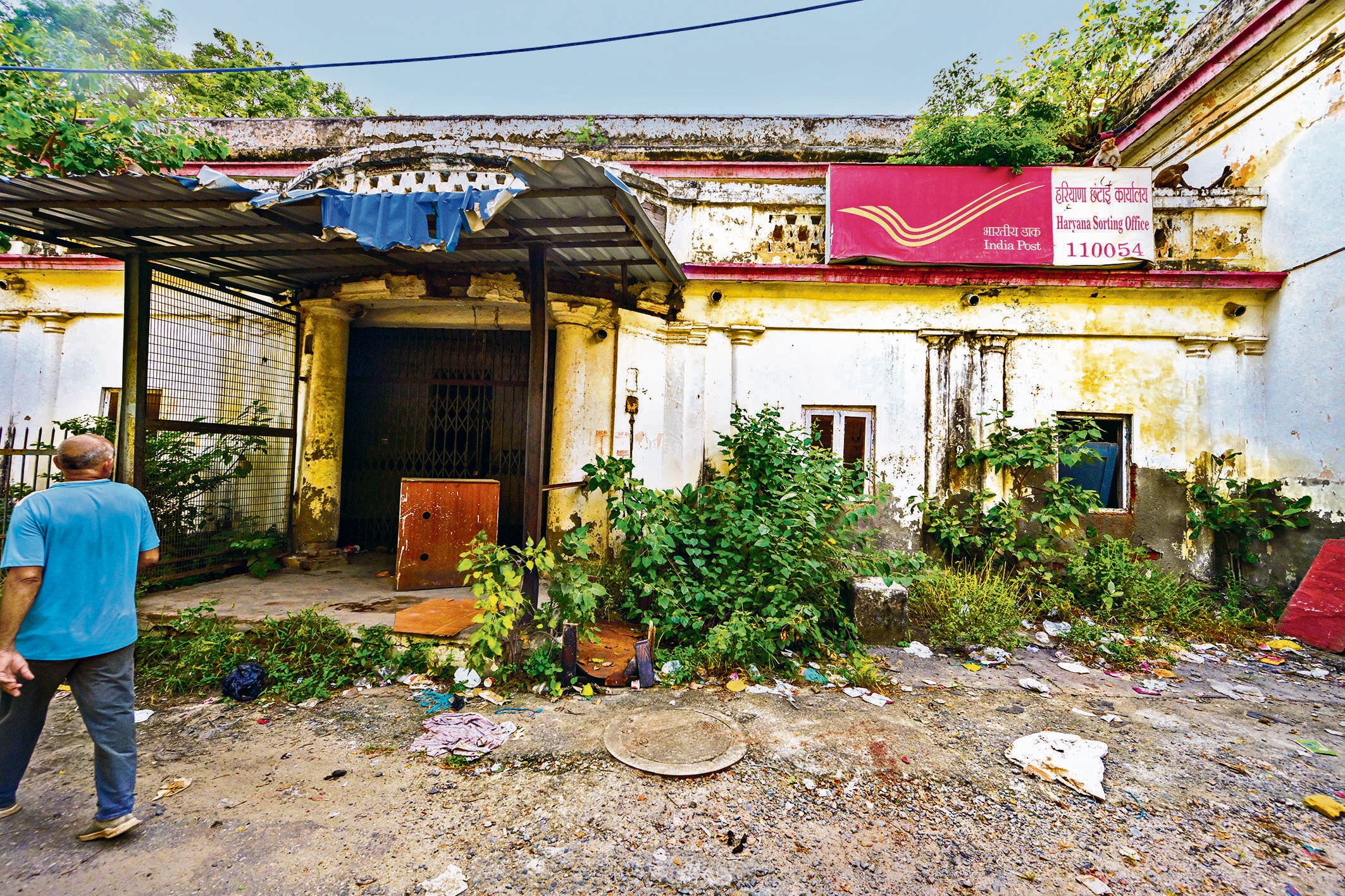
Gol Dak Khana represents revival, the situation at the Civil Lines Post Office illustrates decay. Tucked near Shamnath Marg, close to the Delhi Assembly in north Delhi, this building is a 19th-century structure, a rare specimen of early colonial dispatch architecture, where European building styles were adapted to local conditions.
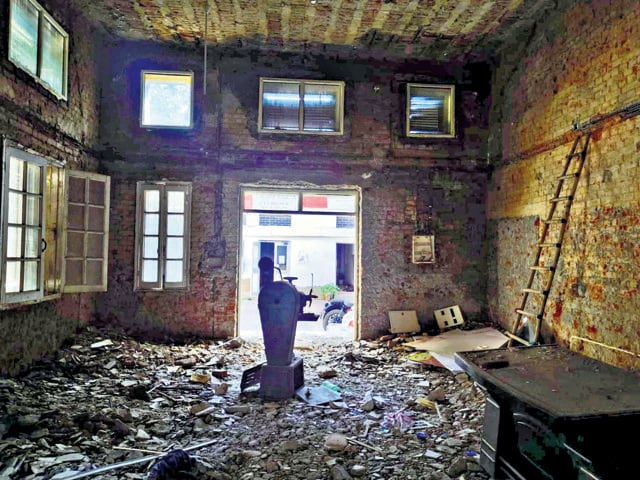
It once relayed mail between Metcalfe House and the Imperial Council. Today, it lies abandoned – its façade crumbling, arched entrance falling apart, roof collapsing in parts, and some of its yellowed blocks entirely overtaken by wild growth.
Built in the 1850s, the Civil Lines Post Office was among the earliest postal stations of colonial Delhi. Its proximity to Metcalfe House and the British military camp at Civil Lines made it an important part of the colonial bureaucratic machinery. But once a new building came up in the 1920s, the old structure was relegated to use as a guest house. Eventually, it was deserted altogether.
For decades, locals said they have seen the structure slip into ruin.
“We have referred to it as ‘Bungalow No 3’, or simply as the ‘bungalow’. We have never seen it open in the past five decades. It may have served as a postal station in the 19th century. While we were kids, very senior officers of postal services used to be allotted this complex,” said Ashok Kumar, a long-time resident.
Now, its roofs are caving in, lithophyte trees sprout from its walls, and its verandahs are overrun with jungle growth.
‘At risk’
INTACH has placed the building in its “Heritage at Risk” category, warning that it is a rare specimen of early colonial postal architecture.
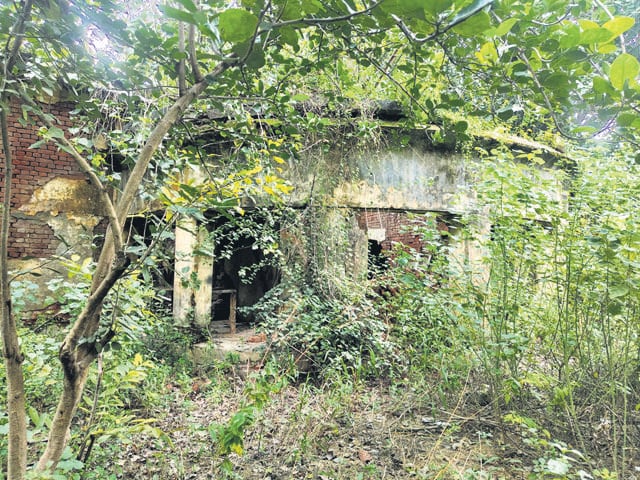
“The old post office is from the 1850s… It is a rare example of early colonial style, which has survived till date in its original design. Its proximity to Delhi’s Vidhan Sabha and Metcalfe House also suggests its importance. The structure is abandoned and requires urgent attention… It has high potential for adaptive reuse owing to its historical value and locational advantage,” the entry noted.
Yet no restoration plan has been announced.
Even the newer 1920s Civil Lines Post Office, still operational, is deteriorating.
Employees at the India Post Station of Civil Lines (Pin code: 110054) said that several of the offices have been moved to the building next door as some repair work is being carried out. Bulk sorting of mail is caried out here, as the building still acts as the central processing centre. During the spot check, HT saw that several portions of the building have become dangerous, are locked away and filled with waste. Heaps of garbage are stacked in alleys and rear end.
Employees admit bulk sorting continues here, but many offices have already shifted next door. “Some parts of the building are too unsafe to use,” one postal worker said.
Contrast with Gol Dak Khana
The neglect of Civil Lines stands in stark contrast to the efforts at Gol Dak Khana – only 9 kilometres away. While INTACH and the postal department are investing crores to restore the latter, the former languishes with no signs of intervention.
Heritage experts warn that without immediate attention, Delhi could lose one of its earliest postal relics forever. According to historian and author Swapna Liddle, the best restoration stories are those where historic structures are not only repaired but continue to serve the purpose they were originally designed for. “Post office buildings, for instance, are living heritage, surviving examples of a particular era. Since they are still in use, keeping them in good condition is a sustainable choice, far better than letting them decay until they are beyond repair, only to demolish and rebuild. Such restoration ensures continuity, both in function and in history,” Liddle added.
As Delhi invests in restoring some of its colonial landmarks, others like Civil Lines Post Office quietly fade, their history swallowed by weeds and neglect. Once a proud dispatch centre, today it stands on the verge of vanishing.

Stay updated with all top Cities including, Bengaluru, Delhi, Mumbai and more across India. Stay informed on the latest happenings in World News along with Delhi Election 2025 and Delhi Election Result 2025 Live, New Delhi Election Result Live, Kalkaji Election Result Live at Hindustan Times.


