E-Paper



‘Almost severe’ days in Delhi this November highest ever
Numbers suggest that without a natural clean-up from favourable meteorological factors, Delhi does not have any plan to control pollution.


Was this the most polluted November in recorded history in Delhi?
Yes and No.
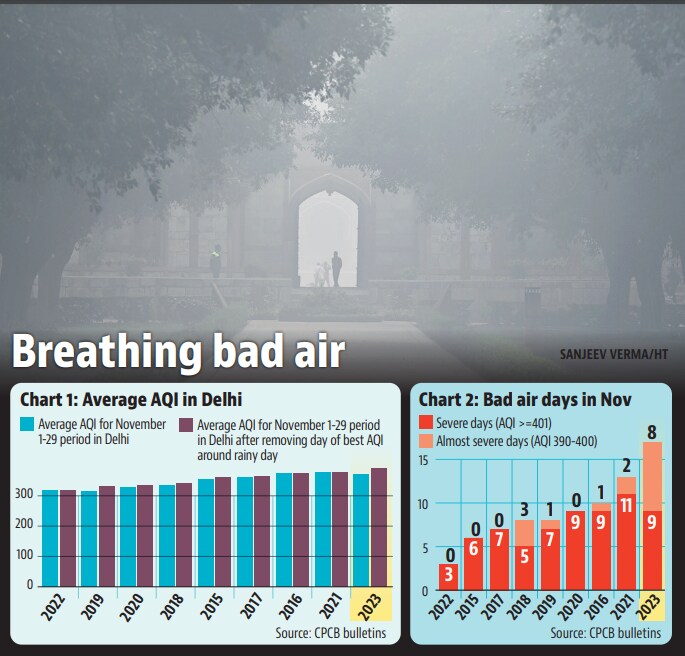
Delhi’s average air quality index (AQI) between November 1 and 29 this year was 372, making this the third most polluted November since 2015, the earliest year for which the Central Pollution Control Board (CPCB) has published daily AQI bulletins. But remove the good AQI days on account of rain and the average AQI reading for November 2023 jumps up to 390, just short of “severe”, making it the most polluted November in recorded history.
More than anything, these numbers suggest that without a natural clean-up from favourable meteorological factors, Delhi does not have any plan to control pollution.
The numbers speak for themselves. Delhi’s average AQI between November 1 and 29, 372, ranked third behind 2016 (373) and 2021 (378). But November 2023 was the rainiest November in Delhi since 2015, both in terms of amount of rainfall and the number of days it rained (2023 is tied with 2019 here). November 2023’s average AQI of 372 is significantly worse than the average AQI reading of 334 for November 2018 which was the second rainiest November in terms of rainfall since 2015.
What would pollution levels look like if it had not rained at all? One way to answer this question is to take out the low AQI (less polluted) days coinciding with rainy days . November 2023’s average AQI jumps to 390 after doing this adjustment, which makes it the most polluted November since AQI has been measured for the Capital.
See Chart 1
The spells of rain seen this month — first between November 9 and 10 and more recently, on Monday and Tuesday, managed to help bring down the AQI to “poor” both times, helping the average AQI improve too, papering over what has been a relentless spell of toxic air caused by unfavourable meteorological conditions, which have trapped both local and external emissions over Delhi for a sustained period of time.
Till Monday, Delhi’s monthly average AQI stood at 377. This fell following rain earlier this week. Data shows the first spell of rain came just at the right time — on November 9 and 10, helping Delhi snap a streak of eight consecutive days of 390+ AQI between November 2 and 9. This included this month’s highest average AQI reading of 468 on November 3.
The rain helped the 24-hour average AQI drop from 437 (severe) on November 9 to 279 (poor) the next day. Delhi recorded another two “poor” air days consecutively. An average AQI of 220 on November 11 and 218 on November 12. However, Delhi was then hit by firecracker emissions from Diwali, sending the AQI rapidly to “very poor” and then “severe” again.
Between November 13 and 27, as farm fires raged in Punjab and calm winds trapped local pollutants, Delhi’s 24-hour average AQI oscillated between “very poor” and “severe”, remaining over 300 and giving Delhi another nine days of 390+ AQI, with Monday’s spell of evening rain helping bring down the AQI below 300 again. Delhi’s 24-hour average AQI on Tuesday was 312 (very poor); it was 290 (poor) on Wednesday.
Experts said even though on paper, the AQI may be lesser than 2021 and 2016, people still faced long spells of high exposure, highlighted by the sheer number of 390+ days.
“This also shows that if there was no rain this month, Delhi would have faced a much worse Diwali too, as we saw a significant improvement in AQI just before this festival. Without this latest spell of rain too, Delhi was struggling to let go of its pollution, which had accumulated over the capital and was simply not dispersing.” said Sunil Dahiya, analyst at the Centre for Research on Energy and Clean Air (CREA).
IMD data shows Delhi had recorded 17.7mm of rainfall till Wednesday – nearly three times the monthly normal monthly average mark of 6mm. This is the highest rainfall total in November since 2010, when 26mm was recorded in November that year.
Mahesh Palawat, vice president at Skymet meteorology, said it was an unusual November, with only two western disturbances recorded, but with both being fairly active. “Usually, we see three to four western disturbances in November but they are less active and lead to drizzle at most. Both spells this time have brought widespread rain and the intensity was stronger,” he said.
The Capital has recorded nine “severe” air days this month — when the AQI has been over 400, but it has also recorded another eight days when the AQI has been on the brink of severe — an AQI between 390 and 400. Delhi, thus, has recorded 17 days of near “severe” or “severe” air this month — the highest number of such days since 13 of them were recorded in November 2021 and 11 in November 2016, CPCB data showed.
See Chart 2