
 E-Paper



Barely standing: The Wall of Walled City
Originally made of mud, the wall was rebuilt in red sandstone in 1657. But centuries later, what survives is scattered, stressed, and scarred.

 Prefer HTon Google


New Delhi : In the mid-seventeenth century, when Mughal emperor Shah Jahan shifted his capital from Agra to the banks of the Yamuna, he imagined a city secure enough to guard an empire and grand enough to project its splendour. Thus, Shahjahanabad, the so-called seventh historic city of Delhi, was born enclosed within a formidable 13-metre-high, six-kilometre stone-and-rubble wall. With 13 monumental gateways and 14 smaller wicket gates punctuated this fortification, sealing the city’s boundary between what chroniclers often described as “civilisation and wilderness,” order and the chaotic world outside.
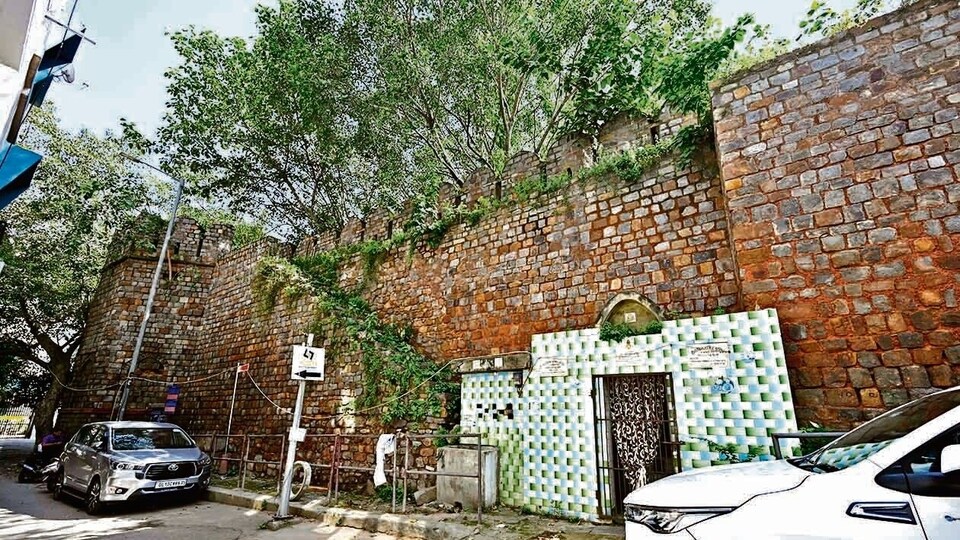
Originally made of mud, the wall was rebuilt in red sandstone in 1657. But centuries later, what survives is scattered, stressed, and scarred. Its decline started with the British conquest, and continues under civic neglect, unchecked construction, and layers of everyday urban life pressing against its stones.
Today, last stretch of the fortification still standing, the Daryaganj section – often described as the best preserved – stands in distress. During a spot check along the 1.4-km stretch, HT found sections falling apart, rubble spilling onto parked scooters, and portions swallowed by careless urban growth. Makeshift temples nestle into its arches. Electricity transformers lean against the stone. Hospital visitors sit in waiting areas carved out of ancient recesses of the wall.
Near a printing unit, a worker Rajeev Dubey points to a jagged hole in the structure where a large section fell during the monsoon. “Thank God no one was standing there. Only vehicles were damaged. But the next part could fall anytime. It needs reinforcement,” he said.

That was three months ago, but the rubble remains uncollected.
Along Ansari Road, the Mughal arches are barely visible behind heaps of construction debris, old bicycles, metal cabinets, and discarded furniture. Some arches are used as parking bays or sitting areas for patients from a nearby hospital. Others have been turned into informal gaming dens where men play cards. A police post, a milk booth, and a small temple cling to the structure like parasitic fixtures along with garbage dumps, urinals, and other encroachments.
All of this has happened despite the wall being a protected monument under the Archaeological Survey of India (ASI). Its boards warn of fines and jail time for violators. Enforcement, however, has been irregular at best. A senior municipal official said that while several encroachment-removal drives have taken place, “the problem is recurrent,” and violations return almost immediately.
The dismantling of Shahjahanabad’s walls began soon after the Revolt of 1857, when British forces, fearing the city could once again become the centre of rebellion, sought to ensure it could never serve as a military stronghold against the crown. At Kashmere Gate, the scars of the siege remain – there are cannonball marks in the wall, a memorial plaque, and the fractured fragments of what was once the city’s northern gate. Here, in 1857, British troops blew up sections of the gate during their suppression of the rebellion.
Several other gates vanished more discreetly. Mori Gate, once positioned near Nicholson and Hamilton Roads, survives, but only in name – the bus terminal and the road still bear its name.
Kabuli Gate, demolished in 1873 to give way to new infrastructure, has disappeared entirely, subsumed by the wholesale markets. Whatever remained of its foundations was eventually swallowed by 20th-century construction.
In his book Delhi Between Two Empires (1803–1931), historian Narayani Gupta traces the post-1857 transformation of the wall. In February 1858, a few months after reclaiming the city, British military authorities ordered that Delhi’s walls be demolished, viewing them as a security threat. But administrators like Sir John Lawrence opposed the decision, arguing about the monumental labour and gunpowder required to bring it down. In practice, soldiers and labourers began manually removing stones – slowly – possibly as a way to stall.
By late 1858, the British reversed course, deciding to retain major portions of the wall along with the surrounding ditch and a cleared open zone for surveillance. The wall’s function changed for the first time: no longer a defensive structure for a Mughal city, it became an administrative boundary. Poet Mirza Ghalib noted in 1858 that structures outside the wall were ordered demolished to keep the area clean and open for military movement.

In the decades that followed, pressure to modernise Delhi created a constant tug-of-war over the wall’s survival. The cramped inner city needed new roads, and the expanding settlements outside the walls required access to the city proper. In 1881, British urban planner Robert Clarke advocated demolishing the Lahori Gate and parts of the wall to improve connectivity between Sadar Bazar and Shahjahanabad. Military authorities argued for preserving sections like Kashmere Gate for historical reasons, but the municipal committee eventually approved demolitions.
In 1888, the committee cleared the proposal to bring down the Lahori Gate and adjacent wall near Khari Baoli. A communication preserved in the Delhi archives records the justification: “The whole of the grains traffic of Delhi… is concentrated immediately inside the Lahore Gate… Cabul [Kabul] and Mori Gate have long since been removed… The Lahore Gate, which it is now proposed to demolish, has no historical interest in connection with the mutiny and no architectural pretensions.” The wall and gate were demolished on “sanitary grounds” and for the “retiring of traffic”.
These decisions set into motion the gradual, almost inevitable erasure of the fortifications – one that accelerated when colonial officials like H.C Beadon oversaw expansion schemes between 1912 and 1919. This included demolishing stretches from Kabuli to Ajmeri Gates and filling the ditch that had once circled the city. New roads – Burn Bastion Road, Jhandewalan Road – were carved out to enable Delhi’s transformation into a British capital. The shift marked a turning point: the city’s growth was no longer organic, but directed by state planning, sweeping away centuries-old layers of the Mughal city.
Author and city chronicler Sohail Hashmi said that several parts of the wall and gates were taken down because of the expansion of the city and changes brought out after the railways came in the 1860s. “Muslim residents who had any connection with the fort were also being hounded after 1857. They were asked to move out and the government would grant certificates regarding the size of the properties so they could get a commensurate property somewhere else. I do not believe the wall was torn down for security purposes. The Britishers did not have anything to fear from after 1857 and the Capital was also in Calcutta.”
Hashmi said that, before 1857, the Britishers had in fact strengthened the walls and gates. “After the 1803 battle of Patparganj, when Britishers subdued the Marathas, they were concerned that the Marathas would reground and attack which led to strengthening of the city defences. There are clear additions to Turkman Gate, Delhi Gate and Kashmiri Gate and wall section which were added to allow cannons and their movement.”
After Independence too, the wall continued to vanish. In the 1950s, Delite cinema in today’s Daryaganj was built on a plot that once held part of the wall. Its founder, Brij Mohan Lal Raizada, constructed it in response to Jawaharlal Nehru’s call for new landmarks in Delhi – and the cinema rose at the cusp of Old and New Delhi only after a portion of the old wall was cleared.
“Post-Independence,” Hashmi said, “Nehru also wanted the separation between the two cities (old and new Delhi to go) when projects like Delite cinema and buildings along the Asaf Ali road came up and the wall was removed.”

A wall under siege
During HT’s spot check, the wall’s slow unravelling was visible throughout. Lithophyte trees – plants that embed themselves in stone crevices – have taken root deep inside the rampart. Their roots pry apart stones and accelerate the decay. Near a Martello Tower – one of the many British-era lookout post built after the 1857 rebellion – a large garbage dump spills against the wall’s base. At another spot, the wall serves as a back wall a home, its surface plastered over and hidden under paint.
Construction has also increased the load on the ancient stonework. Sewage water leaks through several joints, further weaking it. In August, three labourers died when a building collapsed along the wall in Daryaganj. A large hole created by that collapse now stands covered with green tin sheets – again no sign of any repair in sight. Up north, portions of the wall near the Outer Ring Road have been lost entirely – cleared for roads, drains, or simply razed for reasons not remembered by officials or locals today.
Near Nigambodh Ghat, another section recently crumbled. A relatively intact stretch between Nicholson Road and Kashmere Gate survives, but it too bears the scars of encroachment, garbage dumping, and piecemeal stone removal. Behind ISBT, remnants of the wall appear intermittently, interrupted by decades of road-widening and development. Despite being a designated heritage structure, much of the wall today exists outside sustained conservation – protected in principle, but abandoned in practice.
Gates like Mori, Kabuli, and Lahori now survive primarily as names, while Ajmeri, Turkman, and Delhi Gates remain relatively well preserved. Even so, the invisible line of the vanished wall continues to define perceptions of “Old Delhi” and its cultural geography.
More than stone
Historian M Mujeeb, in his biography of Mirza Ghalib, wrote that the city wall once stood “as a bulwark of culture against surrounding barbarism,” marking the oasis of Shahjahanabad against the wildness beyond. The wall, he said, is not just a remnant of Mughal engineering, it’s a chronicle of Delhi’s evolution, its resistance, and its evolutions into modernity.
Narayani Gupta notes that the wall “created a sense of community that cut across communal and class groups. The texture of the circumvallation was as much of the spirit as it was of stone and mortar. Time and again, from Bernier to Abdul Hai, observers have commented on how the people of Delhi were unconcerned with anything beyond their walls. With this came a profound love for the city.”
Hashmi said the periphery still continues to define the life and identity of the Shahjahanabad. “The area within the 13 gates was and still continues to be the Old Delhi. When even the families who have lived from generations in areas like Mehrauli, refer to going to ‘Shahar’ it means this area which was enclosed by wall.”
But what survives today barely qualifies as a wall – it is a fragmentary marker, battered by time, eroded by century neglect. Yet in these fragments lies the story of Delhi itself: the rise of an imperial capital, its violent occupation, its reinvention as a colonial city, and its transformation into a modern metropolis. A wall that once protected a world now needs protection from the world that grew around it.
An official from the Archaeological Survey of India said they will check if the said portion falls under their jurisdiction and will accordingly assess the damage.


Stay updated with all top Cities including, Bengaluru, Delhi, Mumbai and more across India. Stay informed on the latest happenings in World News along with Delhi Election 2025 and Delhi Election Result 2025 Live, New Delhi Election Result Live, Kalkaji Election Result Live at Hindustan Times.


