Coldwave conditions continued in Delhi for the second consecutive day, with Safdarjung, Delhi’s base station, recording a minimum temperature of 3.8 degrees Celsius on Friday morning, while Lodhi Road recorded a minimum of 4 degrees Celsius.
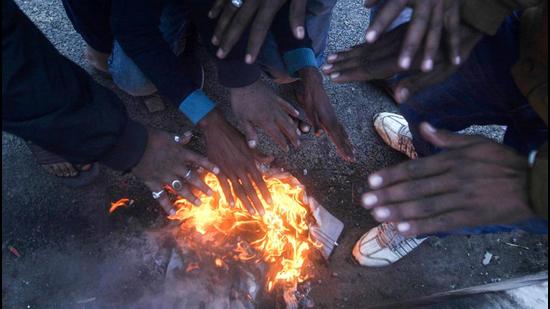
The India Meteorological Department (IMD) declares a coldwave in a region when the minimum temperature is 4.5 degrees Celsius or more below the normal mark, or when it drops to 4 degrees Celsius or lower. Three Delhi stations-- Safdarjung (3.8 degrees Celsius), Lodhi Road (4 degrees Celsius) and Ayanagar (4 degrees Celsius) met IMD’s criteria for a coldwave on Friday.
According to IMD, isolated parts of Delhi could experience coldwave conditions over the next two days as well, with the minimum temperature expected to hover around 4 degrees Celsius, before a gradual rise in temperature from January 3 onwards. This cold spell also pushed Delhi’s air quality back into the “very poor” category, with an Air Quality Index (AQI) reading according to the Central Pollution Control Board’s 4pm bulletin. Delhi recorded an AQI reading of 286 (poor) on Thursday.
An AQI reading between 101 and 200 is considered “moderate”, 201 and 300 “poor”, 301 and 400 “very poor”, and 401 and 500 “severe”.
{{/usCountry}}An AQI reading between 101 and 200 is considered “moderate”, 201 and 300 “poor”, 301 and 400 “very poor”, and 401 and 500 “severe”.
{{/usCountry}}“Cold northwesterly winds are blowing towards Delhi and the minimum temperature is expected to hover around 4 degrees Celsius. Isolated parts of Delhi may experience a coldwave in the next two days as well, before the temperature starts to rise once again from January 3,” said RK Jenamani, scientist at IMD.
He says a fresh western disturbance is also expected to bring light rain to Delhi on January 5 and 6, by which time the mercury will have risen to 7-8 degrees Celsius. “The minimum could touch 6 degrees Celsius by January 3, and will gradually rise to around 8 degrees Celsius due to this western disturbance. A drizzle is expected on January 5 and light rain is expected in Delhi on January 6,” he said.
The Capital recorded a maximum temperature of 19.4 degrees Celsius – one degree below normal for this time of the season. It had recorded 19.5 degrees Celsius on Thursday.
Meanwhile, Delhi ended December with an average AQI reading of 336 for the month, slightly higher than last year’s average reading of 331 for December. In 2019, Delhi recorded an average AQI reading of 337, according to CPCB data. This year, there were seven “severe” air quality days as compared to four in 2020 and eight in 2019.
Forecasts by the System of Air Quality and Weather Forecasting and Research (Safar), a government body, show air quality is expected to rise further in the next three days, however, it is unlikely to touch “severe”.
“Prevailing coldwave conditions in the north-west region, including Delhi, with moderate winds blowing from the west/north-west direction are degrading the air quality. New Year celebrations on the night of December 31 may increase emissions and worsen AQI, but the net effect is likely to keep the AQI within the ‘very poor’ or the higher end of the ‘very poor’ category for the next three days,” said Safar on Friday.
Stay updated with all top Cities including, Bengaluru, Delhi, Mumbai and more across India. Stay informed on the latest happenings in World News along with Delhi Election 2025 and Delhi Election Result 2025 Live, New Delhi Election Result Live, Kalkaji Election Result Live at Hindustan Times.
Stay updated with all top Cities including, Bengaluru, Delhi, Mumbai and more across India. Stay informed on the latest happenings in World News along with Delhi Election 2025 and Delhi Election Result 2025 Live, New Delhi Election Result Live, Kalkaji Election Result Live at Hindustan Times.