Majnu ka Tilla, Chittaranjan Park and Lajpat Nagar are neighbourhoods where houses are islands of culture, building a certain cosmopolitanism in Delhi. These neighbourhoods make me feel proud of my city — a city that always found a place for communities in exile. Tibetan in one, Bengali in another, Afghan in the third, none of it native to Delhi, and all of it now inseparable from the city. This is what an architecture of care looks like in a city of the Global South, where displacement usually hardens into slums or ghettos. Delhi has managed neither, largely because the state allotted land or allowed settlement to continue long enough for people to build, trade, marry and stay.
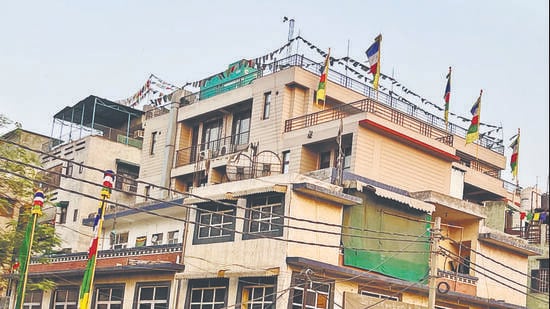
The Majnu ka Tilla/New Aruna Nagar settlement dates to 1963, when Jawaharlal Nehru asked state governments to find land for Tibetan refugees following the events of 1959. Roughly 1.2 acres on the Yamuna’s bank were allotted at what is now called New Aruna Nagar. For close to two decades it had no formal water connection or sanitation. Research on the residents welfare association, formed in 1965, shows how the settlement’s leadership shifted its language over time — from temporary refuge to a working claim on land, services and continued presence, all while remaining legally undocumented, since India is not a signatory to the 1951 Refugee Convention.
That history is why the neighbourhood looks the way it does now. Because tenure was never secure, growth went upward rather than outward: a single-storey shack became three floors over three decades, with the ground floor turned into a shop, café or guesthouse. The bridge into the settlement is strung year-round with prayer flags in five colours. Momo counters, laphing carts and shops selling chanting beads and pirated Tibetan films run right up to the monastery walls, with no real threshold between worship and commerce. Second- and third-generation Tibetans have grown up in a neighbourhood that functions as a permanent temporary settlement and a fully integrated part of the city.
Chittaranjan Park is a well-established Bengali neighbourhood. Its origin goes back to an association for refugees from East Bengal formed in 1954 by government officers displaced by Partition, lobbying for a colony of their own. That lobbying produced the East Pakistan Displaced Persons Colony, allotted through the DDA on rocky, undeveloped land in south Delhi in the early 1960s and renamed Chittaranjan Park in the 1980s.
{{/usCountry}}Chittaranjan Park is a well-established Bengali neighbourhood. Its origin goes back to an association for refugees from East Bengal formed in 1954 by government officers displaced by Partition, lobbying for a colony of their own. That lobbying produced the East Pakistan Displaced Persons Colony, allotted through the DDA on rocky, undeveloped land in south Delhi in the early 1960s and renamed Chittaranjan Park in the 1980s.
{{/usCountry}}The contemporary neighbourhood still runs on the logic of that original allotment. It is organised in blocks, and each block maintains its own RWA and its own Durga Puja committee — B Block, Mela Ground and Cooperative Ground stage three separate pujas rather than one shared event. Research argues that the ritual sustains the memory of an East Bengal that no longer exists, functioning as a kind of architecture rebuilt every year. The same continuity shows up in the neighbourhood’s four markets, where residents gather each evening for adda, and in the fish market, which has kept a supply chain for Bengali freshwater fish running for over 50 years. What began as a state resettlement scheme is now one of Delhi’s most self-governing cultural enclaves.
Lajpat Nagar was built in 1947 for Partition refugees from Punjab. A second wave of displacement arrived here from the late 1970s, as the Soviet invasion of Afghanistan sent successive groups of Afghan refugees toward Delhi, most settling in and around Lajpat Nagar II. Research examines this community through social boundaries: where Afghans can live, work, shop and eat, and how those boundaries mark the community off from the rest of the city even as its economy runs through it.
Those boundaries are legible in the built environment. A few lanes east of the central market, shopfronts carry their names twice — in English and in Dari script. Naan bakeries open from 8am, and general stores stock chilgoza and dried dates alongside soap and biscuits. Like the Tibetans of Majnu ka Tilla, most Afghans here hold no formal refugee status under Indian law; UNHCR registration is the only documentation many have. What they have built instead, on rented floors above an existing Punjabi colony, is Little Kabul: restaurants with a dastarkhwan spread on the floor, guesthouses for patients travelling from Kabul, and a nearby hospital that keeps a Dari-language desk specifically for them. It is a second use of the same rooms, made possible because the first community had already made the space livable.
In each case, the sequence is the same: a legal or administrative act of allotment, followed by decades in which the community, not the state, did the actual work of building a life. None of these are documented refugee settlements, and none are slums. They sit in a category Delhi has made room for again and again: displaced people who arrived from elsewhere in Asia, built houses that turned into economies, and were left alone long enough to become permanent. That is the older, harder version of the city’s cosmopolitanism — built on care rather than display — and it has produced a more interesting Delhi than the one usually put on show.
Anica Mann works on archaeology and contemporary art in Delhi. The views expressed are personal
Stay updated with all top Cities including, Bengaluru, Delhi, Mumbai and more across India. Stay informed on the latest happenings in World News along with Delhi Election 2025 and Delhi Election Result 2025 Live, New Delhi Election Result Live, Kalkaji Election Result Live at Hindustan Times.
Stay updated with all top Cities including, Bengaluru, Delhi, Mumbai and more across India. Stay informed on the latest happenings in World News along with Delhi Election 2025 and Delhi Election Result 2025 Live, New Delhi Election Result Live, Kalkaji Election Result Live at Hindustan Times.