Delhi’s air quality deteriorated sharply for the fourth consecutive day on Monday, pushing the city into the “very poor” category for the first time this season and prompting the Commission for Air Quality Management (CAQM) to invoke Stage 2 of the Graded Response Action Plan (GRAP) across the National Capital Region (NCR).
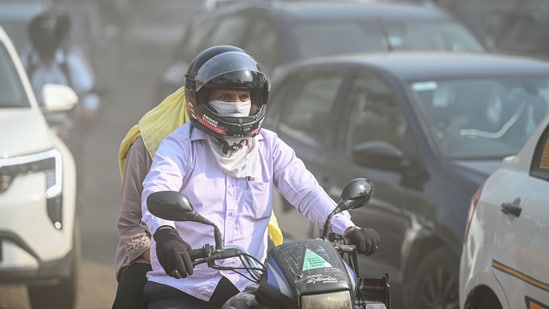
The city was enveloped in a thick haze less than a week before Diwali, when firecracker emissions could further worsen pollution levels.
Delhi recorded an air quality index (AQI) of 324 at 4pm on Monday, down 63 points from Sunday’s 261, but a staggering 264-point deterioration from Friday, when the AQI was 60 in the “satisfactory” category.
Monday’s reading was the worst in 271 days, since February 4, when the city recorded an AQI of 339 (“very poor”).
CAQM, in a statement on Monday, said that its Grap sub-committee reviewed the air quality situation, along with forecasts from the India Meteorological Department (IMD) and the Indian Institute of Tropical Meteorology (IITM), and decided to invoke Stage 2 to prevent further deterioration.
Also Read | Delhi's AQI crosses 300 for first time this season, more smog expected in coming days
{{/usCountry}}Also Read | Delhi's AQI crosses 300 for first time this season, more smog expected in coming days
{{/usCountry}}“The air quality index (AQI) has further increased owing to unfavourable meteorological conditions. The forecast … has also predicted AQI to remain ‘very poor’ in coming days,” the commission said in a statement.
Under Stage 2, the Delhi government and NCR state governments have been directed to stagger office timings for government and municipal employees in Delhi and the districts of Gurugram, Faridabad, Ghaziabad and Gautam Buddha Nagar.
Other measures include higher parking fees to discourage private vehicle use and ensuring resident welfare associations (RWAs) provide electric heaters to security staff to prevent open burning. These measures are also part of Delhi’s winter action plan, which came into effect on November 1.
According to Delhi traffic police, a total 8,263 vehicles were checked, 37 challaned, two impounded, and 1,228 returned in border checks on Monday.
The Delhi Metro Rail Corporation (DMRC) announced 20 additional weekday train trips from Tuesday, taking the total number of additional trips across its network to 40. The move is aimed at encouraging commuters to use public transport, it said.
Also Read | Delhi air quality takes a nosedive ahead of Diwali, anti-pollution curbs kick in
Of the 58 monitoring stations for which data was available, 39 recorded “very poor” air quality and three reported “severe” air. Jahangirpuri was the most polluted, with an AQI of 442.
An AQI between 301 and 400 is classified as “very poor”, while readings above 400 fall in the “severe” category.
The worsening air comes as stubble burning in the neighbouring states gathers pace. NASA satellite data detected 1,394 farm fires in Punjab and Haryana between October 1 and November 1 — 1,249 in Punjab and 145 in Haryana. Of these, 171 were recorded on November 1. The corresponding count over the same period last year was 1,861. The actual number of fires could be higher, as the satellite passes over the region at around 1.30pm and may miss subsequent burning, officials said.
Meteorologist Navdeep Dahiya said stubble burning in Punjab and Pakistan was intensifying, with northwesterly winds carrying smoke plumes towards Punjab, Haryana, Delhi-NCR and Uttar Pradesh. Relatively calm winds and the landlocked geography of the northern plains were also contributing to the pollutants, he said.
Dahiya warned that air quality across the region could deteriorate further, with the first “severe” AQI reading possible within three days. Smog was likely to intensify during night and morning hours, he said, advising people, particularly children and the elderly, to limit outdoor exposure.
Also Read | Delhi Metro to run 20 more trips on weekdays as GRAP-II curbs kick in amid worsening pollution
The Air Quality Early Warning System forecast that Delhi’s air would remain “very poor” on Tuesday and from November 3 to 5, with conditions likely to range between “poor” and “very poor” over the subsequent six days.
Weather conditions are also expected to remain unfavourable for dispersal. IMD said Delhi recorded a maximum temperature of 29.5°C on Monday, one degree below normal, and a minimum of 16.4°C, 1.1 degrees above normal. Shallow fog was reported at Safdarjung airport, where visibility fell to 800 metres between 6.30am and 7.30am.
Stay updated with all top Cities including, Bengaluru, Delhi, Mumbai and more across India. Stay informed on the latest happenings in World News along with Delhi Election 2025 and Delhi Election Result 2025 Live, New Delhi Election Result Live, Kalkaji Election Result Live at Hindustan Times.
Stay updated with all top Cities including, Bengaluru, Delhi, Mumbai and more across India. Stay informed on the latest happenings in World News along with Delhi Election 2025 and Delhi Election Result 2025 Live, New Delhi Election Result Live, Kalkaji Election Result Live at Hindustan Times.