The latest assessment of groundwater data from states and union territories for 2023, carried out by the Central Groundwater Board (CGWB), showed that the number of “safe” tehsils in Delhi has gone up between 2022 and 2023, and the number of zones classified as “over-exploited” has dipped. The report, however, flagged that Delhi drew almost all the water that was available to be extracted last year, making the extraction rate 99.13%, which was marginally higher than that of 98.16% recorded in 2022.
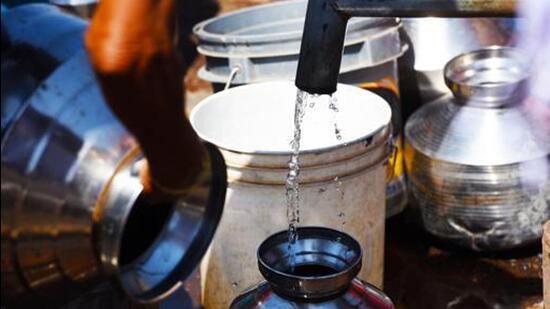
Groundwater extraction over 100% means more water is being extracted than it is being recharged. If the figure is below 100%, then it indicates that significant amount of groundwater is being left unutilised. The extraction rate was 101.4% in 2020 and an alarming 119.6% in 2017, the report said, adding that Delhi still made progress in recent years.
Out of the 34 tehsils in Delhi, 13 were classified as “over-exploited” in 2023, down from 15 recorded in 2022, the report said.
The number of safe tehsils now stands at five, as compared to four in 2022, the report added, calling for Delhi to further improve its water conservation practices.
This comes at a time when Delhi is grappling with a water crisis, relying largely on water supply from neighbouring Haryana to fulfil its water demands.
Data showed that the net annual groundwater recharge for Delhi in 2023 was 0.38 billion cubic metres (bcm) and of which 0.34 bcm was available for extraction. Out of this, 99.13% or almost the whole amount of water was extracted. In comparison, 0.41 bcm was recharged in 2022, with 0.37 bcm being available for extraction. In 2022, 0.36 bcm of water was drawn from the ground.
{{/usCountry}}Data showed that the net annual groundwater recharge for Delhi in 2023 was 0.38 billion cubic metres (bcm) and of which 0.34 bcm was available for extraction. Out of this, 99.13% or almost the whole amount of water was extracted. In comparison, 0.41 bcm was recharged in 2022, with 0.37 bcm being available for extraction. In 2022, 0.36 bcm of water was drawn from the ground.
{{/usCountry}}“Out of 34 assessment units (tehsils), 13 units (38%) have been categorized as ‘over-exploited’, 12 units (35%) as ‘critical’, four units (12%) as ‘semi-critical’, and 5 units (15 %) as ‘safe’ categories of assessment units,” the data added.
Assessment units are categorized as “safe” when the extraction rate is less than 70%, “semi-critical” when it is between 70% and 90%, “critical” when it is between 90% and 100% and “over-exploited” when it is over 100%, CGWB said.
The report further listed recommendations that Delhi can follow, to further improve groundwater table, particularly in “over-exploited” zones. This includes awareness campaigns and trainings.
“Rainwater harvesting may be made mandatory for areas with depleted water level. More numbers of STPs (sewage treatment plants) and usage of this water for other than domestic use may be planned and implemented religiously. Creating awareness regarding water conservation may be organised at appropriate level,” CGWB said in its report, further asking Delhi to bring a suitable water pricing policy and work towards crop diversification initiatives.
Shashank Shekhar, assistant professor, department of geology at the Delhi University, said though initiatives like rainwater harvesting has helped increase the groundwater table in the last decade, in recent years, extraction has reduced, due to an improved piper water supply. “This reduces reliance on borewells and tubewells, and we are gradually seeing less extraction,” he said.
Stay updated with all top Cities including, Bengaluru, Delhi, Mumbai and more across India. Stay informed on the latest happenings in World News along with Delhi Election 2025 and Delhi Election Result 2025 Live, New Delhi Election Result Live, Kalkaji Election Result Live at Hindustan Times.
Stay updated with all top Cities including, Bengaluru, Delhi, Mumbai and more across India. Stay informed on the latest happenings in World News along with Delhi Election 2025 and Delhi Election Result 2025 Live, New Delhi Election Result Live, Kalkaji Election Result Live at Hindustan Times.