Delhi’s air quality remained in the “severe” category for the second consecutive day on Wednesday, as a thick layer of smog continued to blanket the Capital. With a 24-hour average air quality index (AQI) of 418 at 4pm, Delhi ranked as the most polluted city in the country along with Haryana’s Jind, according to the Central Pollution Control Board (CPCB).
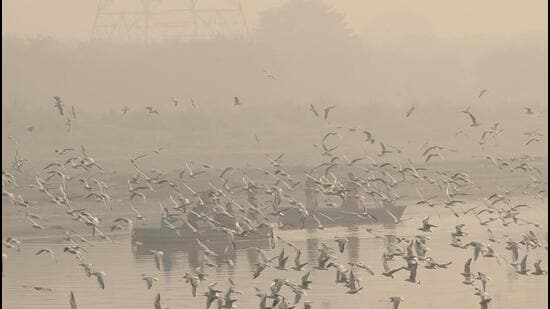
On Tuesday, the Capital had recorded an AQI of 428 — the highest since December 19 last year. The marginal improvement on Wednesday offered little relief, with stagnant winds and a temperature inversion continuing to trap pollutants close to the surface. Inversion occurs when a layer of warm air sits above cooler air, preventing pollutants from dispersing and creating a dense, visible haze.
Mahesh Palawat, vice-president (meteorology and climate change) at Skymet, said winds remained weak through the day, peaking at just 10km/hour. “In the early hours, winds were mostly calm. The direction was northwesterly till Wednesday afternoon before fluctuating to westerly and southwesterly,” he said, adding that forecasts indicate marginal improvement from Thursday onwards.
Data from the Decision Support System (DSS) showed that stubble burning’s contribution to Delhi’s pollution on Wednesday surpassed vehicular emissions — it accounted for 22.4% of PM2.5 levels, compared to 15.5% from transport.
According to CPCB’s Sameer app, 32 of Delhi’s 39 active air quality monitoring stations recorded “severe” pollution levels on Wednesday, with Wazirpur (464) and Bawana (458) among the worst-affected locations.
{{/usCountry}}According to CPCB’s Sameer app, 32 of Delhi’s 39 active air quality monitoring stations recorded “severe” pollution levels on Wednesday, with Wazirpur (464) and Bawana (458) among the worst-affected locations.
{{/usCountry}}The Commission for Air Quality Management (CAQM) in NCR on Tuesday invoked Stage 3 of the Graded Response Action Plan (Grap), banning non-essential construction and demolition activities and restricting the use of BS-3 petrol and BS-4 diesel four-wheelers in Delhi, Gurugram, Faridabad, Ghaziabad, and Gautam Budh Nagar.
The Delhi Directorate of Education (DoE) also ordered all primary schools up to Class 5 to switch to hybrid mode from Wednesday until further notice.
Forecasts by the Centre’s Air Quality Early Warning System (EWS) show that Delhi’s AQI is likely to improve slightly but remain in the “very poor” range from Thursday through Saturday. “The outlook for the subsequent six days from Saturday onwards also shows that AQI is likely to remain ‘very poor’,” EWS said.
Last November, Delhi recorded eight “severe” air days, peaking at an AQI of 494 on November 18, which was the second-highest level ever in the Capital. Historical data shows the city logged nine severe air days in November 2023, three in 2022, 11 in 2021, and between five and 10 in the years prior to that.
Meanwhile, Delhi’s minimum temperature dropped to 10.4°C on Wednesday, three degrees below normal and a sharp fall from 18.4°C recorded a week ago, according to the India Meteorological Department (IMD). The maximum temperature settled at 27.7°C, a degree below normal. The minimum is expected to dip further, possibly falling below 10°C by Friday, said the IMD.
Stay updated with all top Cities including, Bengaluru, Delhi, Mumbai and more across India. Stay informed on the latest happenings in World News along with Delhi Election 2025 and Delhi Election Result 2025 Live, New Delhi Election Result Live, Kalkaji Election Result Live at Hindustan Times.
Stay updated with all top Cities including, Bengaluru, Delhi, Mumbai and more across India. Stay informed on the latest happenings in World News along with Delhi Election 2025 and Delhi Election Result 2025 Live, New Delhi Election Result Live, Kalkaji Election Result Live at Hindustan Times.