
 E-Paper



Delhi readies four-point plan to tackle toxic Yamuna froth, targets illegal discharge
Delhi's plan to reduce Yamuna froth includes relocating dhobi ghats, closing illegal dyeing units, and engineering interventions to improve water flow.

 Prefer HTon Google


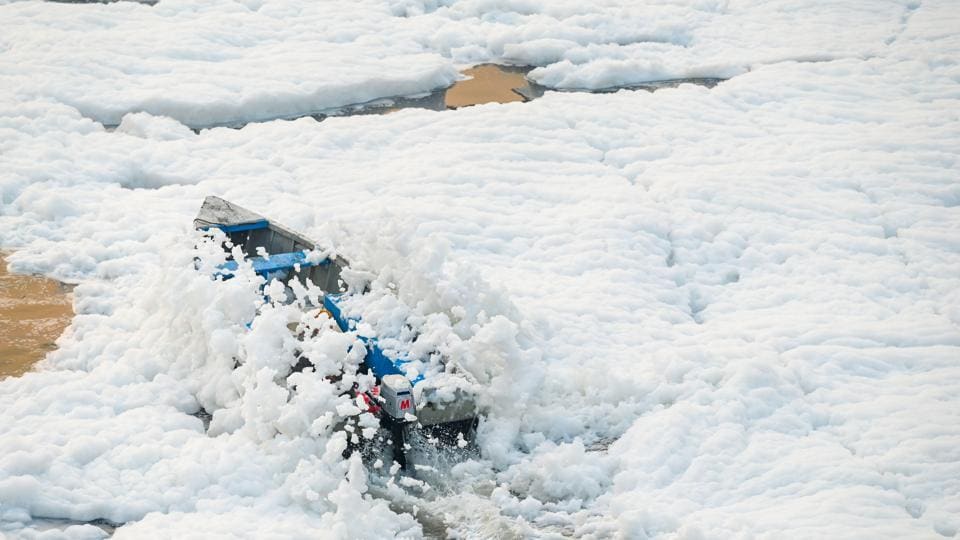
To check froth formation in the Yamuna, under a broader Yamuna rejuvenation plan, the Delhi government has planned a four-pronged approach of relocating dhobi ghats, closing illegal dyeing units, undertaking engineering interventions near the Okhla barrage and developing a riverfront visitor hub at Kalindi Kunj, officials familiar with the matter said.
Minister Parvesh Verma said the irrigation and flood control (I&FC) department, in coordination with other agencies, has started work on the measures. The Delhi Urban Shelter Improvement Board (DUSIB) is formulating a policy for phased relocation of dhobi ghats along the riverbanks, the minister said.
“The dhobi ghats located on the banks are directly impacting the river because of detergents and other untreated discharges into the Yamuna. A phased relocation policy is being prepared so that these activities can be shifted away from the river edge. DUSIB will conduct surveys and plan how families living along the dhobi ghats can be relocated,” Verma said.
Also Read | Over 300 families face eviction at Delhi's Yamuna Bazar Ghat, asked to vacate in 15 days
The anti-frothing measures gain significance ahead of the Chhath festival each year, when thick layers of toxic foam are often seen floating on the river surface, forcing authorities to deploy temporary anti-foaming chemicals and barricades for devotees entering the water. Officials said the planned interventions are intended as long-term structural measures aimed at reducing pollution load and limiting the conditions that lead to recurring froth formation.
Officials said the relocation exercise is expected to be carried out in phases, after identification of alternative sites by DUSIB and consultations with stakeholders. At the same time, the industries department has also begun mapping illegal dyeing units operating near the Yamuna floodplains and drains that eventually flow into the river.
Also Read | DDA issues fresh notice to develop private land lying vacant for years
“The issue has been that some of these units are shut briefly and then resume operations within a few months. This time, the focus is on permanent closure of illegal units so that toxic discharge into the Yamuna can be stopped,” Verma said.
The minister said departments have been directed to identify repeat violators and ensure stricter enforcement against units operating without clearances.
Officials said that the department is still in the process of finalising solutions to handle inflow from Haryana.
Officials said that a key reason behind frothing may be turbulence caused by a steep drop in water at Kalindi Kunj, citing a technical study commissioned by the Delhi government. The study pointed to turbulence as a significant factor, especially alongside untreated sewage inflow and high phosphate content in the water.
Officials said the Delhi government has signed an agreement with the Indian Institute of Technology, Roorkee, to redesign the slope near the barrage to reduce turbulence by easing water flow. “The most important intervention for reducing frothing is the engineering correction near the Okhla barrage. Water currently falls from a height and creates turbulence that leads to foam formation. IIT Roorkee is helping redesign the slope so that the fall is flattened and frothing reduces,” Verma said.
Officials said that the intervention will require coordination with the Uttar Pradesh irrigation department, given that a part of the affected stretch falls outside Delhi’s jurisdiction.
The Delhi and Uttar Pradesh irrigation departments are also jointly planning a large Chhath ghat and waterfront development project near Kalindi Kunj at an estimated cost of around ₹100 crore. The riverfront is planned as a dedicated tourist and cultural space for Chhath celebrations and other public activities. While the Delhi irrigation department will bear the expenditure, it will be executed by the UP irrigation department.
“Discussions with the UP irrigation department are already underway,” Verma said.
The latest measures are part of the Delhi government’s broader plan to clean the Yamuna by 2028. The government has repeatedly stated that the stretch of the river in Delhi can be significantly cleaned in three years through a combination of sewage treatment expansion, drain interception and surface cleaning mechanisms.
Officials said a “water master” machine was recently procured to clean the river and drains, and that decentralised sewage treatment plants (STPs) are being constructed to prevent untreated wastewater from flowing directly into the Yamuna.
“The decentralised STPs are being designed to treat drain water locally before discharge into the river, particularly in areas where conventional sewer connectivity remains inadequate,” said an official, who did not wish to be named.


Stay updated with all top Cities including, Bengaluru, Delhi, Mumbai and more across India. Stay informed on the latest happenings in World News along with Delhi Election 2025 and Delhi Election Result 2025 Live, New Delhi Election Result Live, Kalkaji Election Result Live at Hindustan Times.


