The Commission for Air Quality Management (CAQM) in Delhi-NCR and adjoining areas on Friday allowed schools and other educational institutions to be reopened in a phased manner from Saturday, and told the governments of Delhi, Haryana and Uttar Pradesh to take an “immediate decision” to allow students from Class 6 and above to attend physical classes.
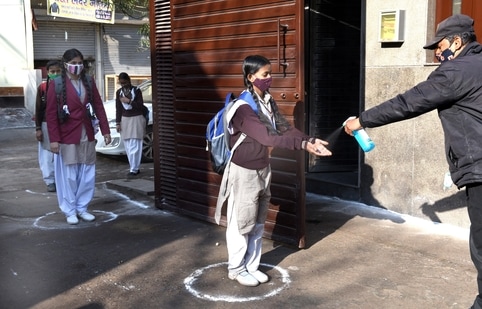
For students in Class 5 and below, schools can reopen from December 27, taking into account the air quality of the city around the time, and the winter vacation schedule, the CAQM directions said.
Just minutes after CAQM’s order, the Delhi government issued directions to open schools in the Capital from December 18.
“All state governments of Delhi and NCR have to follow a phased reopening of schools, colleges and educational institutions located within NCR. State governments of NCR and Delhi have been advised to take an immediate decision for resumption of physical classes in schools for classes 6 onwards, colleges, educational institutions, skill development and training institutes, other training institutes and libraries,” the CAQM statement said.
“The governments should also take the decision for resumption of physical classes, for students up to Class 5, with effect from December 27, duly considering the AQI and the winter vacation schedule,” it added.
air Schools said they expect vacations to take place as per schedule, but added that lessons for students in classes 10 and 12 may continue during this period to make up for lost time. It was not immediately clear if the education department will allow schools to conduct in-person classes in that time.
{{/usCountry}}air Schools said they expect vacations to take place as per schedule, but added that lessons for students in classes 10 and 12 may continue during this period to make up for lost time. It was not immediately clear if the education department will allow schools to conduct in-person classes in that time.
{{/usCountry}}Delhi’s directorate of education (DoE) on Friday ordered that “all government, government-aided, unaided recognised, New Delhi Municipal Council (NDMC), municipal and Delhi Cantonment Board schools will reopen from December 18 for Classes 6 onwards”.
The decision was welcomed by school principals, parents and experts, who have rued how the long break in physical classes due to the Covid-19 pandemic, and the frequent closures after that because of pollution have not just impacted learning levels but even led to complaints of mental health problems among children.
Tania Joshi, principal of The Indian School, said the frequent closure of schools was adversely impacting children, especially adolescents, who needed interaction with peers. “Children are not interacting the way they did earlier. They feel unsure and under-confident in online classes. They are missing out on the experience of growing up with peers,” said Joshi.
After the Covid-19 outbreak first hit India, schools in the Capital were shut on March 12, 2020. On January 18, 2021, schools were opened for classes 10 and 12, keeping practical work and board exam preparations in mind. On February 5, schools were reopened for the students of classes 9 and 11. Delhi’s fourth Covid-19 wave forced schools shut again from April 9. From September, reopening began in phases, with classes opening for 9-12 grades first, before the remaining were allowed to return to in-person attendance from November 1.
Pollution then forced schools to shut again for 13 days in mid-November. Schools reopened on November 29 as pollution eased marginally, but the state government issued yet another closure order on December 2, after the Supreme Court pulled up authorities for sending children to school even while parents were working from home. The top court, however, clarified the next day that it neither passed any order requiring schools to be shut, nor did it suggest the government close schools.
Experts said that while online classes have been ongoing during the repeated closures, they don’t match up in with physical classes in terms of learning and developmental outcomes, apart from prevailing concerns over the digital divide.
AK Jha, principal of the Government Co-ed Sarvodaya Vidyalaya, Rohini, said, “Students and teachers are able to connect better when the interaction takes place face to face. Students also benefit from peer learning.”
Sudha Acharya, principal of ITL Public School, Dwarka, and the chairperson of the National Progressive School’s Conference, which has over 120 private Delhi schools as its members, said that schools were eagerly waiting for students to return to campuses after prolonged delays on account of abrupt closures.
“Finally, we are relieved that schools have reopened. When we reopened last time, we noticed that there was a huge learning gap. Students were struggling with writing and other skills too required polishing,” said Acharya.
Meanwhile, though schools are being allowed to reopen, restrictions on construction activities in Delhi-NCR and the entry of trucks into the Capital’s limits are still in place, according to CAQM. Some relaxations were given for operations of industries and thermal power plants in the NCR states on December 15.
Pollution levels in the Capital have stayed in the “very poor” zone for five straight days, according to data from the Central Pollution Control Board, with local sources contributing to a majority of the city’s bad air. The city recorded a 24-hour average air quality index (AQI) of 329 on Friday, down from 368 the previous day, as strong winds helped wash out pollutants to a certain extent.
In a statement, CAQM said that they received several representations arguing the “compelling necessity to open the schools and educational institutions with immediate effect”.
Nidhi Mehta, a parent whose daughter studies in Class 4, said she will send her child to school whenever classes resume. “It doesn’t make any sense to not send children to school while we are going ahead with other activities. My daughter is keen on going to school and we will happily send her. One cannot stay at home forever,” said Mehta.
Stay updated with all top Cities including, Bengaluru, Delhi, Mumbai and more across India. Stay informed on the latest happenings in World News along with Delhi Election 2025 and Delhi Election Result 2025 Live, New Delhi Election Result Live, Kalkaji Election Result Live at Hindustan Times.
Stay updated with all top Cities including, Bengaluru, Delhi, Mumbai and more across India. Stay informed on the latest happenings in World News along with Delhi Election 2025 and Delhi Election Result 2025 Live, New Delhi Election Result Live, Kalkaji Election Result Live at Hindustan Times.