
 E-Paper



Delhi likely to record cleanest air day post-Diwali in eight years
Calm wind conditions and an increased stubble burning led to this deterioration even as the ban on firecrackers was flouted from Monday evening

 Prefer HTon Google


Delhi is likely to record its cleanest air day post-Diwali in eight years based on the Air Quality Index (AQI) of 326 at 7am on Tuesday. The previous lowest was in 2015 when the AQI was 360 (very poor) on November 12. It was 368 in 2019 (October 28).
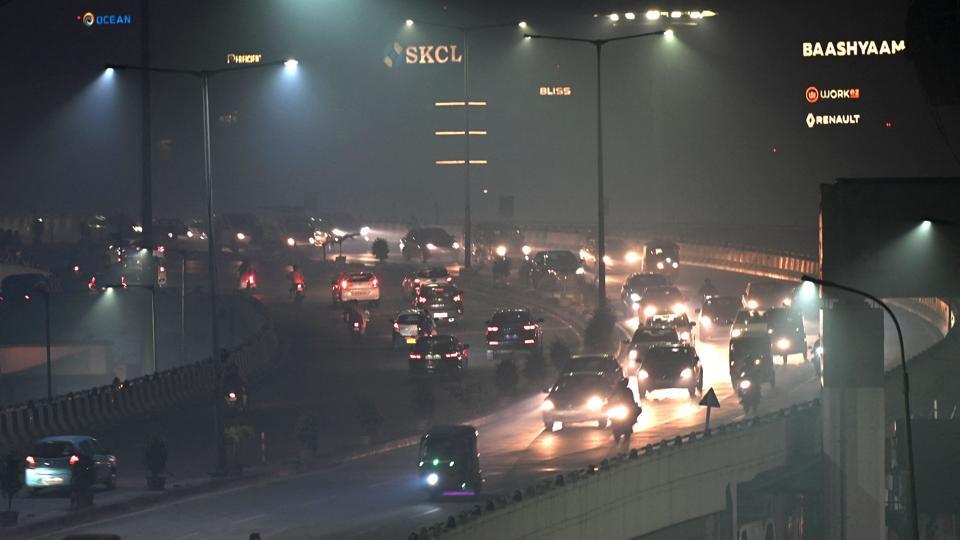
Delhi’s pollution levels worsened to the very poor category for the first time this season on Diwali as the city recorded an AQI of 312 at 4pm on Monday. The average AQI over the past 24 hours was 259 (poor) a day before Diwali. Calm wind conditions and an increased stubble burning led to this deterioration even as the ban on firecrackers was flouted from Monday evening onwards, leading to further deterioration in AQI. The AQI on Diwali was the second lowest since 2015.
The AQI was likely to rise on Tuesday, touching the higher end of the very poor category before the dispersal of pollutants from Wednesday evening as wind speeds were expected to pick up.
According to the monitoring agency System of Air Quality and Weather Forecasting And Research (Safar), the contribution of stubble burning to Delhi’s PM 2.5 concentration touched a season-high of around 10% on Diwali day. It was around 5% a day earlier.
There were 1,484 farm fires across Punjab, Haryana, and Uttar Pradesh on Diwali day, the highest for the season so far, compared to 1,228 on Sunday.
In a statement on Monday, Safar said fine particles (size < 2.5 micrometer) contributed to around 55% to PM10. It added the impact of farm fires on Delhi’s air quality is likely to increase to around 10% due to favourable transport level wind flow from north-west and west. It said the winds were of moderate level of 8-16 km per hour during the day, but there was an accumulation of pollutants at night due to calm conditions. “AQI will be ‘very poor’ on Tuesday and will improve further from Wednesday onward.”
AQI between zero and 50 is considered good, 51 and 100 satisfactory, 101 and 200 moderate, 201 and 300 poor, 301 and 400 very poor, and 401 and 500 severe.
The lowest AQI on Diwali day was 281 (poor) in 2018. But it spiked to 390 (very poor) the day after because of firecracker emissions.
Last year, Diwali (November 4) coincided with a very poor AQI of 382 and worsened to the severe category the day after (462 at 4pm). In 2020, Delhi’s AQI on Diwali day (November 14) was 414 (severe). It increased to 435 (severe) the day after.
The hourly PM 2.5 concentration peaked in Delhi’s Okhla-Phase 2, touching a one-hour average of 1,042 micrograms per cubic metre at midnight. It was nearly 17 times the national daily 24-hour standard for PM 2.5(60 micrograms per cubic metre). At Pusa, it hit an hourly peak of 990 micrograms per cubic metre at midnight.


