E-Paper



Did public social messaging on pollution and the ban on firecrackers help?
Diwali 2023 started as a beautiful day with blue skies. It ended with a shroud cover over its residents. A look at how the ban has helped.


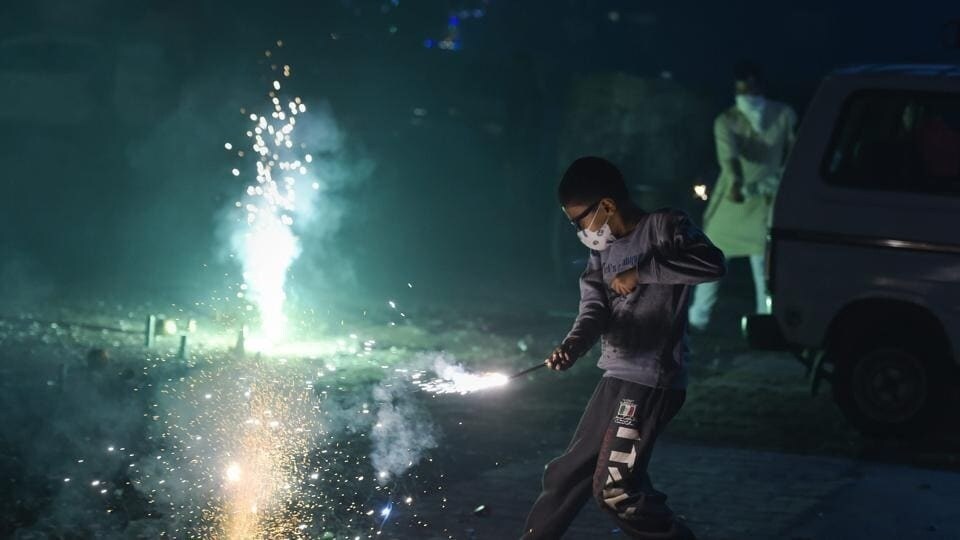
Rain and then strong winds last week contributed to Delhi waking up to its cleanest Diwali day in eight years since the AQI data became available. However, as with the previous years, the blue dissolved into a murky grey in a matter of hours. As Delhi’s residents began to burst firecrackers in the evening, the average AQI had risen from 218 on Sunday 4 pm to 358 (Very Poor category) at 4 pm on Monday — making it the sharpest rise in average AQI in the last eight years in the 24-hour period between Diwali and the day after the festival.
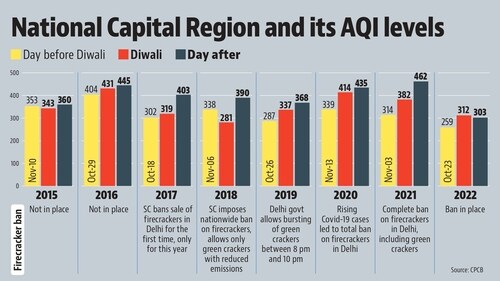
The last time a high jump was recorded was in 2018 when the AQI rose by 109 points from 281 (Poor category) on the day of Diwali to 390 (Very Poor category) the day after.
This is despite the fact that the sale, possession and manufacturing of firecrackers has been banned in Delhi for the past seven years. And paddy straw burning in Punjab and Haryana led to an alarming spike in air pollution in the national capital region in October and November. As the window for rabi crop wheat is very narrow, farmers set their fields on fire after paddy harvest to clear off the crop residue in time for sowing the next crop.
Sunil Dahiya, an analyst at the Centre for Research on Energy and Clean Air (CREA) said the lack of success in enforcing bans on firecrackers and stubble burning underscores the failure of government awareness campaigns to effectively reach the general public and farmers.
“This highlights a deficiency in proactive, comprehensive efforts by the respective governments, with a tendency towards reactive measures and an unfortunate prevalence of blame-shifting. People must recognise that their inaction in controlling their actions and contributions to pollution during these sporadic events allows institutional polluters, such as power plants, industries, and governments neglecting improvements in transportation, to remain concealed and avoid being held accountable,” he said, adding that public engagement was essential.
The perils of being disengaged are visible to all. Data highlights how residents of the Capital — which is regularly ranked amongst the most polluted cities in the world — have learnt little though there has been some form of a firecracker ban in place in the last seven years.
The Supreme Court had first imposed such a ban on firecrackers in 2017, stating that it was imposed only on the Capital, as it wanted to observe its impact on Delhi’s air. Delhiites did very little to self-regulate and there was rampant bursting of firecrackers that year.
In 2018, the apex court called for a nationwide ban on firecrackers and said it was only allowing ‘green’ crackers — those with reduced emissions. However, such firecrackers weren’t readily available in the market and Delhiites burst conventional firecrackers freely. [See graph below]
In 2019, Delhi’s markets were flooded with green crackers and, what’s more, the authorities imposed a strict window of 8-10 pm, but crackers were burst well beyond this time frame, and the police cited difficulty in identifying which crackers weren’t green.
In 2020, the Delhi government imposed a complete ban on firecrackers so as to eliminate the possibility of conventional firecrackers being used instead of their green variants. But Delhi residents did not bother with the diktat, ably aided by poor enforcement by the police. To wit: the Delhi Police registered only 123 FIRs of illegal bursting of firecrackers this Diwali. In fact, five districts did not even register a single FIR.
“People have been complaining to the Delhi Police every year, particularly on Diwali day, but not only are patrolling teams missing, but they also do not take complaints seriously. Until the enforcement act becomes stringent, such a ban can never succeed,” said Delhi-based environmental activist Bhavreen Kandhari.
Central Pollution Control Board’s data since 2015 also shows that there has been a spike in the AQI the day after Diwali in seven of the last eight years, barring 2022, when strong winds on Diwali day helped disperse firecracker emissions.
Also Read: Here’s how air pollution harms our bodies
Hard numbers
Mukesh Khare, professor at IIT Delhi and former expert member in both the Commission for Air Quality Management (CAQM) and the now dissolved Environment Pollution Control Authority (EPCA) said bursting of firecrackers at such a large scale — a clear violation of both the Delhi government and Supreme Court’s orders — has negated the air quality gains Delhi saw on Saturday.
“Pollution levels had dipped down to acceptable levels in the last few days and even on Diwali day, it was fairly low. However, a sharp increase in PM 2.5 levels was seen and this time around, vehicles, or stubble were no longer possible sources. The spike in pollution levels was largely all down to firecrackers and in the absence of strong winds, this will now remain present in the lower levels of the atmosphere for a few days,” he said.
In 2021, the AQI shot up from a reading of 382 (Very Poor category) on Diwali day to 462 (Severe category) the day-after. In 2020, Delhi’s AQI was already in the Severe category — 414 —on Diwali day. In 2019, Delhi recorded a spike of around 30 AQI points with the post-Diwali day recording an average of 368 (Very Poor category) the day after the festival.
To be sure, the AQI offers an average of air quality based on recordings from only certain parts of a city. What this means is that there may be a wide variation in pollution levels across the city that could well be higher than the average. What’s more, the deadliness of pollution lies in its constituents: particulate matter PM 2.5 and PM 10.
Data from this year’s Diwali in Delhi also showed the real-time impact of firecrackers and their emissions, which in the absence of strong winds, can accumulate in the lower atmosphere.
Till 6 pm on Diwali day, Delhi’s average hourly PM 2.5 concentration was within the permissible national standard of 60 micrograms per cubic metre, but pollution levels began to spike from 7 pm onwards as firecracker emissions were released into the atmosphere. This led to a gradual spike in Delhi’s PM 2.5 concentration, which touched a peak of 570 micrograms per cubic metre at 1 am – nearly 10 times the safe limit, CPCB data showed.
Delhi’s hourly PM 2.5 concentration at 6 pm was 57 micrograms per cubic metre, which rose to 78 micrograms per cubic metre at 7 pm; 114 at 8 pm; 179 at 9 pm; 296 at 10 pm; 445 at 11 pm; 558 at midnight, peaking at 570 micrograms per cubic metre at 1 am.
PM 2.5 levels then began to gradually dip, touching 563 micrograms per cubic metre at 2 am and 556 micrograms per cubic metre at 3 am, however, in the absence of strong winds, pollutants were still hanging over the city this morning, having not been able to disperse. Delhi’s hourly average PM 2.5 concentration at 10 am was 304 micrograms per cubic metre – still five times over the permissible standards.
Dr Ravindra Khaiwal, professor of environment health at Post Graduate Institute of Medical Education and Research, Chandigarh said the spike in the pollution levels after Diwali yet again in Delhi this year has shown that more needs to be done to change public behaviour on firecrackers.
“The ban is a start, but it is clearly not enough. Effective and systematic public messaging is crucial — the government needs to consistently emphasise the scientifically proven harms of firecracker smoke to people's health, especially on children. Air pollution is one of the biggest environmental and public health risk factors that leads to premature mortality and morbidity. There is a need to create strategic awareness about the importance of pollution-free Diwali and environment-friendly celebrations in specific target populations so that people can make judicious decisions," he said.
A robust enforcement of the ban besides alternatives is also the need of the hour, he said.
 ABOUT THE AUTHORJasjeev Gandhiok
Jasjeev Gandhiok is an Assistant Editor with Hindustan Times, where he covers environment, climate change, the clean energy transition and wildlife at the National Bureau. Gandhiok has over a decade of experience in journalism and is based in Delhi. He has reported extensively on Delhi and the National Capital Region (NCR). This includes the region's air pollution woes, a polluted Yamuna and on urban wildlife still thriving in the region. He joined HT in October 2021. Prior to that, he had five-year stint at The Times of India in Delhi, where he also covered Delhi, with a focus on environment and wildlife. Gandhiok has covered some recent events around the Capital too, ranging from the farmers' protests, the northeast Delhi riots and the CAA-NRC protests, reporting from the ground on all of these. He also travels across the country to report on how environment and climate change impact everyday life, while also writing on endangered species. His reports in 2019 on toxic leachate from Delhi's landfills led to the National Green Tribunal (NGT) taking suo motu cognisance and ultimately asking the state government to start bio-mining to flatten and remove all three landfills in the capital. He also closely tracks the implementation of government policies on climate, renewable energy and environmental protection. His focus remains on impactful, public-interest journalism which explains how environmental decisions affect people's everyday lives.Read More