E-Paper



DPCC gives conditional nod for Delhi civic body to dump WtE ash at landfill
The DPCC has granted a six-month conditional consent to operate the landfill, with the condition that the ash be used in construction activities.

 Prefer HTon Google


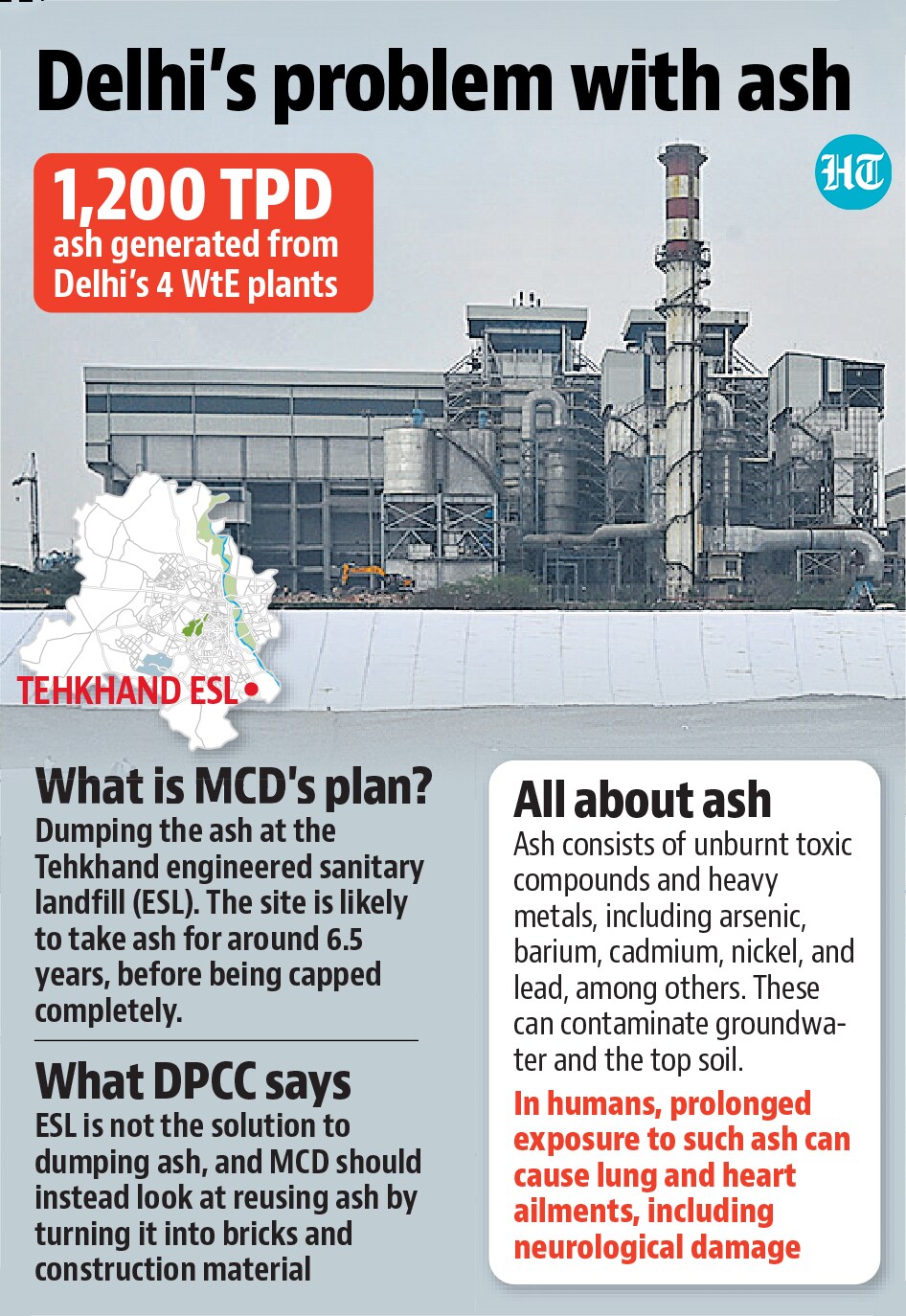
The Delhi Pollution Control Committee (DPCC) has asked the Municipal Corporation of Delhi (MCD) to reuse the approximately 1,200 tonnes per day (TPD) of ash generated at the Capital’s four Waste to Energy (WtE) plants, noting that if dumped, such a large quantity of ash will exhaust the new engineered sanitary landfill (ESL) at Tehkhand in only six-and-a-half years.
Granting a six-month conditional consent to operate (CTO) for the ESL, DPCC said, “The committee has underlined there is substantial (1200 TPD) of ash (fly ash and bottom ash) generated from the existing four operational WtE plants at Okhla, Bawana, Ghazipur and Tehkhand in Delhi. The disposal of this quantity of ash from the WtE plants in the low-lying areas or at dumpsite or even at the ESL is not a solution to the problem.”
The January 11 communique states that DPCC allotted the CTO at a meeting held on December 27, during which the committee looked at possible problems that may arise from the site.
“....this ESL will also get filled soon and then MCD will again start seeking another piece of land. Delhi cannot afford to have such a graveyard of ESL sites and land is a precious resource in Delhi. Therefore, ash generated from all the existing operational WtE plants in Delhi must be used in making bricks and other products, which can be consumed in construction activities — road, building construction etc,” DPCC said.
The other conditions laid down as per the CTO include the need to install piezometer wells around the site to monitor water quality, effluent analysis reports of the leachate treatment plants installed there, and the need to develop a buffer zone or green belt around the landfill.
“A buffer zone of no development shall be maintained around the facility. Bamboo plantation shall be done at the boundary of the facility to prevent dust from the facility in reaching the surrounding areas,” DPCC said in its order.
HT reached out to MCD, but the civic body’s officials did not comment on the development.
Fly ash and bottom ash consist of a number of unburnt toxic compounds and heavy metals, including arsenic, barium, cadmium, nickel, and lead, among others, which can contaminate groundwater. This ash, if blown away by the wind, can also contaminate the top soil.
Read Here: DPCC fines DDA, MCD ₹1 lakh each
In humans, prolonged exposure to such ash can cause lung and heart ailments, including neurological damage.
The Tehkhand ESL is spread over an area of around 23 acres. As per the proposal submitted to DPCC, the ESL has a capacity to hold around 960,000 tonnes of ash, with an average depth of the excavated area being 6.63 metres. The site has six different layers of lining at the bottom, laid down as per Central Pollution Control Board (CPCB) guidelines, and will only hold ash and not municipal solid waste. The MCD has spent ₹42.3 crore on its development.
CR Babu, head of the Centre for Environmental Management of Degraded Ecosystems (CEMDE), who was part of the DPCC committee which issued the conditional CTO to MCD, said, “A permission to operate has been granted for six months only. If the conditions are not followed, then the CTO will not be renewed. The main condition was to reuse ash, as such sites are not feasible in the long-run and we cannot keep dumping ash.”