Even as Delhi government prepares to tighten curbs on construction and demolition activities ahead of winter – with a complete ban on construction and demolition activities from December 10 to January 20 under its winter action plan– several major infrastructure projects across the Capital could continue unimpeded under exemptions that experts said will do little to address the city’s worsening dust pollution crisis.
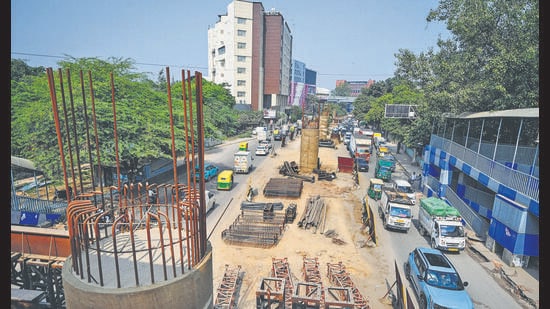
Under the Graded Response Action Plan (Grap), essential public infrastructure projects enjoy exemptions that allow them to continue through several stages of escalating pollution restrictions. Even under Stage IV, the most stringent level, exemptions continue for construction for metro rail, railway projects, airports, hospitals and water-supply and sewage-treatment projects.
The exemptions, while intended to prevent essential public works from coming to a standstill, come as construction activity along busy arterial roads is already contributing to dust pollution, traffic congestion, and commuter inconvenience across the city.
Also Read | Lawyers can work from home, we can’t: Supreme Court judge on post-Diwali air in Delhi
Major infrastructure projects across the Capital
But the sheer number of public construction projects currently underway across the Capital is considerable.
{{/usCountry}}But the sheer number of public construction projects currently underway across the Capital is considerable.
{{/usCountry}}The Delhi Metro Rail Corporation (DMRC) is undertaking projects under its Phase IV and Phase V-A expansion plans, including the Tughlakabad–Aerocity Golden Line and the Central Vista corridor. Road, flyover and drainage projects are also under way across south and east Delhi, often alongside heavily used roads and intersections.
In south Delhi, metro expansion and elevated road construction continue along Mehrauli-Badarpur Road, while metro-related work is under way on Josip Broz Tito Marg, the former Bus Rapid Transit corridor between Chirag Delhi and Siri Fort. The Public Works Department is extending flyovers near Modi Mill and Kalkaji Temple.
In east Delhi, a flyover connecting Yamuna Vihar and Bhajanpura and drainage work between Karkari Mor and Shahdara add to the construction footprint. Work on the Bhairon Marg underpass is also under way, with completion expected by February next year.
Dust pollution around construction sites
Air quality monitoring data point to a persistent dust problem around some of these sites. Between October 22 and 29, three south Delhi monitoring stations – CRRI Mathura Road, Siri Fort Stadium and IIT Delhi – recorded daily average PM10 levels consistently above the citywide average.
The difference was particularly pronounced at the IIT-Delhi station, where PM10 levels remained above 250 micrograms per cubic metre on six of the eight days, peaking at 318.60 micrograms per cubic metre on October 28. The citywide average remained below 230 micrograms per cubic metre on all but one of those days (see chart).
PM10, which includes coarse particles associated with dust, can help indicate localised dust pollution. Weather, traffic and other local sources can also influence concentrations, so the readings alone do not establish construction as the cause. However, the sustained divergence around areas with major infrastructure work points to the need for closer scrutiny of local emissions.
Traffic police officers said loose excavated soil was a recurring problem at construction sites, where inadequate covering and poorly managed debris allowed dust to spread onto roads.
“Spilling of excavated soil on roads is the most common problem that we spot at almost all construction sites. The loose soil is often left exposed around construction sites. When it rains or water is sprinkled to control dust, the soil turns into mud and spreads onto the road. Once it dries, vehicles passing over it kick up dust, adding to pollution,” a traffic police officer said, requesting anonymity.
The officer added that exposed soil could leave surrounding areas hazy and sometimes affect visibility for motorists.
HT’s site visits over the past week at the Modi Mill flyover and metro construction sites along Mehrauli-Badarpur Road and near Siri Fort found gaps in dust-control measures. Barricades were often spaced too far apart to prevent dust from escaping onto roads, while green tarpaulin coverings were barely visible. Passing vehicles then spread the dust across adjoining stretches.
Also Read | The pollutants in Delhi's air, and why they are hard to trace
Winter restrictions, exemptions and enforcement challenges
Delhi’s Winter Action Plan 2026 prohibits dust-generating demolition and outdoor civil construction activities from November 1 to January 31, subject to exemptions for essential public infrastructure projects. Finishing work, plumbing and electrical work may continue within construction sites, provided dust-prevention norms and construction-waste management rules are followed.
The plan also bars vehicles carrying construction materials, including sand, aggregates, bricks, cement, ready-mix concrete and debris, from entering Delhi between December 10 and January 20. Exemptions apply to projects of national or strategic importance, essential public infrastructure and utility services, emergency works and other categories specified by the environment department.
Construction sites are required to be properly barricaded, with green nets or metal sheets to prevent soil and debris from spilling onto roads. Trucks transporting construction materials and debris must be covered. Commercial high-rise buildings with built-up areas exceeding 3,000 square metres, including malls, hotels, offices and institutional buildings of G+5 height and above, must install anti-smog guns or mist systems. Such systems are also mandatory at under-construction sites with plot areas exceeding 1,000 square metres.
Yet enforcement remains a challenge. Traffic police officers said their teams could photograph or record violations and forward the evidence to the relevant agencies, but could not independently penalise construction companies for dust-control lapses.
Construction-related traffic restrictions add another layer to the problem. Narrowed carriageways and diversions slow vehicles, while congestion spills onto neighbouring roads. Motorists using navigation apps to avoid jams can add pressure to alternative routes, officers said.
“Ensuring smooth vehicular movement on roads with crunched space around construction sites is a challenge that we face every day,” another traffic police officer said.
Sunil Dahiya, founder and lead analyst at think-tank Envirocatalysts, said metro projects could help curb pollution in the long run, but inadequate dust control during construction remained a concern.
“October has been a good month because of favourable meteorological conditions, but the task will be difficult in coming months when stubble burning will reach its peak and weather conditions will also not be conducive,” he said, calling for stricter enforcement.
Also Read | Delhi: Light rain expected; min temp 3.1°C above normal, 3 stations record very poor air
S Velmurugan, senior adviser at the National Council of Applied Economic Research, New Delhi, said water should be sprinkled in the morning to prevent dust from becoming airborne, covering not just construction sites but stretches extending 100 metres on either side.
“Vehicular emissions, including carbon monoxide and hydrocarbons, increase when vehicles are stuck in traffic, particularly on roads where congestion is severe due to ongoing construction work. The problem is at its peak, and an immediate measure is to implement traffic diversions to prevent bottlenecks, ensure smoother movement of vehicles and reduce emissions caused by prolonged idling,” he added.
Frequently Asked Questions
Which infrastructure projects are exempt from the strictest Grap restrictions?
What dust-control measures are required at construction sites?
Why can construction activity contribute to traffic-related pollution?
Stay updated with all top Cities including, Bengaluru, Delhi, Mumbai and more across India. Stay informed on the latest happenings in World News along with Delhi Election 2025 and Delhi Election Result 2025 Live, New Delhi Election Result Live, Kalkaji Election Result Live at Hindustan Times.
Stay updated with all top Cities including, Bengaluru, Delhi, Mumbai and more across India. Stay informed on the latest happenings in World News along with Delhi Election 2025 and Delhi Election Result 2025 Live, New Delhi Election Result Live, Kalkaji Election Result Live at Hindustan Times.