
 E-Paper



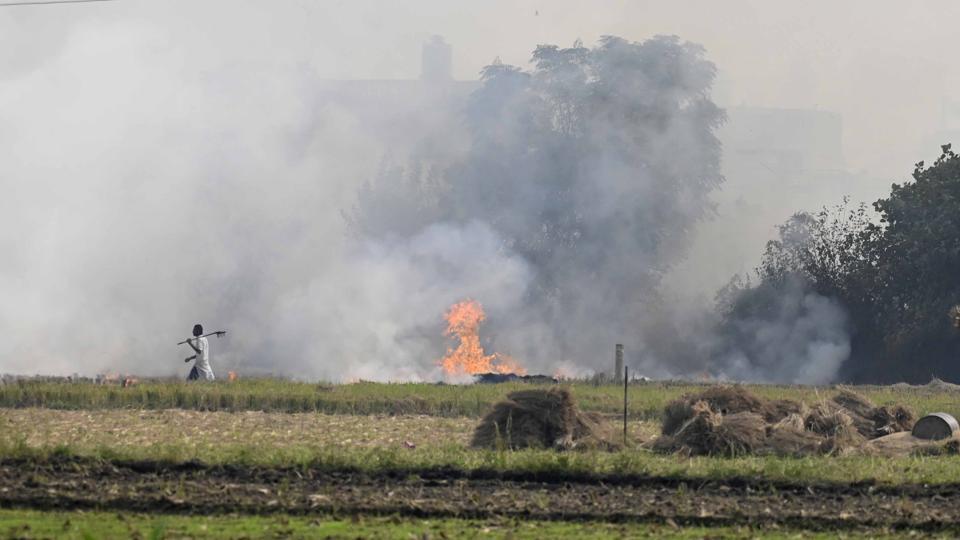
Farm fires’ share in Delhi’s PM 2.5 down to 3.5% this year: CPCB
CPCB cited estimates from the Indian Institute of Tropical Meteorology’s Decision Support System (DSS)

 Prefer HTon Google


The contribution of stubble burning to Delhi’s PM2.5 pollution fell significantly during this year’s burning season, dropping to 3.5% from 10.6% last year, according to data shared by the Central Pollution Control Board (CPCB) in response to a Right to Information (RTI) application.

The figures, provided in response to an RTI application by Noida-based activist Amit Gupta, indicate a significant reduction compared to recent years, when the average contribution was 11% in 2023, 9% in 2022, and 13% in both 2021 and 2020.
CPCB cited estimates from the Indian Institute of Tropical Meteorology’s Decision Support System (DSS), a model that uses satellite data on active fires, converts it into emissions, and simulates impact based on wind and weather patterns.
To be sure, some experts pointed out that the figures rely on satellite data which has previously been exploited by farmers and thus may be “underestimating” the impact of stubble fires this year.
A recent report by the think tank International Forum for Environment, Sustainability and Technology (iFOREST) found that farmers in Punjab and Haryana have increasingly been burning crop residue after 3pm to evade detection by satellites with afternoon pass times. This tactical shift could mean many fires go uncounted in daily tallies.
CPCB officials defended the DSS methodology, stating that while short-term forecasts use satellite passes until 2.30pm, the system’s final calculations of daily pollution contribution incorporate fire data up to 5pm.
“This is why estimates may be inaccurate for fires happening after the satellite pass time of 2.30pm, but the actual contribution has full data,” the official explained.
Despite these assurances, independent analysts argue the model has limitations.
Sunil Dahiya, founder of Envirocatalysts, noted that DSS relies on fire counts from specific satellites rather than geostationary satellites that can monitor late-evening burns. “DSS uses an old emission inventory and methodology, which considers the fire count incidents through satellites and not the burnt area assessment using geostationary satellites. This, this data might also be under reporting the contribution of stubble burning to some extent – as highlighted by some of the latest independent assessments done using the geostationary satellites,” said Dahiya.
The RTI also sought details about the sources contributing to Delhi’s PM2.5 and PM10, to which CPCB cited a 2018 source apportionment study. Gupta said the RTI reply highlights two key points– that the contribution of farm fires is fairly low overall, with other sources likely playing a key role and that stubble burning is not a significant source of pollution in Delhi, but one among many smaller sources. “The fact that we are referring to a 2018 source apportionment study shows we need to update our data,” he pointed out.


Stay updated with all top Cities including, Bengaluru, Delhi, Mumbai and more across India. Stay informed on the latest happenings in World News along with Delhi Election 2025 and Delhi Election Result 2025 Live, New Delhi Election Result Live, Kalkaji Election Result Live at Hindustan Times.


