E-Paper



Flood warning issued for Delhi as Yamuna set to rise
The water usually takes around three days to reach Delhi, officials said, adding that the level at Old Railway bridge, which is considered the benchmark for assessing the flood situation in the capital, currently stands at 204.29 metres, which is less than the danger mark of 205.33m.

 Prefer HTon Google


The irrigation and flood control department of the Delhi government on Thursday issued the first flood warning for the city after over 300,000 cusecs of water was released into the Yamuna from the Hathnikund barrage in Haryana’s Yamuna Nagar on August 11, 2022.
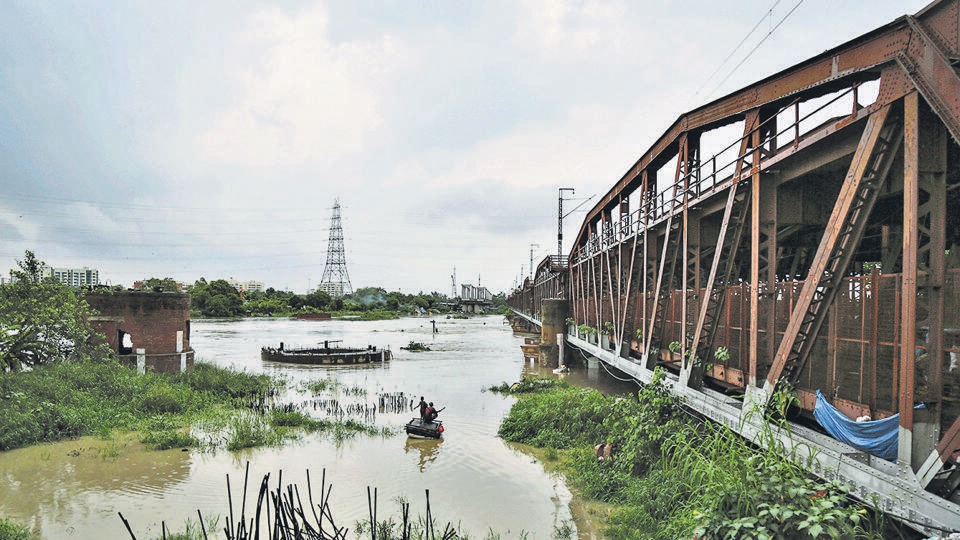
The water usually takes around three days to reach Delhi, officials said, adding that the level at Old Railway bridge, which is considered the benchmark for assessing the flood situation in the capital, currently stands at 204.29 metres, which is less than the danger mark of 205.33m.
Delhi considers a level of 204.5m at the Old Railway Bridge to be the “warning level” while the “danger level”, which prompts evacuation efforts of people living along the banks of the Yamuna, is at 205.33m. Last year, the river had crossed the danger mark of 205.33 meters on July 30, 2021.
A senior irrigation and flood control Department said the first warning is being issued as more than 300,000 cusecs of water was released from the barrage located 228km upstream of Delhi. “A total of 134,912 cusecs of water was released into the river at 7am while another 182,295 cusecs of water was released at 8am on August 11. The vigilance is increased when more than 1 lakh cusecs water is released in one go,” the official said, asking not to be named.
As per the flood warning issued by the department, all sector officers have been advised to keep vigil in their respective areas and take necessary action on vulnerable points. In the coming days, the sector officers and district administration will be carrying out announcements and deploying quick reaction teams to warn people residing near the Yamuna embankments.
While flood warnings are an annual phenomenon, the highest flood level in the city was recorded in the September of 1978 when Yamuna waters reached 207.49 metres.
Yamuna has seen a prolonged dry spell in 2022, leaving the city to grapple with water shortages as water plants operating at reduced capacities all through the summer months. By June end, the river was running dry with the level touching a low of 666.8 feet at Wazirabad.
Another senior government official said that the Najafgarh drainage system has witnessed several instances of high water levels in 1977, 1978, 1988, 2011 and 2013. “During this period, a heightened level of vigil is maintained on river embankments when large volume of released in the river upstream and heavy rainfall in the catchment area can lead to river attacking its embankments and additional measures need to be taken to check any abnormal erosion. The regulators constructed at the mouths of MCD drains will have to be operated from time to time to suitably pump out the drainage in case the river is in high flood,” the official added.
When Yamuna levels rise above 205m, the water-logging situation worsens in the city and Delhi’s topography prevents gravity based flow to larger drains that carry the excess water to the river, a PWD official said.
“The drains managed by the municipal corporations carry the excess runoff from colonies to the PWD drains. The PWD drains carry this excess water to much bigger drains like Barapullah and Najafgarh drains which are connected to the river,” the official said.
Besides Najafgarh and Supplementary drain, there are around 17 more drains which carry waste water into the river such as Dilli gate drains, Mori gate drain, Shahadra drain, Jahangirpuri drain etc.
A government official said as a precautionary measure, 24 boats, each having two divers, have been deployed in the Yamuna. “A total of 24 boats with 48 divers will be taking rounds of the vulnerable locations during the alert period. We have also kept 17 motor boats on reserve. Announcements on loudspeakers -- to make the residents and farmers living along the Yamuna aware about the situation -- have been initiated and people are being advised to remain cautious,” the official said.