A fourth runway, a revamped and expanded Terminal 1, as well as a significant upgrade in passenger handling capacity – 2022 is likely to be a significant year for the Indira Gandhi International Airport, which has seen its upgrade plans hindered several times over the past two years due to lockdowns and curbs on construction.
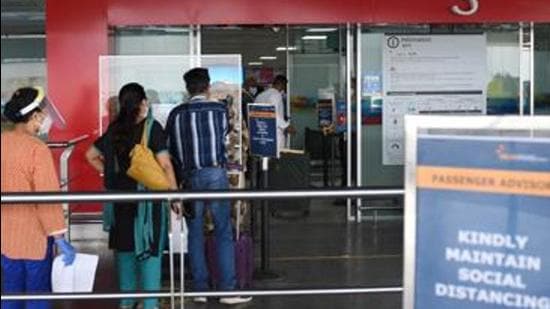
The revamped T1, which is currently undergoing work to double its capacity from 20 million passengers per annum to 40 million passengers, will integrate the departure and arrival terminals under one roof. While the arrivals hall could be complete in 2022, a new T1 apron is also expected to be ready by the end of the year, said officials.
The Delhi airport will also become the first in the country to have four runways. Officials aware of the matter said that while construction work for the fourth runway was complete, it will take several months to install requisite equipment, such as instrument landing system localisers or CAT gear, which is required for aircrafts to land during poor visibility, after which inspections and tests are expected to take up a significant portion of the year. The Directorate General of Civil Aviation (DGCA) will approve the runway once these processes are completed.
The fourth runway is expected to be around 4,400 metres long and 75 metres wide. It is slightly smaller than the third runway (known as 29/11).
{{/usCountry}}The fourth runway is expected to be around 4,400 metres long and 75 metres wide. It is slightly smaller than the third runway (known as 29/11).
{{/usCountry}}The airport also expects to make significant advances in its aim of becoming a ‘net zero carbon emission’ airport by 2030. A smart apron being built at T1 will not only increase the number of parking stands from 55 to 82, but will also have 22 ‘contact’ stands and eight Multiple Apron Ramp System (MARS) -- which can accommodate much larger aircrafts.
So far, 19 new stands have become operational, after statutory approvals from DGCA in early December 2021, said the airport operator.
The airport estimates that the new smart apron will cut carbon dioxide emissions by 70kg per flight. Once the 22 contact stands are made operational, officials said they expect a further reduction of 255kg of CO2 emissions per aircraft during the turnaround process for domestic airlines.
“The new layout will facilitate improved air traffic flow and enhance airside safety. The creation of new contact stands will also lead to a reduction in the Ground Support Equipment required. This will ensure faster aircraft turnaround time and improve safety in the apron area, resulting in improved operational efficiency on the airside,” said a spokesperson of the Delhi International Airport Limited (DIAL).
An airport official aware of the ongoing work said that while T1 is not expected to be fully complete this year, there is a good chance the new-look arrivals hall will be ready by 2022. However, work on the airport has seen a host of interruptions due to the Covid-19 lockdowns and constructions ban owing to the pollution spikes in Delhi.
“Timelines have been impacted to an extent and work was delayed considerably last year. This year, efforts were made to regain lost time, but even this winter, the construction ban and to an extent, the second wave has impacted the expansion work,” said the airport official.
“Despite these setbacks, we expect the fourth runway to be operational this year, as well as a new arrivals hall at T1 and a new smart apron for planes,” the official added.
While construction work on the dual-elevated cross taxiway (ECT) is also expected to be completed by December 2022, it is only likely to become operational by 2023, DIAL said. The ECT will be built on the same lines as the elevated cross-taxiway at Singapore’s Changi Airport, allowing those reaching the airport a visual of aircrafts taxing above them as they approach Terminal-3.
The 2.1km-long dual ECTs, along with the new runway are expected to help decongest the airport and reduce turn-around time for an airline, with passengers also having to wait inside the flight for a shorter duration of time after landing or during take-off.
According to DIAL, once the ECT is complete, the distance covered by an aircraft after landing for taxiing will reduce from around nine kilometres to two kilometres.
Stay updated with all top Cities including, Bengaluru, Delhi, Mumbai and more across India. Stay informed on the latest happenings in World News along with Delhi Election 2025 and Delhi Election Result 2025 Live, New Delhi Election Result Live, Kalkaji Election Result Live at Hindustan Times.
Stay updated with all top Cities including, Bengaluru, Delhi, Mumbai and more across India. Stay informed on the latest happenings in World News along with Delhi Election 2025 and Delhi Election Result 2025 Live, New Delhi Election Result Live, Kalkaji Election Result Live at Hindustan Times.