
 E-Paper



Froth returns to Yamuna, political parties trade charges
The renewed froth was visible on Monday, drawing immediate reactions from opposition leaders who accused the government of “deceiving the common man”

 Prefer HTon Google


Nearly a month after political parties sparred over the condition of the Yamuna ahead of Chhath Puja, thick layers of white froth have once again surfaced near Kalindi Kunj — reviving a political flashpoint and prompting fresh allegations that the BJP-led Delhi government has failed to keep its promises on cleaning the river. The renewed froth was visible on Monday, drawing immediate reactions from opposition leaders who accused the government of “deceiving the common man”.
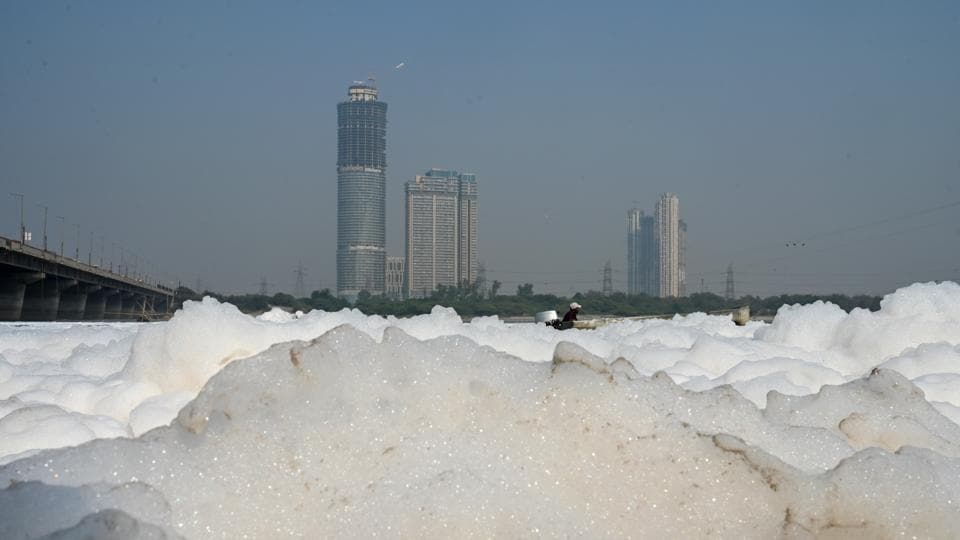
AAP leader Saurabh Bhardwaj posted a video on X showing dense patches of foam drifting along the river’s surface. “With the Bihar election over… the drama over the Yamuna is also over (sic),” he wrote, alleging that the government had abandoned its commitments as soon as the festival ended. The Delhi Youth Congress also released a video from the same stretch, saying, “The BJP had shown some pictures of the Yamuna to the entire country before Chhath; these pictures are from a few days later....”
The video released by Bhardwaj came after senior AAP MLAs Sanjeev Jha and Kuldeep Kumar visited Kalindi Kunj on Monday morning.
Jha said the Yamuna may appear “beautiful” from above, but the white layer floating on its surface was “a sheet of the BJP government’s sins that has engulfed the river.” He added, “It is painful to see this condition when the BJP had promised to clean the Yamuna in six months. Chhath Puja just took place and now the river is in this state.” Jha said the chemical spraying and boat-based foam removal seen 25 days ago had been completely stopped, adding, “This clearly shows they have no intention of removing pollution from the Yamuna.”
Kumar, meanwhile, described the river’s condition as “disastrous.”
The BJP hit back sharply. Delhi BJP president Virendra Sachdeva said AAP leaders had “gone politically insane” since the new government “successfully organised Chhath Puja on the ghats”, and accused them of ignoring “the fact that it was their Government’s failure which resulted in Yamuna turning into a drain.” He alleged that the AAP government had “sat over Yamuna cleaning work for 10 years”, mismanaged drains such as Najafgarh and East Delhi, and misappropriated over ₹6,500 crore for river cleaning between 2015 and 2023.
“Whenever the Yamuna – due to the dirty flow of sewage from major drains – turns white with froth, they (the opposition) start political diatribes accusing BJP,” Sachdeva said, insisting that the current state of the river was the result of the AAP government’s failures. He added that work on Delhi’s 37 STPs and major drains was underway and that “soon Delhiites will get a pure and pious Yamuna.”
A visit by HT to Kalindi Kunj on Monday revealed thick layers of foam floating downstream of the Okhla barrage. Environmental experts said the conditions that lead to froth formation had persisted even before Chhath — and were now intensifying with falling winter temperatures and a reduction in river flow.
A major trigger for the froth is the presence of surfactants and untreated wastewater that accumulate upstream. When water containing surfactants tumbles from a height — especially at the Okhla barrage — the churning traps air and creates foam. Officials had earlier attempted to regulate the flow and diversion of water to Uttar Pradesh to reduce froth formation. “The speed of the water going towards Uttar Pradesh for irrigation will reduce the formation of froth due to surfactants present in the river close to the Kalindi Kunj area,” an irrigation department official had said during Chhath.
HT had reported on October 23 that ahead of Chhath Puja, diversion of water into the eastern and western canals was temporarily stopped, with the entire flow released into the Yamuna to increase velocity. Improved flow helps reduce frothing, as stagnant or slow-moving water traps surfactants more easily.
However, with winter setting in and the river flow dipping again soon after Chhath, the conditions have turned favourable for foam to reappear. Bhim Singh Rawat, Yamuna activist and member of the South Asia Network on Dams, Rivers and People (SANDRP), said the combination of low temperatures, weak flow and persistent untreated discharge was now creating “near-perennial” froth.
“In fact we are now witnessing froth almost throughout the year. It starts to appear soon after the monsoon as the river’s flow dips and we also have temperature dipping, which makes the water cooler. Earlier, we used to see more froth in the winter months, but with absence of adequate flow, we see it beyond February — till monsoon too nowadays, like last year,” Rawat said.
He added that several STPs and CETPs were not functioning as per prescribed standards, and that the volume of effluents entering the river was increasing year-on-year. “The problem is amplified downstream. We also only see this after ITO barrage and Okhla barrage as the water there falls from a height and leads to churning. A temporary solution is to manage this drop better,” he added.


Stay updated with all top Cities including, Bengaluru, Delhi, Mumbai and more across India. Stay informed on the latest happenings in World News along with Delhi Election 2025 and Delhi Election Result 2025 Live, New Delhi Election Result Live, Kalkaji Election Result Live at Hindustan Times.


