E-Paper



How the Delhi municipal bodies have fared since being split in three
The final notification for the trifurcation was issued in January 2012, carving North, South and East Delhi Municipal Corporations with 104 wards given to the first two and 64 to the third respectively

 Prefer HTon Google


The state election commission’s announcement that it has deferred the announcement of the schedule for the municipal corporation elections, citing a communication by the Centre in which its has mentioned its intention to unify the three civic bodies in Delhi has reignited the debate over the division of the MCD in 2012 by the then Congress government in Delhi.
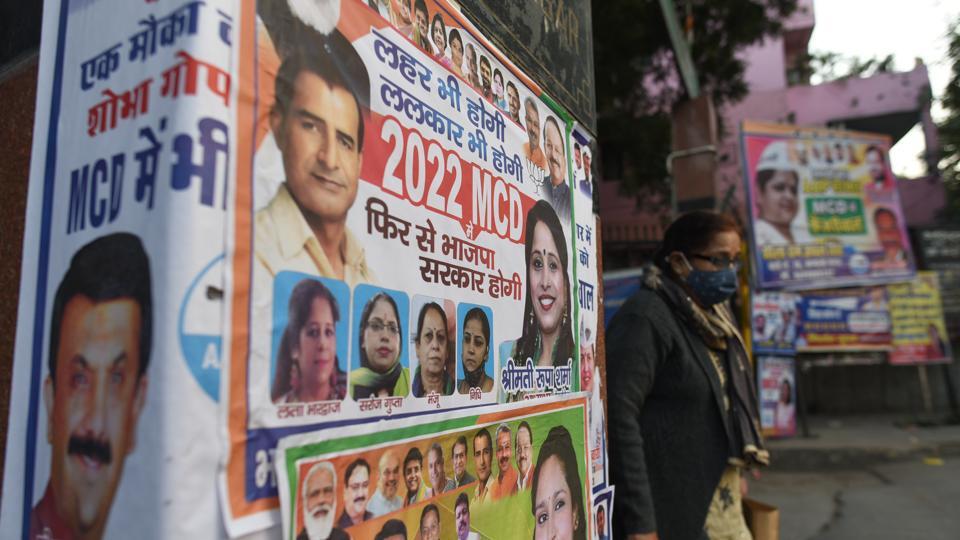
To be sure, the election panel has clarified that it has neither deferred nor cancelled the MCD polls, and asserted that it needed time to examine the communication -- sent just half an hour before the press conference in which it was expected to announce the election date.
The MCD was one of the largest local bodies in the world with 160,000 employees overseeing services to 97% of the city, spread over 272 municipal wards and 12 administrative zones.
In 2011, the Sheila Dikshit government moved a proposal to divide the MCD into three separate bodies, arguing that it will improve overall efficiency. In November 2011, the Union home ministry cleared the proposal. The Delhi government convened a special assembly session and passed the Delhi Municipal Corporation (Amendment) Bill in December 2011. Then President Pratibha Patil cleared it in the same month.
The final notification for the trifurcation was issued in January 2012, carving North, South and East Delhi Municipal Corporations with 104 wards given to the first two and 64 to the third respectively.
Rakesh Mehta, a former commissioner of the unified MCD, said the idea behind trifurcation was that the commissioner would be much closer to the areas, and that smaller local bodies on the lines of NDMC and Delhi Cantonment Board will function efficiently. “It was supposed to make it easier to govern the massive geographical spread and the large population of the city. The experience over the last decade, however, has shown that the experiment did not succeed. There has been lack of resources, non-payment of salaries to workers, lack of modernisation of system. Since the experience has not been good over the last 10 years, then it is better to unite the corporations,” he added.
In a communication issued after the press conference, an SEC official said that according to the centre’s communication the Union government intends to bring a legislation in the ongoing session Parliament to unify the three MCDs.
Senior officials, both serving and retired, however, pointed out that it would not be easy to achieve the task since currently different parties rule Delhi and the Centre. They said the trifurcation could be done smoothly since the Congress ruled both Delhi and the Centre.
A senior official who asked not to be named explained that the unified MCD was trifurcated through the Delhi Municipal Corporation (Amendment) Act, 2011 which was passed by the Delhi Assembly. “If the MCDs are to be reunited, an amendment to the Act has to be passed by the Delhi assembly. But, there are several provisions in the MCD Act according to which the central government has additional powers, including the authority to appoint commissioners. Therefore, unless the central government and state government agree to the amendments, unification cannot materialize,” the official said.
A retired bureaucrat who was with the Delhi government during the trifurcation process said it was the Sheila Dikshit government in the city that had agreed to allow the Centre to have the “controlling authority” over the three corporations.
“Unifying the three MCDs will take amendments to the DMC Act again. During Sheila Dikshit’s time, the bill to trifurcate the MCDs was tabled in the Delhi Assembly and after it being passed was sent for the President’s assent. That time, the Congress ruled both in Delhi and the Centre, which is why it happened in close coordination between the two governments. However, in this case, since the AAP has a majority in the Delhi assembly, the Centre might have gone directly introducing a Bill to amend the DMC Act in Parliament,” the official said.
KS Mehra, the last commissioner of the MCD, said reunification is a good idea for improving governance of the national Capital. “I have been arguing for reunification for the last one decade. Unified MCD will be better off in terms of financial as well as administrative structure having a common command. As far as decentralization is concerned, it can be achieved by empowering the 12 deputy commissioners and zonal bodies. We had better discipline and much senior cadre officers at the helm of affairs before 2012. We don’t need three engineer-in-chiefs, three commissioners, three heads of departments for everything,” Mehra said.
He said that with the advent of AAP on the city’s political scene, and the ensuing tensions between the AAP and the BJP, which rules both the MCDs and the Centre, the governance may become even more complicated with different parties in different corporations.
Subhash Arya (BJP), former mayor and a veteran municipal leader, said the reform should be comprehensive. “It is not practical to have mayors and chairpersons having one-year term. We should not have three different rules for the same city. We had also argued in 2012 that the trifurcation should be carried out only after making successive corporation areas financially viable. North and East MCDs did not have enough resources and support from state government was not provided,” he said.
A senior former municipal functionary, who asked not to be named, said co-ordination between the leadership of MCDs, state government and the Centre was essential for the trifurcation experiment to succeed. “Nothing can happen without money. We needed mature leadership and a large heartedness on part of the political leaders for the experiment to succeed,” he said, explaining why the experiment did not work.
Atul Goel, who heads URJA United RWAs Joint Action, a collective body of resident welfare associations, said that the condition of drains, streets, and general sanitation shows that Delhi is suffering. “Unification is our long-standing demand but the elections must not be postponed. The structure of civic governance has been diluted by the trifurcation of the corporation,” he said.