
 E-Paper



In the long-term, Metro will reduce Delhi’s pollution: DMRC chief Mangu Singh
“They say if you want to save the earth, save trees, but the positive aspect also has to be looked at, in the sense that if one does not build the Metro, Delhi’s pollution and emissions will be much higher,” the Metro rail corporation’s chief says.

 Prefer HTon Google


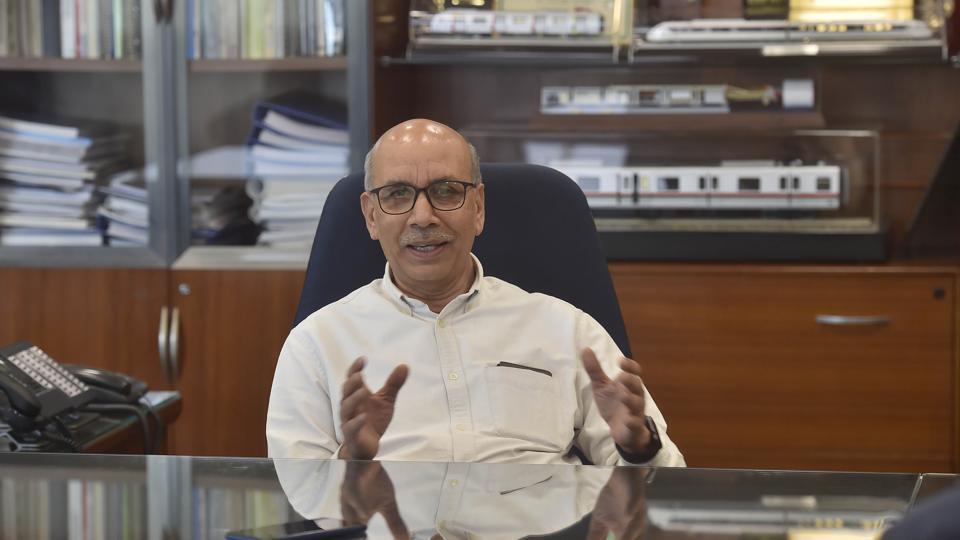
Mangu Singh, managing director of the Delhi Metro Rail Corporation, will retire this month after 39 years of service, including over a decade as the top boss of the country’s largest Metro system. He, like his predecessor, E Sreedharan, has been involved in the Delhi Metro’s expansion since its inception. He spoke to HTabout his journey and future plans.
You have overseen development works from the Metro’s Phase 1 to the start of Phase 4. How has your experience been at Delhi Metro and what has changed in this time?
When we started, the construction practices and techniques were new. Now, this is the new normal. We have come up with better practices and faster construction. During Phase 1, we would complete underground sections in 3.5 to 4 years. But now, people don’t have that much patience. We have evolved, and now we want to reduce the overall inconvenience to the public. So we first complete work on the surface before beginning the underground stretch. Earlier it used to be the opposite. We have also improvedcapacity-building, as during Phase 1, a majority of the work was done by international contractors. But now, most of the work is done by Indian contractors.
What has been the biggest challenge for you over the last decade, since you took charge as MD?
I feel completing projects on time has been the biggest challenge for us. In Phase 1, we had ample land available across Delhi. Today, things are different and one has to struggle and go through courts and litigation, so the land acquisition process is lengthy now. Similarly, tree-cutting permissions are a challenge and activists can sometime misguide the public. They say if you want to save the earth, save trees, but the positive aspect also has to be looked at, in the sense that if one does not build the Metro, Delhi’s pollution and emissions will be much higher. In the long-term, the Delhi Metro will reduce the pollution, because so many vehicles will be off the road.
In terms of technical challenges, a section from Azadpur to Mukundpur was particularly tricky as we came up against hard rocks underneath the surface, which the tunnel boring machine could not penetrate. The machine could also not go back, so the only option was to demolish the area on the surface — which included residential houses and a gurdwara — and to dig downwards to pull the machine out. We were able to convince the people that we have to demolish these structures to carry out construction and that the structures will be rebuilt after work is complete. The machine was eventually taken out and other tunnel boring machines that could dig through hard rock were then introduced from the opposite direction to open this stretch up. In places where we had less land, we redesigned the shape of stations to make them wider and smaller in length so the total volume could remain the same.
How has the pandemic impacted the Delhi Metro’s ridership and what is the ridership at present?
We have been taking all the precautions necessary to sanitise our trains and maintain social distancing during the pandemic, and we have realised that there is no dearth of people who want to use the Delhi Metro. We have now reached almost 70% of our pre-Covid ridership, and on peak weekdays, we are touching 4.2 million, compared to the 5.6 or 5.7 million earlier. We hope that the moment all schools and colleges open, there will be a jump of another 500,000 or 600,000 and we will be closer to 5 million. From there, it may take some time to reach 5.6 million again as people are still working from home and some are avoiding unnecessary travel, especially on weekends.
How has the pandemic impacted the Delhi Metro’s finances?
When you don’t run the trains but have to spend almost the same amount, barring some reduction in electricity, one is bound to suffer losses. We could not shut down the stations either as they had to be maintained. We had to pay our staff, vendors and had to run the trains to ensure our system and trains stay in optimum condition. We had reserves before the pandemic, earned through consultancy and other revenue streams, which had been kept for emergency purposes and for the long-term replacement of assets, which we had to use. We lost more than ₹3,500 crore during this period.
Looking at possible revenue options, it’s been five years since the hike in Metro fares. Do you think another hike is required now?
There may or may not be, but this is not the right time to speak about fares and a possible hike. People have suffered a lot during the pandemic and if one talks about the fare hike, then it may be difficult for them.
What are the alternative revenue streams that the Delhi Metro is looking at to recuperate these losses?
Fortunately or unfortunately, we have already tapped them to the highest possible levels. Our annual revenue recently from the non-fare box was to the extent of ₹500 crore plus, which is huge. This is through advertisements, station rights and retailing from within Delhi alone.
Like the driverless Metro, what other technological innovations is the Delhi Metro looking at?
We will soon appoint an agent to develop an e-market platform, which will be integrated with our smart card, so that particular agency will have a captive two crore market. E-services can be offered to our passengers and there is also the concept of digital malls. We believe this has a huge potential and a portion of the revenue will come to us. In the next one to two years, this will come. There are also concepts like smart lockers at stations where if you order something and want it delivered at a particular station, then the item will be delivered and stored in a box there and once you enter, you can enter a pin or an OTP and take your delivery.
DMRC has to pay DAMEPL, a subsidiary of Reliance Infrastructure, over ₹6,300 crore as per the arbitration award for the Delhi Metro Airport Express Line. What’s your view about Public-Private-Partnership in Metro operations? Is it feasible in future projects?
We believe right from the beginning that Metro projects are not fit for private investments. The contract period is so long, nearly 30 years, and there are so many uncertainties. For instance, DMRC, which is a 100% government organisation, is not sure about what the fare will be after two years. How can a private player know what the fare rate or the ridership will be after five years? The ridership depends on how you develop the city. How will a private player take into account all those things which will happen in the next 30 years?
Moreover, the financial aspect will be very costly for the private player, who will also not get the same taxation and other benefits which DMRC gets. Putting all this together, we believe that Metros are not fit for private investment.
But Metro projects are capital intensive.
These projects can’t be justified just based on financial return; this is a social investment. You have to provide people modes of travel in the city. If people move with ease, they will contribute more to the economy. We have to see the overall benefit to the city.
Do you have any regrets?
There are so many things that are happening that one feels shouldn’t happen. The fare is not getting increased regularly. The fourth fare fixation committee was appointed after six or seven years. There should be a mechanism where every year or alternate year the fare is increased by 4-5% depending on the wholesale price index.
Metro projects use very high-end or modern technology, but the technical control lies with the Indian Railways. The railways has got no — not even an inch — railway lines, which have got technical similarities to our system. But we have to take approval from them. This is something I always feel is unreasonable.
On the other hand, in the case of the High Speed Rail Corporation, the railways have said since they don’t have the knowledge, the approval will be given by the consultant. The same spirit is not (maintained) with the Metro.
The Metro unnecessarily gets controlled by the Ministry of railways, which doesn’t have any knowledge about the system like Metro…They (railways) don’t have platform screen doors anywhere, but they will give observations about the ones installed by us. They don’t have a single coach similar to our technology… There should be a separate organisation to approve Metro technology.
What’s your plan for the future?
I have decided to remain not out. I have declared my innings… I plan to work, but as of now I plan to take a break for a month.


