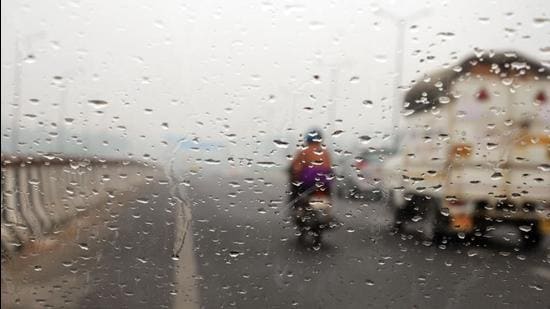
NEW DELHI: With many short but intense spells of rainfall, Delhi has witnessed a series of flooding episodes during this year with the highest annual precipitation on record being observed since 1933. Despite the extreme weather events becoming increasingly frequent, Delhi continues to operate on a four-and-a-half-decade-old drainage plan which needs to be urgently upgraded.
A report prepared by the Public Works Department (PWD) states that the drainage system of Delhi can only cater to 50mm of rainfall in a
NEW DELHI: With many short but intense spells of rainfall, Delhi has witnessed a series of flooding episodes during this year with the highest annual precipitation on record being observed since 1933. Despite the extreme weather events becoming increasingly frequent, Delhi continues to operate on a four-and-a-half-decade-old drainage plan which needs to be urgently upgraded.
A report prepared by the Public Works Department (PWD) states that the drainage system of Delhi can only cater to 50mm of rainfall in a day, and anything more than that overwhelms the system, resulting in the flooding of arterial roads and massive traffic jams.
A senior official from the PWD - which is the nodal agency for the implementation of a new drainage master plan - stated that the agency is in the process of appointing a consultant to formulate “actionable points” and the report on the drainage master plan submitted by IIT Delhi will serve as the basis of this plan.
According to the decision taken by the Delhi government in August, a time when the city was brought to its knees on several occasions due to heavy downpours, the PWD will be coordinating the efforts between various drain-owning agencies of the city while the implementation will be the responsibility of the respective departments.
“The consultant will submit a plan on factors like linking specific parks with a catchment area, slope modification in old drains and incorporation of new drains. The general guidelines have been stated in the IIT-Delhi master plan report and the task of the consultant under phase-2 will be to set specific targets for each agency,” the PWD official said.
The delays in upgrading the master plan
The Capital still operates on a drainage plan conceived in 1976 even as the city has seen massive urban expansion, growth in new colonies and increased concretisation in the period since. The process of establishing a new plan has itself been mired with several delays, faulty data collection and bureaucratic hurdles.
In 2009, the then Lieutenant Governor, Tejendra Khanna, had asked civic agencies and all stakeholders to prepare a new master plan for Delhi’s watershed and drainage system. “The last drainage master plan was finalised way back in 1976. A new plan must be prepared, keeping in view, the fast changing scenario of the city’s growth,” former chief minister Sheila Dixit had remarked in 2012, while announcing that IIT-Delhi would be making the plan.
Now, almost a decade later, the master plan continues to be stuck in bureaucratic red tape while the fast-growing Capital is being repeatedly brought to its knees by massive water-logging due to even moderate spells of rains.
Delhi has 11 different agencies overseeing 426.5km of natural drainage lines and 3,311.5km of engineered storm-water drains. The 201 natural drains in Delhi are sub-divided into three major basins. The Public Works Department manages around 2,064km of the drain network while smaller lengths are overseen by the three municipal corporations of Delhi, Irrigation and Flood Control Department, Delhi Development Authority and New Delhi Municipal Council. Other agencies that oversee less than 100km of drains in the city include DSIIDC, Cantonment board, NTPC and UP Irrigation department.
The multiplicity of agencies has often been blamed for the poor maintenance of the drainage network. Manoj Misra from Yamuna Jiye Abhiyan said that the natural drainage system of Delhi is in a complete mess with several natural drains identified in the 1976 master plan now missing. “There has to be one agency overseeing the drainage network, otherwise the blame game cycle will continue every year. It can be any agency but the responsibility must be fixed,” Misra said.
A team of experts from the IIT submitted the draft plan in December 2016 and its recommendations were finally resubmitted in 2018, but it was later found to be “inadequate” and the process continues to drag on. In October earlier this year, a technical expert committee of the Delhi government had rejected the report citing many problems including discrepancies in data.
The drainage master plan submitted by IIT Delhi recommends several steps, including the separation of sewage and storm water drain system; a unified framework for drainage and common plan; restoration of natural drain systems; and laying pipes to convey storm water from the surface to nearby parks or water bodies. The IIT team behind the new drainage plan has stated that the master plan report can still be salvaged and it can form the basis of finding solutions for chronically waterlogged points.
Data discrepancies in the IIT Delhi study
Prof AK Gosain, a professor at the civil engineering department of IIT Delhi said that the study proposal was undertaken with an assumption that the supply of validated data will be the responsibility of the concerned departments of Delhi government.
“The data was to be validated by the departments and at this late stage, they are checking 10-20% data and data discrepancies are being found. We did our part and a huge effort was undertaken to submit this exhaustive report. It is their responsibility now,” he remarked.
Prof Gosain added that the situation can still be salvaged and the government can focus on key chronic water-logging points. “Drainage development is an ongoing process and the report can form the basis of future interventions. They can concentrate on specific water-logging locations which have an impact on a larger area and validate the data at these locations,” he added.
Also Read: Make climate science research more accessible
Delhi Traffic Police had identified 146 chronic water-logging points in the city. The PWD has started making interventions by making localised solutions at 13 most prominent sites. For instance, sensors, 24x7 cameras, parallel drains and a monitoring room has been made at Minto bridge, where the rains, year on year cause water-logging and provide a picture that is synonymous with Delhi’s drainage network failure.
A key part of the IIT master plan is software which can be used by agencies to formulate different solutions to the water-logging problems based on hydrology, catchment area and various other parameters.
Even the draft drainage master plan documents clearly state the responsibility of data collection and its collation would rest solely with the designated constituent offices of the Delhi government, and data would be made available in a final usable form. “However, none of the above understanding was followed. So, a massive exercise of coordination of data collection and correction efforts was taken up by IIT Delhi. Out of the overall time spent by the IIT team, more than 114,120 hours have gone into data collection activity, and in a way, has over-exhausted the budget earmarked for the study,” the report underlines.
Mishra said that the team led by Prof Gosain had itself submitted that there were data discrepancies. “The general recommendations of the report should be implemented, but the specific interventions should not be made based on wrong data. We should also go back to the 1976 drainage plan to see what holds true and which natural drains are missing,” he added.
Meanwhile, with the increased load on the existing drains due to unplanned urban expansion and climate change-induced weather change, the problem of water-logging continues to grow worse in Delhi with every passing year.
One Subscription.
Get 360° coverage—from daily headlines
to 100 year archives.
Archives
HT App & Website
Stay updated with all top Cities including, Bengaluru, Delhi, Mumbai and more across India. Stay informed on the latest happenings in World News along with Delhi Election 2025 and Delhi Election Result 2025 Live, New Delhi Election Result Live, Kalkaji Election Result Live at Hindustan Times.
Stay updated with all top Cities including, Bengaluru, Delhi, Mumbai and more across India. Stay informed on the latest happenings in World News along with Delhi Election 2025 and Delhi Election Result 2025 Live, New Delhi Election Result Live, Kalkaji Election Result Live at Hindustan Times.