
 E-Paper



Delhi’s Malcha Mahal gets tourist boost, but lies in ruins
The monument is dilapidated, with several parts sustaining heavy damage through neglect. Trees are growing through the stairs and windows, while one bay of the complex has collapsed and caved in. Its outskirts are surrounded by heaps of garbage


Built as a hunting lodge during the reign of the Tughlaqs, the Malcha Mahal near New Delhi’s Chanakyapuri was occupied by the self-proclaimed royal family of Oudh for around three decades starting in the 1980s. The family was highly territorial and kept the monument out of bounds for the common citizenry, unless specifically invited.
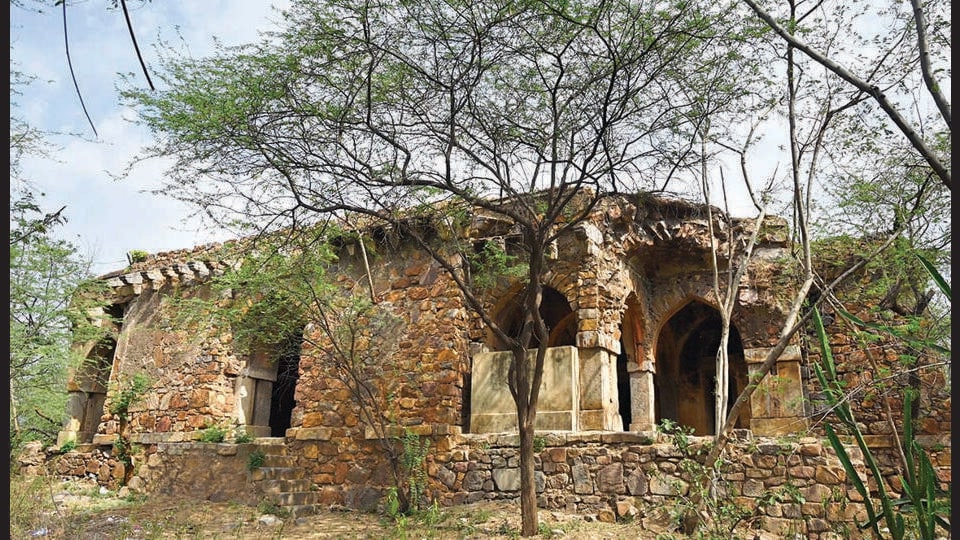
The last of the family died in 2017, leaving behind a dilapidated structure that is seeped in mystery.
The Delhi government has tried to capitalise on the monument’s spooky atmosphere, launching “haunted” heritage walks around the structure from May 7. These spine-chilling excursions may boost tourist footfall at the Malcha Mahal, but nearly a year after the state in July 2022 announced plans to give the structure a facelift, it is yet to take a concrete step to conserve the crumbling, neglected structure.
Built by Firoz Shah Tughlaq, the ruler of Delhi Sultanate, in the 14th Century the imposing structure is located deep inside the south Delhi Ridge forest, where it stands atop a mound. However, there is no plaque or inscription bearing any information about the structure, which comes under the jurisdiction of the Delhi government’s department of archaeology.
During the day, the monument is usually ensconced in silence. However, at night, the quietude is broken by thrillseekers, curious college students, and other visitors with a more nefarious design.
Dhruv Jain, an adventure junkie who discovered Malcha Mahal during a cycling expedition, said, “I love cycling and adventure, and Malcha Mahal seems to fit the bill perfectly. When I first came to the place, it used to be a mess. There was a termite-infested bed here that supposedly belonged to a former royal. I also spotted a dead jackal. It seems much cleaner now but can do with repairs.”
The monument is dilapidated, with several parts sustaining heavy damage through neglect. Trees are growing through the stairs and windows, while one bay of the complex has collapsed and caved in. Its outskirts are surrounded by heaps of garbage. Portions of the ceiling have fallen off, while the floor has caved in other areas. Deep cracks run across its pillars, while newer construction — seemingly done in a hasty and in a haphazard manner — can also be spotted in parts.
The walls of the lodge have also been vandalised with graffiti and other scribblings by visitors despite the presence of guards. Although the interiors are clean, one can spot liquor bottles and cigarette packets strewn across the complex in nooks.
Sumanto K Bhowmick, a regular visitor to Malcha Mahal, said, “The complex needs conservation in various parts. The floor is damaged and there are other parts that need repairs.”
When this reporter visited the monument during two separate trips — on April 23 and May 6 — she found that the walls were defaced with graffiti, while holes were dug at different points. The premises were spruced up for the tourism department’s “haunted” night walk on May 6, but structural gaps remain.
A senior official from the department of archaeology said that the structure will be taken up for conservation this year and other amenities for tourists will also be made available. “This year, we will initiate conservation at Malcha Mahal. Besides conservation, other amenities such as pathway, washrooms, and CCTV cameras will also be available to tourists. We will focus on conservation whereas the tourism department will focus on other tourist amenities,” said the official.
The official added that the project was not delayed and procedures take time. “We couldn’t initiate plans without approval from concerned agencies such as the Forest department,” said the official, who declined to be named.
Maulvi Zafar Hasan, the Archaeological Survey of India (ASI) expert who prepared the first list of monuments worthy of conservation in 1916, in his listings identifies Malcha Mahal as a palace built during the reign of Firoz Shah Tughlaq. Hasan also mentions the presence of a water tank close to the palace. “Some 50 yards to the south of the palace there is a bund of a large tank into which, says Sham Shirazi, the emperor Firoz Shah threw a quantity of the water of Zamzam (sacred water from a famous well at Mecca). The palace seems to have been a pleasure house or Shikargah on the bank of the tank,” he wrote, referring to Sham Shirazi, who wrote an account of Firoz Shah’s reign.
The palace is mentioned as Bistadari Mahal in INTACH’s listing of built heritage in Delhi, drawing from its location on Bistadari Road in the southern Ridge.
Not much is known about the structure’s fate over the next few centuries.
In the 1980s, however, it was inhabited by the self-proclaimed royal family of Oudh. In September 2017, its last resident, Prince Ali Raza, was found dead.
Bhowmick said, “The people who used to live here did not permit outsiders to enter. A guard would keep a watch and there was a board that said that intruders would be shot. Barbed wires were all over the place and one could hear dogs barking. As a result, there was an element of mystery surrounding the place.”
Aditi Raj, an 18-year-old student, said that the monument offers an oasis of peace away from the bustle of the city, and grimaces over plans to make the structure more tourist-friendly. “Delhi is a busy city but this place is deserted… The government could possibly put up a board informing people about the name and history of Malcha Mahal. However, large crowds will not suit the place or its character,” she said.


Stay updated with all top Cities including, Bengaluru, Delhi, Mumbai and more across India. Stay informed on the latest happenings in World News along with Delhi Election 2025 and Delhi Election Result 2025 Live, New Delhi Election Result Live, Kalkaji Election Result Live at Hindustan Times.


