E-Paper



Cycling track in Delhi’s Nehru Park set to open by June-end
The track will be largely away from traffic, situated between park walls and footpaths, and will include three tabletop crossings.

 Prefer HTon Google


A 2.7km cycling track along the periphery of Nehru Park in Chanakyapuri is likely to be operationalised by the end of June, New Delhi Municipal Corporation officials aware of the matter said on Wednesday, adding that around 60% of the work on the facility has been completed.
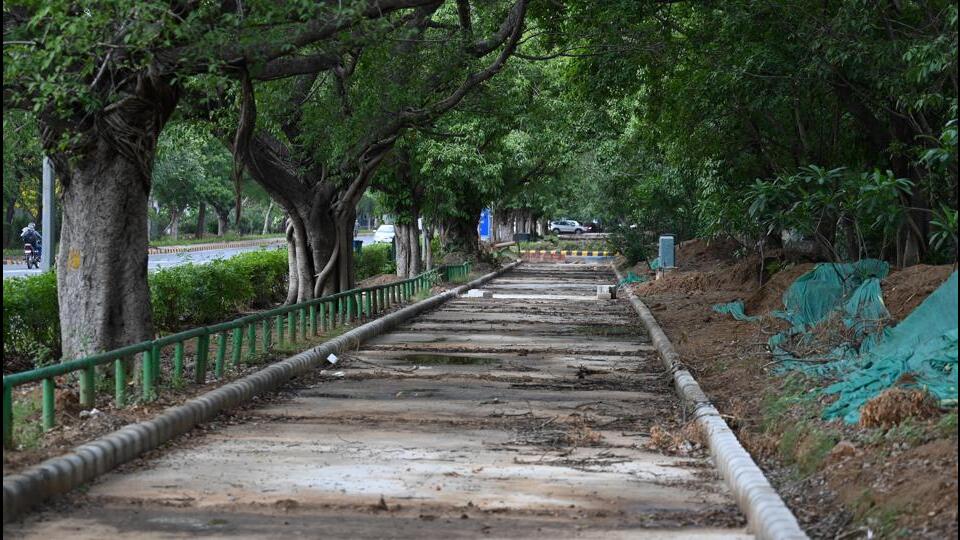
The Nehru Park is spread over an area of 75 acres and it is situated in an area surrounded by various embassies, high commissions, and residences of diplomats, apart from state houses. Construction work for a cycling track around the park began in January after lieutenant governor VK Saxena laid the foundation stone. Initially, it was expected to be developed in four months.
A senior NDMC official said that of the total length of 2.7km, concrete has been laid across 1.6km, and the track is expected to be usable within a month. He added that the project has various hurdles, in the form of rocky structures and labour shortages.

“Most of the hurdles that the project faced have been removed. There were also two mobile towers along the proposed length. One has been relocated, while the second one located along the Vinay Marg will relocated in coming week,” the official said.
A second NDMC official said that the alignment of the track is such that cyclists will be largely away from traffic with the lane situated between the park walls and footpath. “Some plants and shrubs will be relocated. No trees are being removed for the track despite it being located in dense green area. On a few patches, we have decided to merge footpaths and the cycling track due to a shortage of space. Right now, the concrete laying is being done in the clear patches and the gaps outside gates of establishments will be taken up in the end. We will also be constructing three tabletop crossings along Vinay Marg, Panchsheel Marg and Niti Marg. Such crossings will automatically reduce the speed of vehicles and help people cross the stretch,” the second official said.
On Thursday, during a spot check, HT found NDMC construction teams were deployed to lay concrete along Vinay Marg and PSOI club, while a second team was clearing the path along Niti Marg.
Separately, the civic body has moved a proposal to the Central government to fund its larger cycling track from Moti Bagh to Raisina Hills under the Smart City project. In future, the civic body plans to link the two tracks.
Sarika Panda Bhatt, a road safety expert and co-founder of the Raahgiri Foundation, said cyclists and pedestrians remain the most vulnerable group in any city, with speed calming measures being the simplest of interventions that Delhi can initially make. “Most cyclists use neighbourhood streets, so it is important to have speed calming measures around neighbourhoods to start off. We have also seen most crashes happening at intersections, so there is a need to look at the most dangerous intersections and to improve road engineering and road designs there. In the long-run, a dedicated cycling lane which has been demarcated using kerbstones or bollards can considerably reduce risk,” she said.