For generations, the centuries-old havelis of the Walled City in Delhi were repositories of culture. Stories, myths, songs, hymns, art and architecture – these crumbling edifices recounted the fabled history of Delhi. But soon enough, their decay and the ever-increasing congestion in Old Delhi drove the owners of these lavish, intricately designed havelis away.
These homes, many of which were built in the Mughal era, began to disappear. Some were replaced by commercial complexes, after being sold off by owners eager to get the daunting costs of upkeep and repair. Others sat in neglect, the bricks crumbling to dust.
But a reversal may be in store.
Buoyed by interest from several people keen on preserving the heritage structures in the Walled City, these havelis in Old Delhi have found enthusiastic buyers, many of whom have reworked these buildings into vibrant cultural spaces that offer platforms for a gamut of artistic performances.
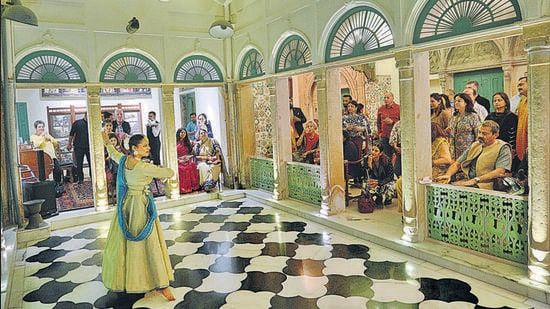
One of these is Kathika Cultural Centre, a museum and performance space that morphed from two dilapidated havelis.
Hotelier Atul Khanna bought the two crumbling havelis in a narrow, winding lane in Sitaram Bazar. He restored and converted them into Kathika, which opened this May.
“These havelis are an important part of Old Delhi’s cultural heritage and I wanted to do something to help preserve them,” said Khanna, whose family was originally from the Walled City, and who spent his early childhood in that part of town.
{{/usCountry}}“These havelis are an important part of Old Delhi’s cultural heritage and I wanted to do something to help preserve them,” said Khanna, whose family was originally from the Walled City, and who spent his early childhood in that part of town.
{{/usCountry}}In the months since its inauguration, Kathika — which means a collection of stories — has become one of the most popular cultural spots in the Walled City, hosting book readings, poetry recitations, workshops, dance performances, discussions, ghazal evenings, and film screenings.
Kathika also showcases the history of Delhi through old paintings, historic crafts, photographs, and a host of everyday objects such as vintage mirrors, telephones, clocks, walking sticks, almirahs, safes, vintage iron presses, typewriters, and radios, among others.
“The idea was to create a performance venue that doubles up as a Walled City museum, tracing the history of the city through art, culture, and objects. We are also developing a library and archives at the centre, with a vast collection of books on the Walled City,” said Khanna.
Sharif Manzil, a 350-year-old haveli in Ballimaran is another of the monuments leading this charge of rejuvenation in the snaking streets of Old Delhi.
In the Mughal tradition, Sharif Manzil now hosts baithaks, mehfils, and mushairas, with students and cultural enthusiasts from all over Delhi and the National Capital Region (NCR) in attendance.
Muneeb Ahmed Khan, a constitutional lawyer who lives in the Sharif Manzil and hosts cultural programmes at his residence, said the idea was to introduce the audience to Delhi’s cultural legacy and its distinctive ‘way of life’.
“It is marked by respect, courtesy, etiquette, and language, all of which are fast becoming extinct,” said Khan, whose great-great-grandfather Hakim Ajmal Khan founded Jamia Millia Islamia and the Ayurvedic and Unani Tibbia College.
Khan’s father Masroor Ahmed Khan, the last practising hakim of Delhi’s famous family of Hakims, said the Partition led to a massive influx of refugees from across the border, and brought about a great demographic and cultural shift in the Walled City.
He said once only Urdu or Hindavi — a mixture of Hindi, Arabic, and Persian languages, also referred to as Delhlvi — were spoken in the city, but now, one could hear Punjabi in the streets.
“Many houses that were left vacant by those who migrated to Pakistan were occupied by refugees who came from across the border, and by Muslim families from Uttar Pradesh. Today, it is difficult to find the original Delhiwallas in the Walled City. But, there are still a few families who continue to cherish and preserve the old Delhi way of life, and language,” the elder Khan said.
Ashok Mathur’s is one such. The courtyard of his ancestral haveli in Nai Sarak often transforms into a stage for many musical evenings. Among the diverse events hosted at his house include Haveli Sangeet — a form of Hindustani classical music — along with dhrupad sessions featuring classical vocalist Wasifuddin Dagar, and ghazals soirees by Ananya Gaur. Besides, the haveli has also hosted sessions on Mirza Ghalib by historian Sohail Hashmi.
Old Delhi culture, Mathur said, was lost in the 1980s, as several residents started leaving parts of Walled City, such as Sitaram Bazar, Nai Sarak, and Chandni Chowk. He said that the neighbourhood’s demographic shift continued long after Partition, and those who came here in the 1940s post-Partition integrated well with local culture, but most of those who bought houses there in the past three decades only had commercial objectives and no interest in preserving the heritage and culture of the walled city.
“Mughal Delhi had a unique culture. Every house boasted a harmonium, tabla, and tanpura. While Mughal culture might today be a subject of drawing-room discussion, we have lived it for generations and continue to live it,” said Mathur. “The demolition of a haveli is not just the loss of a building, but also signifies the loss of unique architecture, language, and a culture.”
Abu Sufiayan, who runs Purani Dilli Walon ki Baatein, an organisation that works to promote the Walled City’s culture, said the idea behind these events is to spread awareness about the need for the conservation of havelis and keep alive whatever is left of Mughal Delhi’s art, culture and traditions.
“We currently hold performances in about six havelis. The popularity of these events is growing so fast that now an increasing number of haveli owners are showing interest in hosting these cultural gatherings,” says Sufiyan. “The artistes who perform in these havelis come from various parts of Delhi-NCR and even other cities.”
Talking of her experiences performing in Walled City havelis, Gaur, the Ghazal singer, said these occasions are very intimate and interactive, boasting more engaged listeners compared to large auditorium settings.
“The audience mostly consists of cultural aficionados, who connect with my music at a deeper level. Since the distance between me and the audience is not much, I get to see their expressions, reactions, and their emotional involvement,” said Gaur. “In fact, when I recently performed at Kathika, people began to dance, a sight seldom seen in auditoriums, where audiences are more formal. Besides, I find the ambience of these havelis very inspiring.”
Historian Swapna Liddle, whose talk on her book Shahjahanabad: Mapping a Mughal City was the inaugural event on May 27 at Kathika, commended the efforts to preserve the city’s culture and heritage through performances at these havelis. “Kathika was an instant success. But, after all, how many performance spaces can one have in the Walled City,” she said. “These havelis can be preserved in a variety of ways. They can also be turned into aesthetic retail spaces, and may be repurposed as B&B (bed and breakfast) accommodations.”
Stay updated with all top Cities including, Bengaluru, Delhi, Mumbai and more across India. Stay informed on the latest happenings in World News along with Delhi Election 2025 and Delhi Election Result 2025 Live, New Delhi Election Result Live, Kalkaji Election Result Live at Hindustan Times.
Stay updated with all top Cities including, Bengaluru, Delhi, Mumbai and more across India. Stay informed on the latest happenings in World News along with Delhi Election 2025 and Delhi Election Result 2025 Live, New Delhi Election Result Live, Kalkaji Election Result Live at Hindustan Times.